
The All on Four Dentures Guide to Permanent Teeth
What Are All on Four Dentures? A Clear Answer Before You Read On
All on four dentures are a permanent, fixed set of replacement teeth supported by just four dental implants per arch — giving you a full smile without the slipping, adhesives, or discomfort of traditional dentures.
Here's a quick summary of what makes them different:
Feature All-on-4 Dentures Traditional Dentures Fixed or removable Fixed (non-removable) Removable Number of implants 4 per arch None Chewing ability restored 70% or more ~20% Bone preservation Yes No Lifespan 20+ years (implants) 5-10 years Adhesives needed No Often yes
The concept is straightforward: two implants go straight into the front of your jaw, and two are angled toward the back — all four working together to anchor a full arch of teeth. No bone grafting is required in most cases, and many patients leave the same day with functioning teeth.
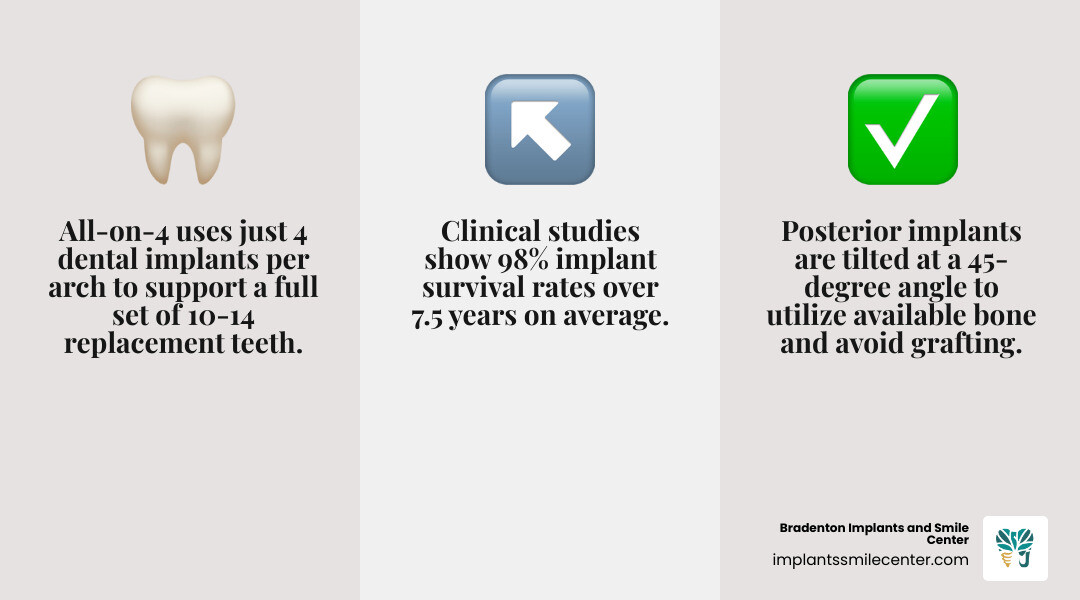
Over 250,000 patients worldwide have been treated with the All-on-4 concept, with clinical studies reporting implant survival rates of 98% over an average follow-up of 7.5 years. For patients who have struggled with tooth loss, gum disease, or ill-fitting dentures, this can be a genuinely life-changing solution.
I'm Dr. John Hegazin, owner of Bradenton Implants and Smile Center, with over 8 years of experience in implant dentistry — including tooth replacement solutions like all on four dentures, full mouth rehabilitation, and Teeth in a Day procedures. In this guide, I'll walk you through everything you need to know to make a confident, informed decision.
Understanding the Mechanics of All on Four Dentures
To understand why all on four dentures are such a breakthrough, we have to look at the "engine" under the hood. Unlike traditional implants that require one screw for every missing tooth, this system uses just four titanium anchors to support an entire arch of 10 to 14 teeth.
The secret lies in the strategic placement. We place two straight implants in the anterior (front) of the jaw where the bone is naturally denser. The two posterior (back) implants are then tilted at a 45-degree angle. This "tilted" approach is what makes this a "graftless" solution. By angling the implants, we can use the available bone you already have, often avoiding the need for expensive and time-consuming bone grafts.

This biomechanical setup isn't just clever engineering; it’s backed by decades of data. In fact, scientific research on 10-18 year follow-up success shows that this configuration is incredibly stable over the long term. These titanium anchors act as multi-unit abutments, providing a rock-solid foundation for a fixed bridge. If you're curious about how these mechanics apply to your specific smile, you can find more info about our services and how we utilize this technology at our Bradenton FL office.
Who is a Candidate for All on Four Dentures?
We often see patients who have been told they "don't have enough bone" for traditional implants. Because all on four dentures utilize the denser bone in the front of the mouth, many of these patients are actually excellent candidates.
Generally, a good candidate is someone who:
Is missing most or all of their teeth in an arch (edentulous).
Has failing teeth due to advanced gum disease or decay.
Struggles with the instability of removable dentures.
Is in good systemic health (conditions like diabetes must be well-controlled).
Can obtain physician clearance for a minor surgical procedure.
Scientific research on patient-related outcomes highlights that lifestyle factors matter, too. For instance, non-smokers typically have higher success rates because smoking can interfere with the healing process (osseointegration). During your consultation in Bradenton, we’ll take a 3D scan to check your jawbone density and ensure your mouth is ready for a transformation.
The Biomechanical Advantage of Tilted Implants
Why the 45-degree tilt? It’s all about safety and strength. In the upper jaw (maxilla), tilting the implants allows us to avoid the maxillary sinuses. In the lower jaw (mandible), it helps us steer clear of the mental foramen (the opening for the nerve).
Beyond safety, this tilt increases the "A-P spread." Think of it like the legs of a chair—the wider they are spread, the more stable the chair. By spreading the implants further back into the cortical bone, we reduce the stress on the individual implants and allow for a shorter "cantilever" (the part of the bridge that hangs off the back). This distribution of force is what allows you to bite into an apple or a steak with total confidence.
The Step-by-Step Procedure for Full-Arch Restoration
At Bradenton Implants & Smile Center, we believe the best results start with the best planning. We don't just "guess" where the implants go; we use 3D CBCT imaging to map out your entire jaw in three dimensions.
The journey typically follows this path:
Consultation & Digital Design: We take digital impressions and scans to design your new smile before the surgery even begins.
Surgical Day: Any remaining failing teeth are extracted, and the four implants are precisely placed.
Immediate Loading: This is the "magic" part. We often attach a provisional (temporary) bridge on the same day. You walk in with missing teeth and walk out with a smile. You can even view our before and after gallery to see the dramatic same-day changes our patients experience.
Osseointegration: Over the next 3–6 months, your jawbone fuses with the titanium implants.
Final Restoration: Once healed, we swap the temporary bridge for your permanent, high-strength final bridge.
Immediate Function and Same-Day Teeth
The ability to provide "Same-Day Teeth" depends on "primary stability." During surgery, we measure the torque (tightness) of the implant. If we achieve a torque of 35-45 Ncm, the implant is stable enough to support a temporary bridge immediately.
Scientific research on immediate loading success confirms that as long as the implants are splinted together by the bridge, they heal beautifully. This functional loading actually helps maintain bone density. It means you don't have to spend months wearing a "flipper" or going toothless while you heal.
The Final Prosthetic Phase
Once your mouth has fully healed, we move to the definitive phase. This is where we create your "forever" teeth. We use CAD/CAM technology to design a framework—often made of milled titanium or zirconia—that fits with microscopic precision.
Zirconia is a favorite for many of our Bradenton patients because it is incredibly strong, resists staining, and has a natural translucency that mimics real enamel. We also carefully design the "occlusal scheme," which is just a fancy way of saying we make sure your top and bottom teeth bite together perfectly to prevent wear and tear.
Comparing All-on-4 to Traditional Tooth Replacement
If you’ve been wearing traditional dentures, you know the struggle. The slipping, the clicking, and the constant fear that they might pop out during a conversation. All on four dentures solve these problems by moving the support from your gums to your bone.
One of the biggest wins is the "palate-free" design. Traditional upper dentures cover the roof of your mouth, which can dull your sense of taste and make speech difficult. Because All-on-4 is anchored by implants, the roof of your mouth stays open. You can finally taste your food again! To make this transition even easier, be sure to check our special offers for new patients.
All-on-4 vs. Traditional Removable Dentures
Traditional dentures rely on suction and adhesives. Over time, because there are no roots in the bone, the jawbone begins to shrink (resorption). This changes the shape of your face and makes the dentures fit even worse.
While traditional dentures only restore about 20% of your chewing capacity, all on four dentures restore 70% or more. This isn't just about comfort; it's about nutrition. Being able to eat fiber-rich vegetables and proteins is vital for your long-term health. Scientific research on patient satisfaction shows that the jump in quality of life after switching from removable dentures to fixed implants is massive.
All-on-4 vs. Implant-Supported Overdentures
Overdentures (often called "Snap-ins") are a middle ground. They use 2 to 4 implants, but the teeth are still removable. You "snap" them in for the day and take them out at night.
While overdentures are better than traditional ones, they still have locator attachments or bar-and-clip systems that wear out and need replacing every year or two. All on four dentures are fixed. They don't come out. They feel much more like your natural teeth because they stay in your mouth 24/7. To learn more about which option fits your lifestyle, you can learn more about us and our philosophy on restorative care.
Recovery, Costs, and Maintenance for Longevity
The recovery from All-on-4 is usually smoother than people expect. Most of our patients manage any post-operative discomfort with basic over-the-counter medications. You can expect some swelling and bruising, which typically peaks around 48 hours and then fades.
During the first few weeks, a "soft food diet" is mandatory. Think mashed potatoes, pasta, and smoothies. You want to give those implants a chance to settle into the bone without being knocked around by a crusty baguette!
Regarding costs, all on four dentures are a significant investment, typically ranging from $15,000 to $30,000 per arch. This varies based on the materials used (acrylic vs. zirconia) and any pre-surgical needs. While dental insurance often has low annual maximums, we offer various financing options to help fit this life-changing treatment into your budget. When you consider that the dental implants are designed to last a lifetime, the "cost per year" is often lower than traditional dentures that need constant relining and replacement. Scientific research on long-term survival rates proves that this is a durable, long-term solution.
How to Care for Your All on Four Dentures
Maintenance is key to protecting your investment. Even though the teeth aren't real, your gums still are! You can still get "peri-implantitis" (the implant version of gum disease) if you don't keep things clean.
We recommend:
An Electric Toothbrush: To clean the surfaces of the bridge.
Water Flosser: This is a game-changer for cleaning under the bridge where it meets the gums.
Interdental Brushes: Small "Christmas tree" brushes to get into the gaps.
Antibacterial Rinse: To keep bacteria levels low.
Professional Cleanings: You still need to see us every 3–6 months for a professional check-up.
Expected Lifespan and Success Rates
The success rate for all on four dentures is exceptionally high—reported at 95% to 98% over a 10-year period. With proper care, the titanium implants themselves can last a lifetime. The prosthetic bridge may need some maintenance or replacement after 10–15 years due to normal wear and tear, but the foundation remains solid. The biggest risk factor for failure is poor hygiene or smoking, so staying on top of your "recalls" is the best way to ensure your smile lasts for decades.
Frequently Asked Questions about All-on-4
Is the All-on-4 procedure painful?
We take your comfort very seriously. The procedure is performed under local anesthesia, and we also offer sedation options for those who are a bit nervous. Most patients describe the feeling as "pressure" rather than sharp pain. By the next day, most people are pleasantly surprised by how little discomfort they feel.
Can I eat steak with All-on-4 implants?
Yes! That is one of the most common questions we get. Once you have moved past the initial healing phase (usually about 3-4 months) and have your final permanent bridge, you can return to a normal diet. Because the implants restore 70% or more of your natural bite force, steak, apples, and corn on the cob are back on the menu.
How long does the entire process take?
The surgery itself takes about 2–3 hours per arch. You'll leave that day with temporary teeth. The "hidden" part of the process is the 3–6 months of healing (osseointegration). After that, we take final impressions and deliver your permanent bridge. Total time from start to finish is usually about 5–8 months.
Conclusion
At Bradenton Implants & Smile Center, we’ve seen how all on four dentures can transform a person's life. It’s not just about the teeth; it’s about the confidence to laugh without covering your mouth and the ability to enjoy a meal with friends in Bradenton FL without worry.
We combine personalized, compassionate care with modern dental technology to make the process as seamless as possible. If you’re tired of struggling with failing teeth or loose dentures, we are here to help you find a permanent solution. Schedule your consultation for all on four dentures today, and let's start planning your new smile.