
Dental Implant Costs in 2026: A Comprehensive Price Breakdown
What Does a Dental Implant Actually Cost in 2026?
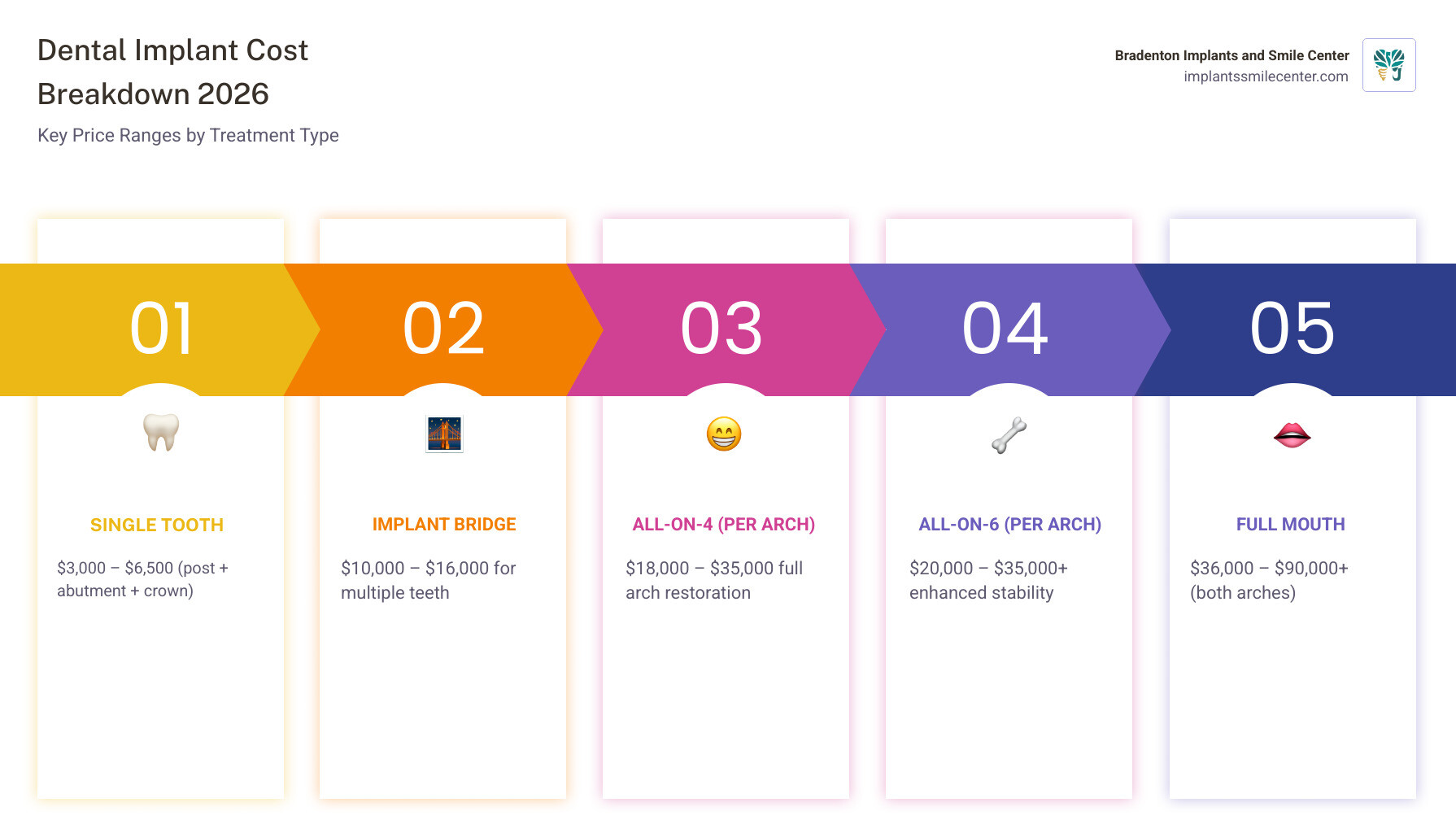
The estimated cost of dental implants 2026 ranges widely depending on what you need — but here are the most common projected price ranges to give you a fast, clear answer:
Treatment Type Typical Cost Range Single tooth implant (post + abutment + crown) $3,000 – $6,500 Implant-supported bridge $10,000 – $16,000 All-on-4 full arch (per arch) $18,000 – $35,000 All-on-6 full arch (per arch) $20,000 – $35,000+ Full mouth (both arches) $36,000 – $90,000+ Bone grafting (if needed) $500 – $3,500 Sinus lift (if needed) $1,500 – $5,000
Note: These are national averages. Your final cost depends on your specific needs, location, and provider.
These numbers can feel overwhelming — especially if you're already dealing with the stress of missing or damaged teeth. But the sticker price rarely tells the whole story. Some quotes include everything. Others leave out the abutment, the crown, or the imaging — and that's where surprise bills come from.
This guide breaks down exactly what you're paying for, what drives the price up or down, and how to make implants work within your budget.
I'm Dr. John Hegazin, owner of Bradenton Implants and Smile Center, with over 8 years of experience helping adult and senior patients navigate the real cost of dental implants 2026 — from single-tooth replacements to full-mouth restorations using the latest implant technology. Let me walk you through everything you need to know to make a confident, informed decision.
Cost of Dental Implants 2026: National and Regional Price Trends
As we look at the landscape for the cost of dental implants 2026, we see a market that has stabilized after the inflationary spikes of the early 2020s. Nationally, the average cost of dental implants remains a significant investment, but one that more Americans are choosing due to the long-term health benefits.
In the United States, a single dental implant typically falls between $3,000 and $7,000 when you factor in the surgical placement and the final restoration. However, geography plays a massive role. If you were in a high-overhead metro area like New York City or San Francisco, you might see prices 20% to 50% higher than the national average.
Fortunately for our patients, the Florida regional pricing landscape is much more competitive. In the Bradenton and Sarasota markets, we benefit from a robust dental workforce and moderate business expenses compared to the Northeast or West Coast. While some regions like Louisiana typically feature costs below the national average due to lower overhead, Bradenton offers a "sweet spot" where patients can access world-class technology and highly experienced specialists without the "big city" price tag.
At Bradenton Implants & Smile Center, we focus on providing more info about dental implant services that combine this local market advantage with premium materials, ensuring you don't have to sacrifice quality for affordability.
What is the average cost of dental implants 2026 for a single tooth?
When patients ask us about the cost of dental implants 2026 for just one tooth, they are often looking at a range of $3,000 to $6,500. It’s important to understand that this isn't just for a "screw." A complete single-tooth replacement involves several distinct financial components:
The Titanium Post: This is the "root" of your new tooth. In 2026, medical-grade titanium remains the gold standard for its ability to fuse with your bone (osseointegration).
The Abutment: This is the connector piece that sits on top of the post and holds the crown.
The Ceramic Crown: This is the visible part of the tooth. We use high-quality materials like zirconia or E-max to ensure it looks natural and lasts for decades.
Surgical Placement: The expertise of the doctor and the use of sterile, surgical-grade environments.
Diagnostic Imaging: Modern 3D CBCT scans are essential for safety and precision, ensuring the implant is placed exactly where your bone is strongest.
Full mouth cost of dental implants 2026: All-on-4 and All-on-6 options
For patients facing the loss of all their teeth in one or both arches, full-mouth restorations offer a life-changing alternative to removable dentures. In 2026, the two most popular "fixed" (non-removable) options are All-on-4 and All-on-6.
All-on-4: This technique uses four strategically placed implants to support a full arch of teeth. It is often the most cost-effective "teeth-in-a-day" solution, ranging from $18,000 to $35,000 per arch.
All-on-6: By using six implants, we provide even greater stability and bone preservation. This is often recommended for patients with higher bite forces or specific bone structures, typically costing $20,000 to $35,000+ per arch.
Zygomatic Implants: For patients with severe bone loss in the upper jaw, we may use zygomatic implants that anchor into the cheekbone. These are more complex and can range from $8,000 to $15,000 per side, but they often allow patients to avoid expensive and time-consuming bone grafting.
Dual-arch pricing (replacing both top and bottom teeth) usually starts around $36,000 and can go up to $90,000+ for premium zirconia arches that offer the ultimate in durability and aesthetics.
Breaking Down the Components of Dental Implant Pricing
Understanding the cost of dental implants 2026 requires looking under the hood. You aren't just buying a product; you are paying for a multi-stage medical procedure.

The Three-Part System
Implant Fixture ($1,500 – $3,000): This is the surgical component. High-quality brands like Straumann or Nobel Biocare cost more but have decades of research backing their success rates.
Abutment ($300 – $1,000): This connector can be "stock" (pre-made) or "custom." We often prefer custom abutments because they help the gum tissue shape naturally around the new tooth.
Custom Dental Crown ($1,000 – $3,000): The lab fees for a crown are a significant part of the cost. A crown hand-crafted by a master technician using durable zirconia will naturally cost more than a generic alternative.
We always follow strict FDA guidance on dental implant safety, which emphasizes using biocompatible materials that the body won't reject.
Factors influencing the total investment in 2026
Why does one clinic charge $3,000 while another charges $5,000? It usually comes down to these variables:
Surgeon Expertise: A board-certified specialist or a doctor with thousands of successful placements under their belt will have higher fees than a general dentist who performs the procedure occasionally. In 2026, experience is the best insurance against implant failure.
Technology: We utilize 3D CBCT scans and digital surgical guides. This technology allows us to "virtually" perform your surgery on a computer before we ever touch your mouth, significantly reducing risks and healing time.
Material Quality: There is a difference between "value" titanium and premium, cold-worked titanium alloys. The latter is much stronger and less likely to fracture over twenty years of chewing.
Additional Procedures and Potential Hidden Costs
One of the most common ways patients get "low-balled" with a quote is when a clinic leaves out the necessary preparatory work. At Bradenton Implants & Smile Center, we believe in transparency. We often have special offers on restorative procedures to help offset these costs, but it’s vital to know what they are.
Common Add-Ons:
Bone Grafting ($500 – $3,500): If your tooth has been missing for a while, the jawbone naturally shrinks. We may need to add bone mineral to create a solid foundation for the implant.
Sinus Lifts ($1,500 – $5,000): For upper back teeth, the sinus cavity is often too close to the jaw. We gently lift the sinus floor to make room for the implant.
Tooth Extractions ($150 – $500): If the damaged tooth is still in place, it must be removed. "Surgical" extractions that preserve the surrounding bone are slightly more expensive but worth it for the implant's future success.
Sedation ($500 – $1,500+): While local numbing is included, many of our Bradenton patients prefer IV sedation or "twilight sleep" for a completely anxiety-free experience.
Preparatory surgery costs and timelines
The cost of dental implants 2026 is also a "time" investment. After the post is placed, we must allow for osseointegration — the 3 to 6-month period where your bone grows into the implant. During this time, you may need:
Healing Abutments: Small caps that shape the gum tissue.
Temporary Prosthetics: "Flippers" or temporary bridges so you never have to go without teeth during the healing phase.
Site Preservation: Special membranes or sutures used during extraction to ensure the bone doesn't collapse.
Insurance, Financing, and Long-Term Value Comparison
"Will my insurance cover this?" is the number one question we hear. In 2026, the answer is still a bit complicated. Most private dental insurance plans still classify implants as "major" procedures.
According to dental insurance coverage limitations, many plans typically reimburse a portion of the "allowed" charges, often up to 50%. Furthermore, many plans maintain annual maximums, which commonly range from $1,500 to $2,500. This means that while insurance might help pay for the crown or the extraction, you will likely still have a significant out-of-pocket balance for the implant itself.
Financing Strategies for 2026:
We don't want the cost of dental implants 2026 to stand between you and a healthy smile. Here is how our patients make it work:
CareCredit & LendingClub: These are healthcare credit cards that offer 0% interest promotional periods (often up to 18 months) or low-interest long-term fixed payments.
HSA/FSA Eligibility: Dental implants are a qualified medical expense. Using pre-tax dollars from your Health Savings Account can save you 20-30% effectively by reducing your tax burden.
In-House Plans: We often work with patients to phase their treatment. For example, placing the implant in December (using one year's insurance max) and the crown in January (using the next year's max).
Denture Trade-In: Some programs allow you to apply the value of your old dentures toward the cost of a new implant-supported system.
Comparing implants to bridges and dentures
When you look at the cost of dental implants 2026, you have to compare it to the "cost of doing nothing" or choosing cheaper alternatives.
Bridges: A bridge typically lasts 5 to 15 years. It requires cutting down healthy adjacent teeth to act as anchors. Over a 30-year period, you might replace a bridge three times, making it more expensive than a single implant that lasts a lifetime.
Dentures: While cheap upfront ($600 – $3,000), dentures do nothing to stop bone loss. As your jawbone shrinks, your face begins to "collapse" or sag, and the dentures will need frequent, costly relines to stay in place.
The Value Winner: Implants restore approximately 90% of your natural bite force (compared to roughly 20% with dentures), preserve your facial structure, and are designed to last 25 years to a lifetime. When you break the cost down over 20 years, an implant is often the most affordable tooth replacement option available.
Frequently Asked Questions about Dental Implant Costs
Are dental implants worth the cost compared to traditional dentures?
Yes, for the vast majority of our patients. Beyond the ability to eat steak and apples again, implants prevent the jawbone from deteriorating. This preservation of your "facial height" keeps you looking younger and prevents the sunken-in look associated with long-term denture wear.
Does dental insurance cover the full cost of implants in 2026?
Almost never. While coverage is improving, most plans have "caps" or "maximums" that were set in the 1970s and haven't kept up with inflation. You should expect insurance to cover between $1,000 and $2,000 of the total cost, leaving the rest as your responsibility.
How can I avoid surprise fees in a dental implant quote?
Always ask for an all-inclusive, itemized quote. Ensure it includes:
The 3D imaging (CBCT scan)
The extraction (if needed)
The bone graft (if needed)
The implant post AND the abutment AND the crown
All follow-up appointments
If a price looks too good to be true (like a "$999 implant"), it almost certainly excludes the abutment and crown, which are the most expensive parts!
Conclusion
At Bradenton Implants & Smile Center, we understand that the cost of dental implants 2026 is a major decision for you and your family. Our goal is to remove the mystery and provide a clear, honest path to a smile you love.
We combine personalized, compassionate care with the most modern technology available in the Bradenton area. Whether you are a senior looking to upgrade from frustrating dentures or an adult needing to replace a single failing tooth, we are here to help you navigate the financial and clinical aspects of your journey.
Don't let missing teeth affect your confidence or your health for another year. Schedule your consultation for dental implants with us today at our 55th Ave E location. We’ll sit down together, look at your 3D scans, and give you a precise, no-surprises breakdown of exactly what it will take to get your smile back.