
Detailed Guide to Compare Dental Implants Abroad Costs
Compare Dental Implants Abroad Cost Before You Book
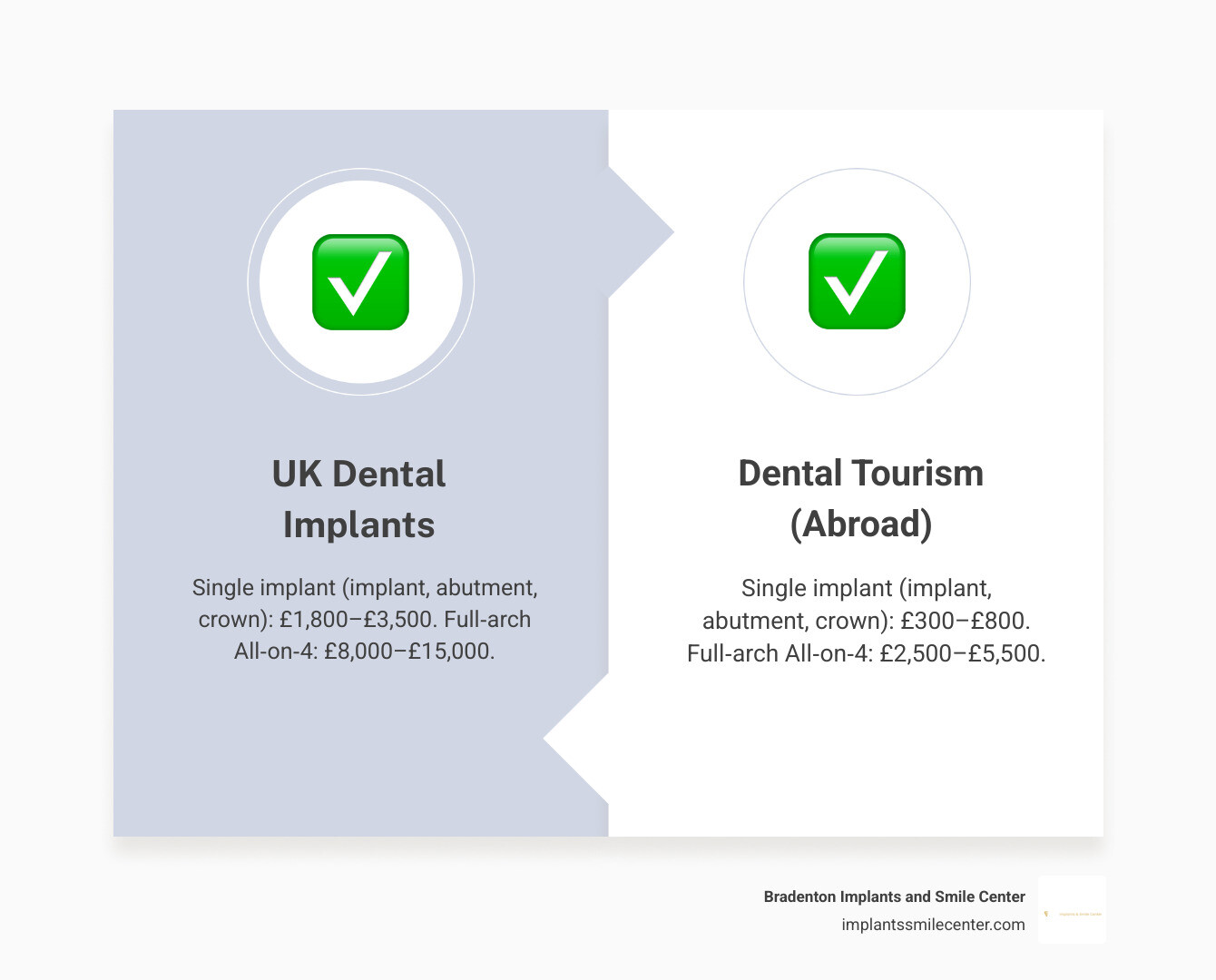
Dental implants abroad can cost about £300 to £800 for a single implant, versus roughly £1,800 to £3,500 in the UK when the implant, abutment, and crown are included. Full-arch options such as All-on-4 may cost £2,500 to £5,500 abroad, compared with about £8,000 to £15,000 in the UK.
But the lowest advertised dental implants abroad cost is not always the lowest total cost. Before choosing a destination, compare written quotes that clearly list:
The implant brand, abutment, and final crown or bridge
CBCT scans, extractions, bone grafts, and sedation
Temporary teeth and the cost of permanent teeth
Flights, lodging, return visits, and time away from work
Warranty terms and a plan for care if a problem develops at home
A standard implant often needs two visits, with several months of healing between surgery and the final crown. Immediate-load and All-on-4 treatment may reduce travel, but only when your bone health, bite, and medical history make that approach safe.
I am Dr. John Hegazin, a dentist with more than eight years of experience in restorative and implant care, including treatment planning for single-tooth and full-mouth tooth replacement. In this guide to dental implants abroad cost, I will help you weigh the price against the clinical details, long-term support, and alternatives available closer to home.
Breakdown of Dental Implants Abroad Cost Across Top Destinations
When evaluating the overall dental implants cost, patients frequently look across borders to compare domestic fees with popular dental tourism destinations. In Western nations, dental care involves substantial clinical overhead, high laboratory fees, rigorous compliance standards, and administrative expenses. By comparison, international hubs operate with lower labor expenses, favorable currency exchange rates, and lower real estate overheads, allowing them to market comparable procedures at substantial reductions.
To understand these variations, it helps to review verified benchmarks from international providers such as the Dental Implants Abroad — Compare Prices by Country & Clinic | MeetYourClinic | Meet Your Clinic guide. Below is a realistic price comparison across key global markets:
Country / Destination | Single Implant (Fixture, Abutment & Crown) | Full Arch All-on-4 (Per Arch) | Typical Savings vs. Domestic Western Care |
|---|---|---|---|
United Kingdom | £1,800 – £3,500 ($2,300 – $4,500) | £8,000 – £15,000 ($10,000 – $19,000) | Baseline |
United States | $2,500 – $5,000 (£1,950 – £3,900) | $19,000 – $35,000 (£15,000 – £27,000) | Baseline |
Turkey | £300 – £800 ($380 – $1,000) | £2,500 – £5,500 ($3,200 – $7,000) | 60% – 83% |
Hungary | £450 – £950 ($570 – $1,200) | £3,800 – £6,500 ($4,800 – $8,200) | 50% – 70% |
Mexico | $750 – $1,500 (£600 – £1,200) | $6,000 – $10,000 (£4,700 – £7,800) | 50% – 75% |
Costa Rica | $850 – $1,600 (£670 – £1,250) | $8,500 – $12,750 (£6,700 – £10,000) | 45% – 65% |
Czech Republic (Prague) | €1,400 – €1,700 (£1,200 – £1,450) | €6,000 – €9,000 (£5,100 – £7,700) | 30% – 60% |
Country-by-Country Single Implant Price Overview
Turkey: Offers some of the lowest entry-level prices in the global market, with basic single implant packages starting from roughly £300 to £800. These prices reflect aggressive government tourism subsidies and lower local operating overheads.
Hungary: Long regarded as Europe's primary dental hub, Hungary complies directly with strict European Union dental directives while offering single implants between £450 and £950.
Mexico: Due to geographic proximity, Mexico is a popular destination for North American travelers, providing single fixtures with crowns ranging from $750 to $1,500.
Costa Rica: Known for highly accredited dental clinics, Costa Rica averages $850 to $1,600 per single implant and demonstrates high long-term success rates with premium titanium fixtures.
UK Benchmarks: Private UK restorative care commands higher out-of-pocket costs due to stringent regulatory burdens, high indemnity insurance, laboratory overheads, and mandatory staffing requirements.
Factors That Influence Dental Implants Abroad Cost
The final price of a dental implant abroad is determined by several core clinical and operational variables:
Fixture and Abutment Material: Grade 4 or Grade 5 medical titanium and biocompatible ceramic (zirconia) represent the industry standard. Sub-tier unbranded fixtures cost clinics significantly less, directly lowering initial pricing.
Prosthetic Crown Fabrication: Custom-milled monolithic zirconia or layered porcelain-fused-to-metal (PFM) restorations affect laboratory expenses. Monolithic zirconia crafted via digital CAD/CAM milling offers high fracture resistance but adds to base costs.
Surgeon Expertise and Accreditation: Board-certified maxillofacial surgeons and accredited implantologists typically charge higher procedural fees than general dentists performing high-volume surgery.
Clinic Infrastructure: Facilities that house their own digital CBCT 3D imaging units, computerized surgical guide printers, and in-house ceramic labs maintain higher precision, which is reflected in overall package pricing.
How Full Arch Solutions Impact Dental Implants Abroad Cost
When replacing an entire dental arch, modern techniques like All-on-4 or All-on-6 use strategically angled fixtures to maximize available cortical bone. This approach can reduce the need for extensive bone grafting.
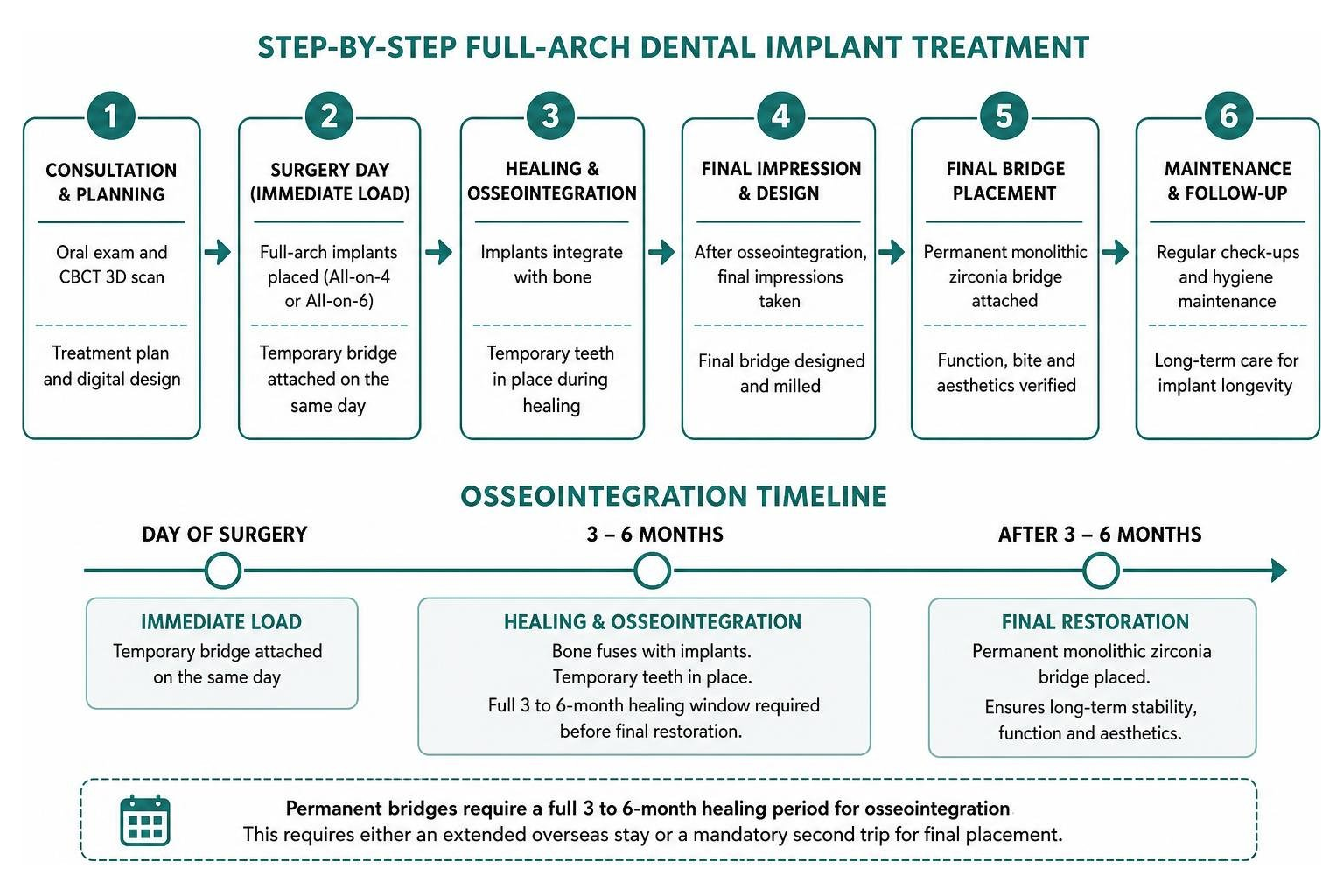
Understanding the cost of full mouth dental implants guide 2026 requires distinguishing between immediate provisional teeth and the final permanent restoration. Many clinics promote immediate-load teeth in a day protocols where a temporary bridge is attached on the day of surgery. However, permanent monolithic zirconia bridges require a full 3 to 6-month healing window for osseointegration before final fabrication, requiring either an extended overseas stay or a mandatory second trip.
What Is Included in Overseas Quotes vs. Hidden Expenses
Marketing campaigns often advertise attractive flat-rate quotes, but patients must carefully distinguish between basic procedural fees and comprehensive surgical solutions. A transparent breakdown from resources like the Dental Implants Abroad 2026 — Compare Turkey, Dubai, India & Philippines Prices directory highlights the importance of itemized estimates.
Standard Package Inclusions and Verification
Reputable overseas medical tourism providers commonly bundle non-clinical conveniences into all-inclusive packages:
Dedicated airport meet-and-greet with private local clinic transfers
Hotel accommodation (typically 4 to 7 nights per trip)
Comprehensive pre-operative consultation and local anesthesia
Surgical placement of the titanium fixture and healing cap
Initial temporary acrylic provisional prostheses
Before committing, request an itemized clinical estimate ensuring that diagnostic 3D CBCT scans, custom abutments, and permanent zirconia restorations are formally covered rather than billed as supplemental add-ons upon arrival.
Travel Logistics, Consultations, and Unexpected Procedures
When calculating the true bottom line of cross-border dental surgery, non-clinical travel expenses must be factored in alongside unforeseen clinical requirements.
Travel and Logistics: Flights, daily meals, hotel upgrades, travel insurance, and travel expenses for a companion can add £1,000 to £2,500 ($1,300 to $3,200) across the entire treatment sequence.
Unplanned Pre-Surgical Procedures: When underlying jawbone volume is compromised due to long-term tooth loss or periodontal disease, supplemental procedures become clinically necessary. Dedicated bone grafting can add £150 to £500 ($200 to $650), while sinus lift procedures may range from £400 to £1,200 ($500 to $1,500) per side.
Lost Wages and Extended Time Off: Taking multiple weeks away from professional obligations represents an indirect financial cost that is often overlooked during initial planning.
Evaluating Clinical Risks, Implant Brands, and Failure Rates
While international dental care can provide financial savings, prospective patients must balance cost considerations against procedural risks and long-term maintenance requirements.

A comprehensive survey by the British Dental Association (BDA) revealed that 85% of dental implants placed abroad required additional follow-up care or corrective intervention upon the patient's return home. Furthermore, clinical studies evaluating complications from overseas dental tourism noted that among complicated cases, 86% involved failing restorations, 76% presented with persistent post-operative pain, and 72% suffered from poorly executed prosthetics.
The Role of Premium Implant Systems and Traceability
One of the most critical factors determining long-term implant success is the manufacturer brand used by the surgical team. Globally recognized systems—such as Straumann, Nobel Biocare, Astra Tech, Osstem, and Zimmer Biomet—carry decades of peer-reviewed clinical research and maintain 10- to 18-year implant survival rates of 91% to 98%.
Crucially, premium manufacturers maintain global component distribution networks. If an unbranded, low-cost implant screw fractures or loosens years later, domestic dentists often lack the proprietary driver tools, matching abutment screws, or prosthetic parts required to repair it. Always insist on receiving the official manufacturer authentication card, detailing the exact brand, model, diameter, length, and lot batch number.
Addressing Complications and Follow-Up Protocols
Post-surgical complications can arise in any surgical discipline:
Early-Stage Infection & Failed Osseointegration: If the bone fails to integrate with the titanium surface within the first 12 weeks, the implant becomes mobile and must be removed.
Peri-Implantitis: Bacterial colonization around the implant collar can cause progressive bone loss. Managing peri-implantitis requires specialized deep debridement, laser therapies, or surgical revision.
Cross-Border Continuity Gaps: Most domestic dental practices are cautious about adjusting or repairing complex full-arch work initiated overseas due to legal liability, unfamiliarity with generic hardware, and missing surgical documentation. Resolving an acute failure often requires traveling back to the original clinic at personal expense.
Preparing for Overseas Care vs. Domestic Treatment Alternatives
If you decide to seek dental care abroad, thorough clinical preparation helps safeguard your investment and oral health.
Essential Checklist for Vetting International Clinics
Before making travel deposits, verify the following standards:
Clinic and Hospital Accreditations: Look for verified accreditations such as Joint Commission International (JCI), ISO 9001 certification, or formal licensing from national health ministries.
Surgeon Qualifications: Confirm that the practitioner holds specialized postgraduate qualifications in oral surgery, periodontology, or prosthodontics, rather than basic general dental licensing.
Written Warranty Terms: Clarify in writing what the clinic's guarantee covers. Does it pay for replacement hardware, laboratory remakes, and local accommodation if an implant fails to integrate?
Pre-Travel Diagnostic Sharing: Send comprehensive panoramic X-rays or digital CBCT DICOM files for pre-assessment to prevent unexpected treatment plan changes upon physical arrival.
Exploring Domestic Alternatives and Flexible Financing
For many patients, choosing domestic restorative care eliminates travel stress and provides continuous local support. Choosing domestic full mouth dental implants ensures that every phase of treatment—from preliminary diagnostic scans to ongoing hygiene checkups—is managed under strict domestic regulatory standards.
Modern practices provide multiple paths toward affordable dental implants. Staged treatment protocols, healthcare installment financing plans (such as CareCredit or specialized lending options), and modular hybrid dentures make comprehensive care manageable within a regular monthly budget. This keeps your care close to home, backed by predictable warranties and routine follow-up.
Frequently Asked Questions About Dental Implants Abroad
How many trips are required for dental implant treatment overseas?
Standard implant protocols require at least two separate trips. During the first trip (lasting roughly 3 to 5 days), extractions, bone grafting, and surgical implant placements are performed, and a temporary restoration is fitted. The patient then returns home for 3 to 6 months to allow complete osseointegration. The second trip (lasting 5 to 7 days) involves uncovering the implants, taking final digital impressions, and attaching the permanent zirconia or ceramic crown. Immediate-load All-on-4 cases may occasionally be finished in a single extended visit (7 to 10 days), but only if the patient has ideal bone density.
What should I do if an implant placed abroad fails after returning home?
If you experience severe pain, mobility, swelling, or prosthetic loosening after returning home, seek an emergency examination from a local dentist or oral surgeon immediately to control acute infection. Request your complete surgical records, implant brand identifiers, and radiographic files from the overseas clinic. Once stable, contact your overseas provider to discuss their warranty policy. Be aware that warranty policies generally require you to travel back to their overseas facility for corrective surgery, as foreign clinics rarely reimburse third-party domestic dental fees.
Is dental tourism truly cheaper once flights and accommodation are included?
For a single missing tooth, dental tourism rarely generates meaningful savings. When factoring in two round-trip flights, 8 to 12 total nights of hotel accommodation, meals, airport transfers, and potential unpaid time off work, a £600 overseas single implant quickly escalates to £2,000 or more—matching or exceeding local treatment costs without providing local aftercare. However, for extensive restorative cases—such as double-arch All-on-4 or All-on-6 reconstructions costing upwards of $35,000 to $50,000 domestically—traveling abroad can still result in net financial savings of 40% to 60%, even after all travel expenses are included.
Conclusion
Deciding whether to travel abroad for dental implant surgery requires balancing upfront financial savings against clinical safety, treatment timelines, and long-term maintenance. While international clinics offer attractive entry prices, the true cost includes travel expenses, time away from work, the risk of unexpected surgical add-ons, and potential challenges if complications arise after you return home.
A successful, lasting smile relies on comprehensive diagnostic planning, genuine premium components, and accessible follow-up care. At Bradenton Implants & Smile Center, we provide transparent, personalized consultations to help you explore dependable restorative solutions tailored to your oral health and budget. If you are weighing your restorative options, we welcome you to discover how our modern dental implants can safely restore your smile with the peace of mind that comes from trusted, local care.