
Everything You Need to Know About Full Mouth Implants
What Are Full Mouth Implants? (Quick Answer)
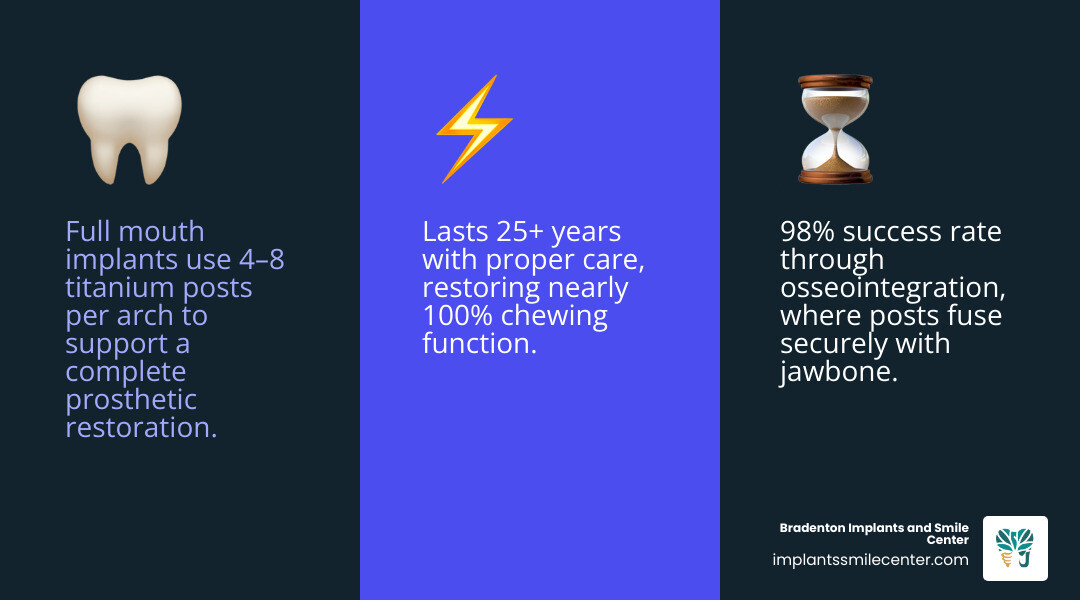
Full mouth implants are a permanent tooth replacement system that uses titanium posts anchored into the jawbone to support a full arch of prosthetic teeth — restoring your smile, bite, and confidence in one comprehensive treatment.
Here's a quick overview of what to expect:
Topic Key Facts What they are Titanium implants + abutments + full prosthetic arch How many implants Typically 4–8 per arch Success rate Up to 98% How long they last 25+ years with proper care Cost range $14,000–$36,000 per arch Chewing function restored Nearly 100% (vs. 25–30% with dentures) Same-day option Available for qualified patients
Tooth loss affects far more than just your smile. It changes how you eat, how you speak, and how you feel about yourself. About 3 million Americans currently have dental implants — and that number grows by 500,000 every year. For adults dealing with missing or failing teeth, full mouth implants have become the gold standard solution in modern restorative dentistry.
Whether you've been struggling with uncomfortable dentures for years, or you're facing the loss of most of your teeth, this guide walks you through everything you need to know — from how the procedure works to what it costs and what recovery looks like.
I'm Dr. John Hegazin, owner of Bradenton Implants and Smile Center, with over 8 years of experience providing full mouth implants and advanced restorative care to patients in the Bradenton area. I've helped hundreds of patients reclaim their smiles using the latest implant techniques and technology, and I'll be your guide through this topic.
What Are Full Mouth Implants and How Do They Work?
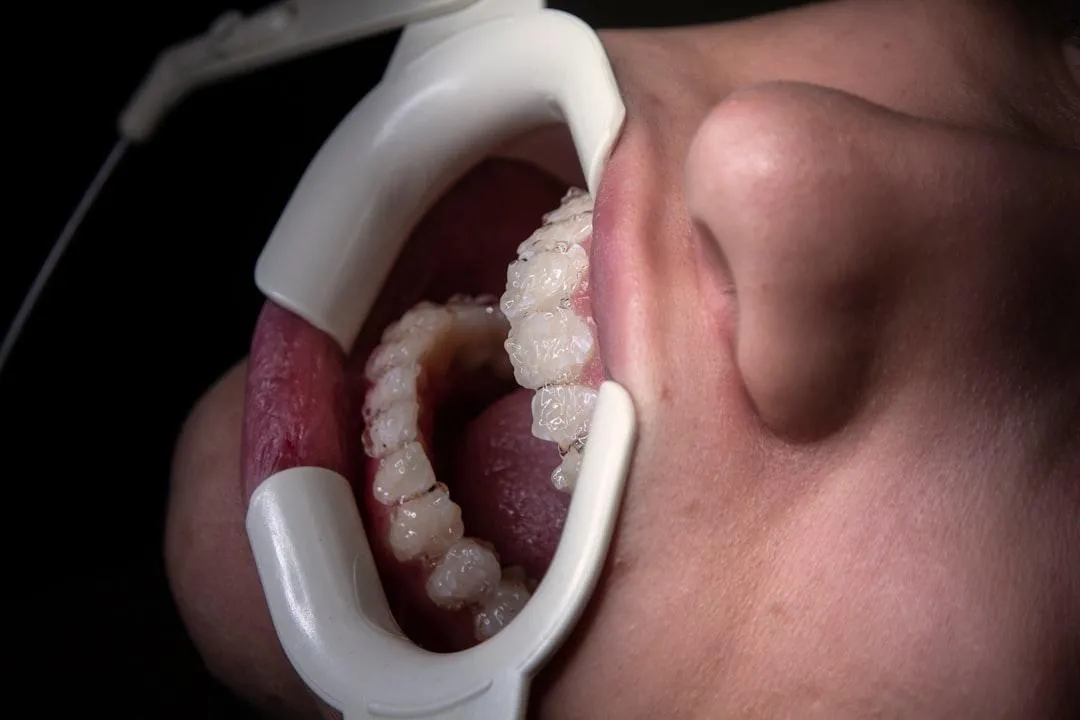
At its simplest, a full mouth implant system is a sophisticated piece of bio-engineering designed to mimic the natural structure of your teeth. Unlike a bridge that relies on neighboring teeth or a denture that sits on top of the gums, full mouth implants replace both the visible tooth and the hidden root.
The system consists of three primary components:
The Implant Post: A small screw-like cylinder usually made of medical-grade titanium. This is surgically placed into the jawbone.
The Abutment: A connector piece that sits on top of the implant post and serves as the mounting point for your new teeth.
The Prosthetic Arch: A custom-crafted set of teeth (often made from high-strength zirconia or premium acrylic) that looks and feels just like natural enamel.
The magic happens through a biological process called osseointegration. Over a period of 2 to 6 months, your jawbone actually grows around and fuses with the titanium posts. This creates a rock-solid foundation that won't slip, click, or shift. According to the Full Mouth Dental Implants - American Academy of Periodontology, this integration is what allows the implants to function as artificial roots, preserving the health of your jawbone for years to come.
If you are curious about how these components come together in a clinical setting, you can find more info about full mouth dental implant services on our dedicated service page.
Who is a Candidate for Full Mouth Implants?
We often tell our patients in Bradenton that while almost anyone can eventually become a candidate, there are a few "must-haves" for immediate success. The most critical factor is jawbone density. Because the implants need to fuse with the bone, there must be enough volume and height to support the posts.
Other candidacy factors include:
Gum Health: You should be free of active periodontal (gum) disease.
Systemic Health: Conditions like uncontrolled diabetes or autoimmune disorders can slow down the healing process.
Lifestyle Factors: Smoking is a significant risk factor. It constricts blood flow to the gums and can interfere with osseointegration. We don't say "no" to smokers, but we do strongly encourage a "pause" on the habit during the healing phase!

Preparatory Procedures: Bone Grafting and Extractions
What happens if you’ve been missing teeth for a long time and your jawbone has started to shrink? Don't worry—you aren't necessarily disqualified. We use several preparatory techniques to build a better foundation:
Bone Grafting: We can add specialized bone material to areas where the jaw is too thin.
Sinus Lifts: For the upper jaw, we can gently lift the sinus membrane to make room for new bone and longer implants.
Tooth Extractions: If you have remaining teeth that are failing or decayed, we will remove them (often during the same appointment as implant placement) to clear the way for your new smile.
To ensure your comfort during these steps, we offer various titanium implants and sedation options ranging from local anesthesia to full sedation, so you can literally sleep through your transformation.
The Benefits of Full Mouth Implants Over Traditional Dentures
If you’ve ever worn traditional dentures, you know the struggle: the messy adhesives, the fear of them falling out during a laugh, and the inability to eat a crisp apple or a steak. Full mouth implants eliminate these worries.
Feature Traditional Dentures Full Mouth Implants Stability Can slip or click; requires adhesives Permanently fixed; no movement Chewing Power 25–30% of natural strength Nearly 100% of natural strength Bone Health Bone continues to shrink/deteriorate Stimulates and preserves jawbone Taste & Speech Plastic covers the palate (less taste) Natural palate; clear speech Maintenance Must be removed and soaked daily Brushed and flossed like real teeth
Beyond the functional perks, there is a major aesthetic advantage. When you lose teeth, your jawbone begins to resorb (melt away), which can lead to a "sunken" facial appearance and premature wrinkles. Implants provide the internal support your face needs to maintain its youthful structure. You can see the dramatic difference in facial support by viewing our Before & After results.
Different Types of Full-Arch Implant Solutions
Not every mouth requires the same number of implants. We customize the approach based on your bone density and budget.
All-on-4®: This technique uses just four strategically placed implants to support a full arch of teeth. The back implants are often tilted at an angle to take advantage of the densest part of the bone, frequently eliminating the need for bone grafting.
All-on-6: For patients with larger jaws or softer bone, we may use six implants to provide additional stability and distribute the biting force more evenly. You can learn more about the All-on-4 vs All-on-6 stability and support to see which might fit your needs.
Implant-Supported Overdentures: These are a middle-ground option. The denture "snaps" onto the implants for stability but can still be removed at night for cleaning.
The Step-by-Step Procedure and Recovery Timeline
Getting full mouth implants is a journey, but we make sure every step is mapped out for you.
Initial Consultation: We use 3D CBCT imaging to get a high-resolution look at your bone structure and plan the exact placement of each implant.
Surgical Placement: On the day of surgery, we place the titanium posts. For many patients, we can also attach a "temporary bridge" so you don't leave our office without teeth.
Healing Phase: This is the most important part! Over the next few months, your bone will bond with the implants.
Final Restoration: Once healing is complete, we swap the temporary bridge for your permanent, high-strength zirconia or porcelain arch.
To learn more about our team and how we handle these procedures, read more about our practice.
The Healing Process and Osseointegration
The first week after surgery is all about rest. You may experience some swelling and minor bruising, which is easily managed with ice packs and over-the-counter pain medication.
During the 2 to 6 months of osseointegration, you will be on a "soft food diet." Think pasta, eggs, fish, and smoothies. You want to avoid "crunching" down on hard foods while the bone is still knitting itself to the metal.
Maintaining Your Full Mouth Implants Long-Term
One of the best things about full mouth implants is that they can't get cavities! However, the gums around them can still get infected if not cared for. This condition is called peri-implantitis.
To keep your new smile for a lifetime, we recommend:
Brushing twice daily with a soft-bristle toothbrush.
Using a water flosser to clean underneath the prosthetic arch.
Regular professional cleanings at our Bradenton office every six months.
Wearing a nightguard if you have a habit of grinding your teeth.
For more tips on daily care, visit our Home page.
Understanding the Cost and Financing of Full-Arch Restoration
We believe in total transparency when it comes to the "price tag." The cost of full mouth implants typically ranges from $14,000 to $36,000 per arch.
Why the wide range? Several factors influence the final cost:
Number of implants (e.g., All-on-4 vs. All-on-6).
Material choice (Acrylic vs. Zirconia).
Preparatory work (Whether you need extractions or bone grafting).
Laboratory fees for custom-crafting your smile.
While the upfront cost is higher than dentures, implants are a "one-and-done" investment. Dentures usually need to be replaced or relined every 5 to 7 years, adding up over time. We offer various Special Offers on dental services and work with third-party financing companies like CareCredit to help make this life-changing treatment fit your monthly budget.
Frequently Asked Questions About Full Mouth Restoration
Can I get "Teeth-in-a-Day" with full mouth implants?
Yes! For many patients, we can perform the extractions, place the implants, and attach a temporary functional bridge all in one day. You’ll walk in with failing teeth and walk out with a beautiful, temporary smile. We then place the final, permanent arch once the healing phase is complete.
Are full mouth implants permanent?
The titanium posts themselves are designed to last a lifetime (25+ years). The prosthetic arch that sits on top is incredibly durable but may eventually need minor repairs or replacement after 15 to 20 years of heavy use—much like the tires on a high-end car.
Is the full mouth implant procedure painful?
Most of our patients are surprised by how little discomfort they feel. During the procedure, we use local anesthesia and sedation to ensure you are completely comfortable. Afterward, the "soreness" is usually described as being similar to a tooth extraction and is well-managed with standard pain relief protocols.
Conclusion
At Bradenton Implants & Smile Center, we’ve seen how full mouth implants can transform a person's life. It isn't just about a "pretty smile"—it's about the ability to eat your favorite foods again, speak clearly without embarrassment, and feel confident in your own skin.
If you’re tired of struggling with missing teeth or uncomfortable dentures, our team is here to provide personalized, compassionate care using the most advanced technology available. We’ll be with you every step of the way, from your first 3D scan to the day you walk out with your permanent new smile.
Ready to see if you’re a candidate? Schedule your full mouth dental implant consultation with us today at our Bradenton location. We can't wait to help you smile again!