
Permanent Full Mouth Teeth: Exploring Your Restoration Options
Understanding Full Arch Restoration and Jawbone Health
Full mouth implant options replace an entire arch of missing or failing teeth, primarily through fixed full arch bridges (like All-on-4 and All-on-6) or removable implant-supported overdentures (snap-on dentures). Fixed solutions permanently secure prosthetic teeth onto strategically positioned implants for optimal bite strength and stability, whereas removable overdentures snap onto implants to provide solid retention with straightforward daily hygiene.
When natural teeth are lost, the underlying jawbone experiences a progressive lack of stimulation. Natural tooth roots transfer the mechanical stresses of chewing directly into the alveolar bone, signaling the body to continuously remodel and maintain bone density. Without these roots, the alveolar ridge resorbs over time, leading to changes in facial structure, compromised chewing ability, and premature aging around the mouth.
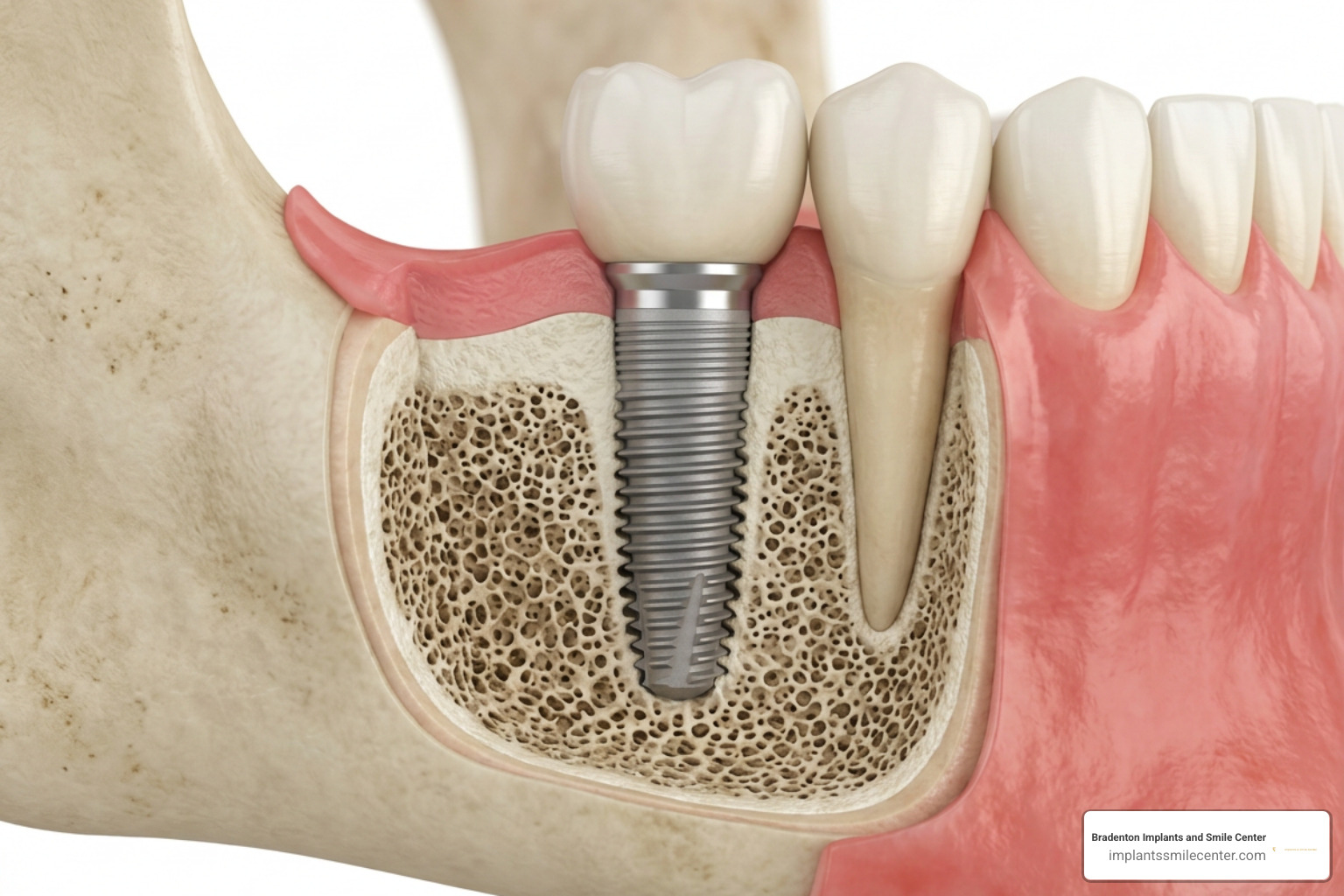
Dental implants address this fundamental biological challenge. Made from medical-grade titanium or biocompatible ceramics, implants serve as prosthetic tooth roots. Through osseointegration, the living jawbone fuses directly with the microscopic surface of the implant, creating a solid anchor. This structural bond restores biting force to levels near that of natural teeth while halting bone loss.
Precision is essential when evaluating a patient for full arch treatment. We use low-dose 3D cone-beam computed tomography (CBCT) imaging to visualize bone volume, ridge density, nerve pathways, and sinus anatomy in three dimensions.
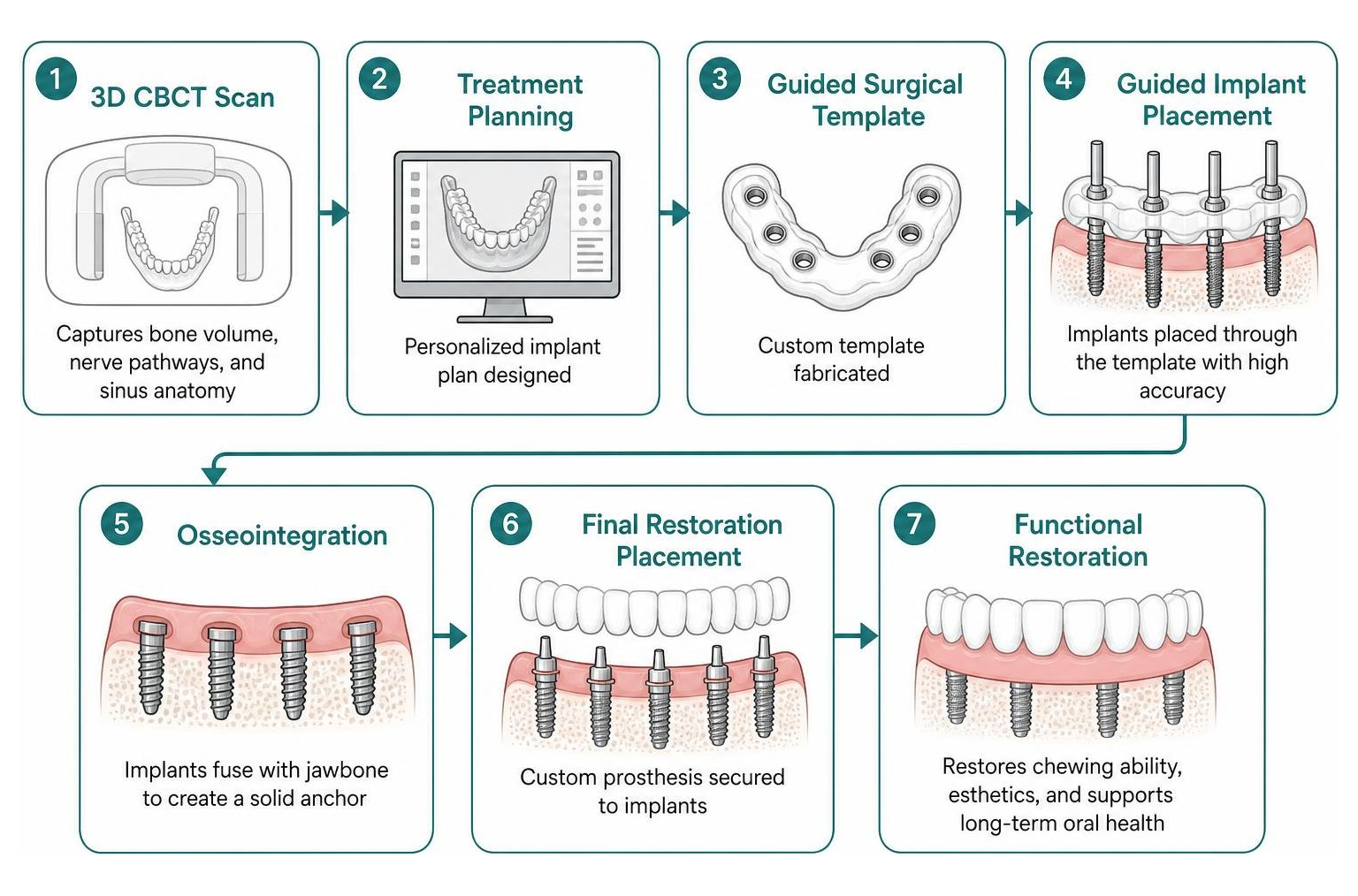
This diagnostic data enables our team to design a personalized dental implant plan using guided surgical templates, ensuring implants are placed with high accuracy to optimize structural load distribution and esthetics.
Comparing Full Mouth Implant Options: Fixed vs Removable Solutions
Restoring a full arch requires choosing between fixed restorations, removable implant-retained overdentures, and conventional prostheses. Each system offers distinct mechanical stability, hygiene access, and surgical requirements, as highlighted in a scientific review on full-mouth implant prosthetics (Surabathula et al., 2025).
Restoration Type | Attachment Mechanism | Palate Coverage | Chewing Efficiency | Bone Preservation | Maintenance Requirements |
|---|---|---|---|---|---|
Fixed Full Arch Bridge (All-on-4 / All-on-6) | Screw-retained onto 4–6 implants | None (horseshoe design) | High (~90–95% of natural) | High (direct load stimulation) | Daily water flossing, specialized threaders, routine clinical checkups |
Implant Overdenture (Snap-On System) | Snaps onto 2–4 implants (Locators or Bar) | Minimal to partial | Moderate to High (~60–80%) | Moderate (slows anterior resorption) | Daily removal for cleaning, nylon cap replacement every 12–18 months |
Conventional Denture | Mucosal suction and peripheral seal | Full upper palate coverage | Low (~20–30%) | None (accelerates ridge resorption) | Nightly removal, daily adhesive use, regular relining |
Fixed options provide high prosthetic stability, eliminating movement during speech or eating. Removable overdentures offer a balance between improved retention and straightforward hygiene access.
Fixed Full Mouth Implant Options: All-on-4 and All-on-6 Systems
Fixed full arch reconstructions, commonly referred to as All-on-4 or All-on-6 protocols, anchor a complete set of prosthetic teeth to strategically placed implants. In the All-on-4 approach, two anterior implants are placed vertically, while two posterior implants are angled up to 45 degrees.
This posterior angulation bypasses anatomical landmarks such as the maxillary sinus or inferior alveolar nerve, engaging denser bone toward the front of the jaw. It also extends the anteroposterior spread, providing a stable foundation that reduces prosthetic cantilever stress.
For patients with higher biting forces, larger jaw arches, or bruxism, an All-on-6 system introduces two additional fixtures to distribute chewing loads more evenly across the ridge. Scientific literature shows 5- to 10-year implant survival rates for these concepts ranging between 92% and 99%, with prosthetic stability around 95% (Surabathula et al., 2025).
When primary stability is achieved during surgery, we can utilize immediate-load protocols, often called Teeth in a Day. A temporary, screw-retained bridge is attached within 24 to 48 hours, allowing you to speak and eat soft foods while the implants undergo osseointegration. To better understand treatment investments, explore our breakdown of the All-on-Four dental implants price and read our comprehensive full arch implants guide.
Removable Full Mouth Implant Options: Overdentures and Snap-On Systems
Removable overdentures offer a dependable, cost-conscious solution for full mouth rehabilitation. Instead of resting entirely on the gum tissue, these prostheses clip securely onto underlying implants.
The two primary retention configurations include:
Locator Attachments: Individual stud attachments seated atop two to four implants snap into matching nylon matrix housings embedded within the denture base.
Bar-Retained Systems: A custom-milled titanium or cobalt-chromium bar splints the implants together, using retentive clips to deliver strong retention and resistance against lateral movement.
The landmark McGill Consensus established that a two-implant mandibular overdenture is the minimum standard of care for edentulous patients, offering vastly superior stability and nutritional intake compared to conventional lower dentures. Over a 10-year follow-up, implant-retained overdentures demonstrate implant survival rates between 90% and 96%, alongside prosthesis survival rates around 95% (Surabathula et al., 2025).
Patients often appreciate snap-on dentures because they can be removed after meals and at bedtime, simplifying home hygiene for individuals with limited manual dexterity. They also serve as effective, affordable permanent teeth alternatives for those seeking increased stability without the higher cost of a fixed full arch bridge.
Advanced Surgical Techniques for Severe Bone Loss
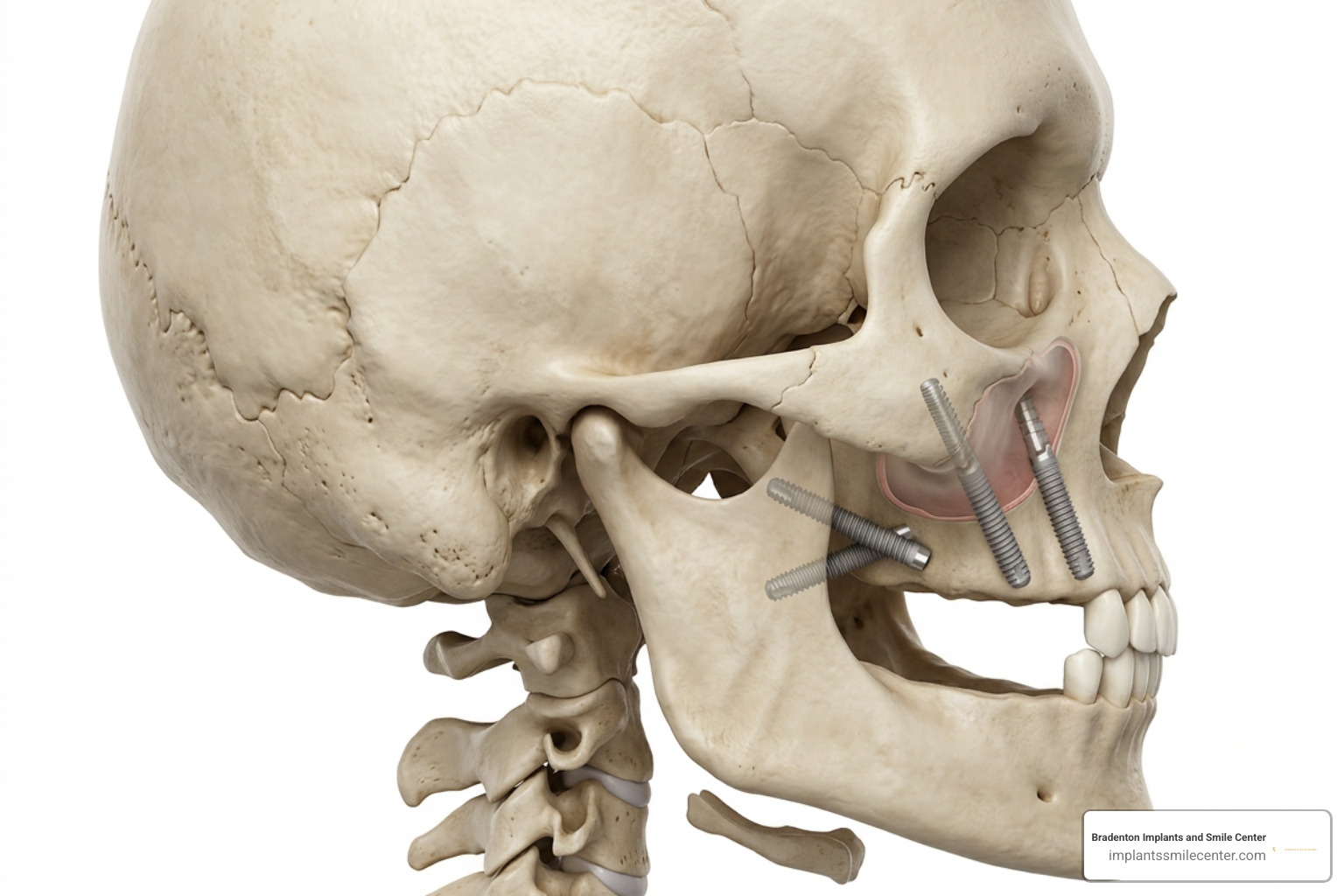
Patients who have worn removable dentures for decades or experienced severe periodontal disease often present with severe bone resorption in the posterior upper jaw. Historically, this necessitated extensive sinus lifts and autogenous bone grafting, delaying final prosthetic delivery by up to a year. Modern implantology offers alternatives to these prolonged grafting timelines.
Zygomatic implants are extended titanium fixtures (ranging from 30 mm to 52 mm in length) designed to anchor directly into the dense cortical bone of the zygoma (cheekbone), entirely bypassing the deficient maxillary alveolar ridge. Pterygoid implants can also be placed into the pterygomaxillary region to provide solid posterior anchorage.
When localized bone deficiencies exist, predictable tissue regeneration techniques remain an option. Patients can learn about guided bone regeneration in our review of bone grafting for implants and explore grafting materials in our guide to types of bone graft in dentistry.
Prosthetic Materials and Durability Considerations
The long-term success of full mouth reconstruction depends heavily on the materials used to craft the final prosthesis. Modern dental laboratories fabricate full arch restorations using distinct restorative mediums:
Monolithic Zirconia: Milled from a solid puck of high-translucency zirconium dioxide, these bridges are virtually fracture-proof, highly resistant to staining, and biocompatible with surrounding soft tissues. Because zirconia is rigid, precise bite calibration is necessary to prevent excessive wear on opposing natural teeth.
Titanium-Reinforced Hybrids: These feature a computer-milled titanium sub-framework wrapped in high-impact pink acrylic and reinforced denture teeth. Hybrids absorb chewing forces well, making them an excellent choice for heavy grinders. The acrylic teeth can also be repaired or replaced if occlusal wear occurs over time.
For an in-depth review of hybrid maintenance, view our guide on hybrid dentures. If you want to compare structural dynamics, check out our resource on implant bridge full mouth restorations.
Cost Factors and Investment in Full Mouth Restoration
Full mouth restoration involves surgical expertise, precision diagnostics, premium materials, and custom dental laboratory fabrication. Several factors influence overall investment:
Surgical Complexity: The presence of severe atrophy, need for extractions, or requirement for advanced fixtures like zygomatic implants.
Number of Implants: Reconstructions supported by six or eight implants involve higher component costs than two- or four-implant frameworks.
Prosthetic Material: Monolithic zirconia frameworks require advanced CAD/CAM milling and sintering, representing a higher initial investment than traditional acrylic overdentures, but offering greater long-term durability.
Sedation and Diagnostics: Advanced 3D imaging, surgical guide printing, and IV sedation contribute to safety and comfort.
To learn more about financial planning, explore our overview of dental implants cost and our financing full mouth dental implants guide.
Frequently Asked Questions About Full Mouth Implants
How long do full mouth dental implants last?
The titanium implant posts that integrate into your jawbone are designed to last decades, often a lifetime, with 10-year clinical survival rates between 92% and 99% (Surabathula et al., 2025). The attached prosthetic bridge or overdenture experiences normal daily wear; acrylic teeth may require maintenance or replacement after 7 to 10 years, whereas monolithic zirconia prostheses can last 15 years or longer with regular professional maintenance and daily hygiene.
What is the difference between All-on-4 and All-on-6?
The core difference lies in the number of supporting implants and how chewing forces are distributed across the jaw. All-on-4 uses four angled implants to maximize available bone in patients with moderate resorption, whereas All-on-6 introduces two additional fixtures to provide wider structural support, reduce posterior cantilever spans, and accommodate larger jaws or heavier bite forces.
Can I get full arch implants if I have significant bone loss?
Yes. Modern techniques such as tilted posterior implants (All-on-4), zygomatic implants that engage the dense cheekbone, and targeted bone grafting make full mouth rehabilitation possible even for individuals with severe bone resorption who have been told they are not traditional implant candidates.
Conclusion
Full mouth dental implants offer dependable, long-term options to restore biting function, preserve jawbone health, and rebuild your smile. Whether you benefit most from a fixed All-on-4 zirconia bridge or a removable snap-on overdenture, our team at Bradenton Implants & Smile Center is here to guide you through every step.
Located at 7270 55th Ave E, Bradenton, FL 34203, our practice provides advanced diagnostics, gentle surgical techniques, and flexible financing tailored to your needs. Contact us today to schedule your comprehensive evaluation for full mouth dental implants and discover which restoration fits your lifestyle.
References
Surabathula D, Birajdar S, Joshi M, Vaz M, Kadam N. "Prosthetic Options for Full-Mouth Implant Rehabilitation: A Contemporary Review.." Cureus, 2025. PMCID PMC12799391.