
The Science of Staying Numb During Your Root Canal
Why Local Anesthesia Makes Root Canals Far Less Scary Than You Think
Local anesthesia for root canals is the standard method dentists and endodontists use to completely block pain during the procedure — so you stay awake, relaxed, and comfortable while the infected pulp is removed.
Here's a quick look at what to expect:
What You Want to Know Quick Answer Will it hurt? No — local anesthesia blocks pain signals before they reach your brain Are you awake? Yes, in most cases How long does numbness last? Typically 2–4 hours after the procedure Most common anesthetic used Lidocaine (often with epinephrine) What if it doesn't work? Supplementary techniques like PDL or intraosseous injections are used
Despite its reputation, a root canal today is often no more painful than getting a filling. Decades ago, that wasn't always true. But modern local anesthetics — combined with better techniques and technology — have changed that completely. The real discomfort most patients feel is from the infected tooth itself, not the treatment.
That said, pain management during a root canal isn't always straightforward. Certain teeth — especially lower back molars with severe infection — are genuinely harder to numb. Understanding why that happens, and what your dental team can do about it, is exactly what this guide covers.
I'm Dr. John Hegazin, owner of Bradenton Implants and Smile Center, with over 8 years of experience performing root canal therapy and managing local anesthesia root canal challenges for patients with dental anxiety and complex cases. I'll walk you through the science behind staying numb — so you know exactly what to expect before you sit in that chair.
How Local Anesthesia for Root Canal Procedures Works
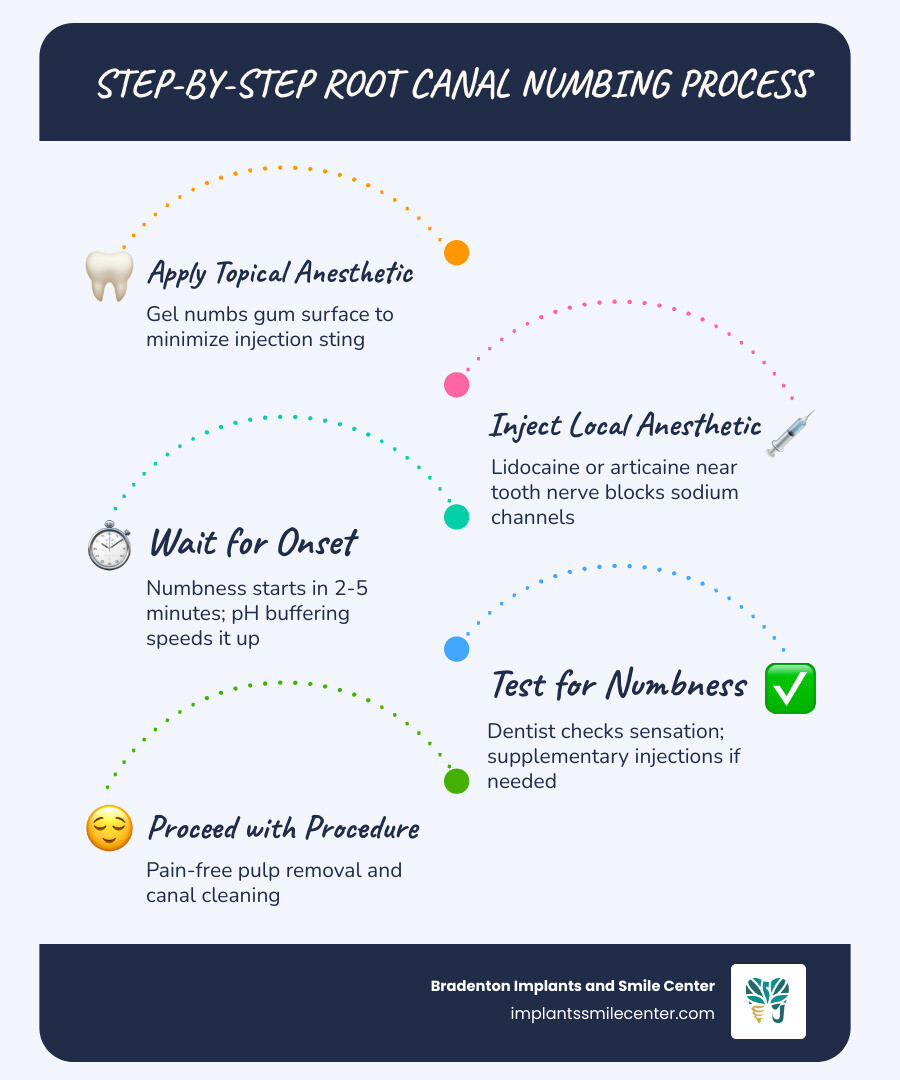
When we perform a root canal, our primary goal is to ensure you don’t feel a thing. This is achieved through Local anesthesia , which involves injecting a specialized solution near the nerves of the affected tooth. These medications work by blocking "voltage-gated sodium channels" in your neuronal membranes.
Think of your nerves as electrical wires sending a "pain" message to your brain. The anesthetic acts like a switch that flips the circuit off. By preventing sodium from entering the nerve cells, the action potential (the electrical signal) cannot be generated. This results in a temporary absence of sensation in a very specific part of your body.
In our Bradenton office, we select the anesthetic based on the length of your procedure and your medical history. Most local anesthetics fall into the "aminoamide" class, which are safe, effective, and lack the high allergy risks of older "ester" types like cocaine or procaine.

Common Agents: Lidocaine vs. Articaine
The "gold standard" in many dental offices is lidocaine. It has a fast onset (usually 2 to 5 minutes) and provides reliable pulpal anesthesia for about 60 minutes. However, for more complex root canals, we often look to articaine.
Articaine is highly regarded in The Art of Local Anesthesia in Root Canals because of its superior tissue diffusion. It can often penetrate bone more effectively than lidocaine, making it a favorite for "hot" teeth (teeth with active, painful inflammation). We also use bupivacaine when we want the numbness to last longer—sometimes up to eight hours—to help you get through the initial post-operative period without discomfort.
Most of these agents contain a vasoconstrictor like epinephrine. This keeps the anesthetic in the area longer, reduces bleeding, and increases the depth of the numbness.
Anesthetic Agent Potency Onset Time Duration (Pulpal) Lidocaine 2% Moderate 2–3 mins 60 mins Articaine 4% High 1–2 mins 60–75 mins Mepivacaine 3% Moderate 1–2 mins 20–40 mins Bupivacaine 0.5% High 6–10 mins 90+ mins
The Role of pH Buffering
One of the newest advancements in Dental anesthesia is pH buffering. Standard local anesthetics are quite acidic (pH around 3.5), which is why you might feel a "sting" during the injection. By adding sodium bicarbonate to the solution right before injection, we can bring the pH closer to your body’s natural 7.4.
Research shows that buffered local anesthetics have a 2.29 times increased success rate. Not only does it hurt less going in, but it also works significantly faster. This is a game-changer for patients who are nervous or have a history of being "hard to numb."
Why Some Teeth Are Harder to Numb
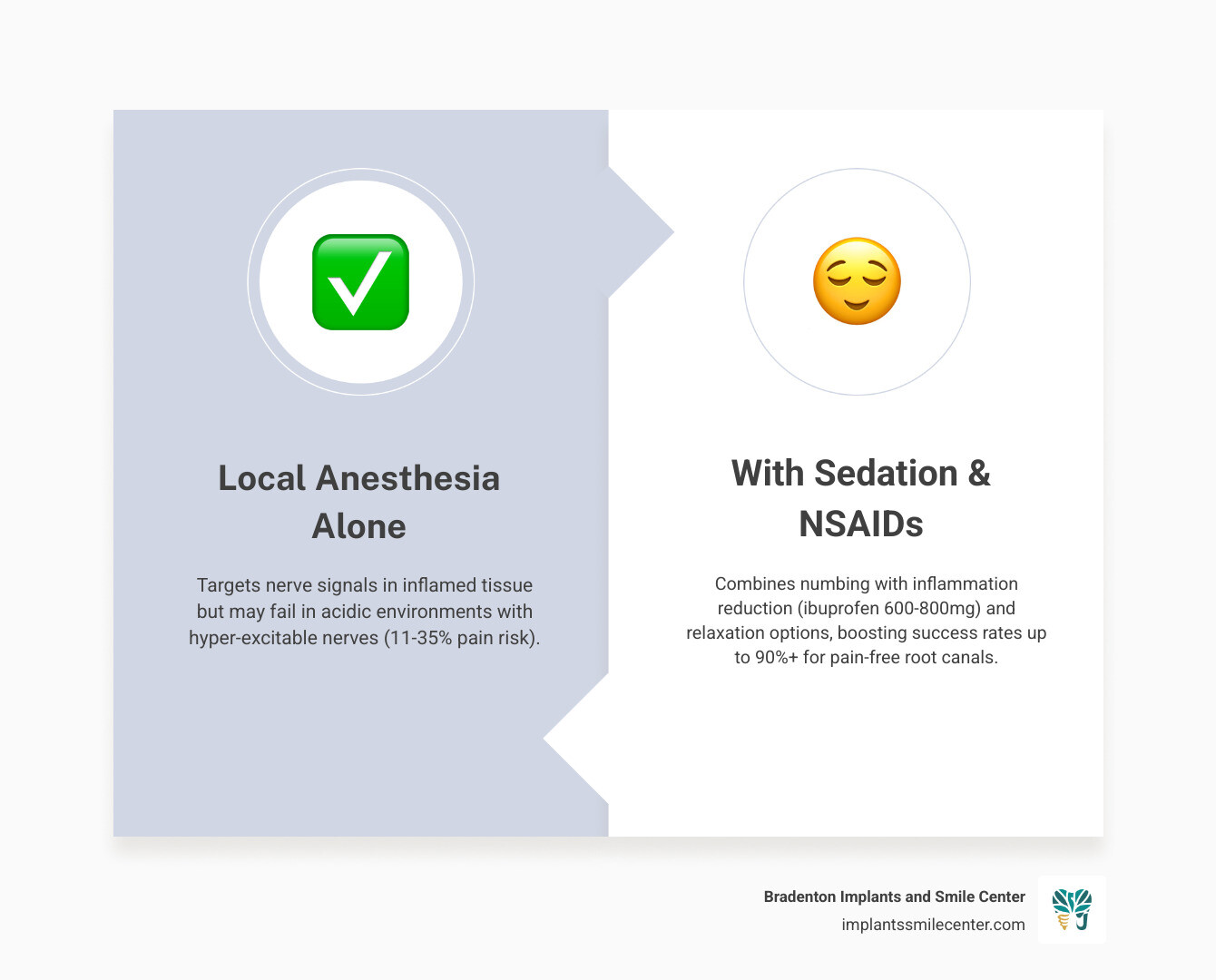
Even with the best techniques, local anesthesia isn't 100% foolproof. In fact, statistics show that about 13% of general practitioners encounter anesthesia failure during a typical work week. For patients with "irreversible pulpitis" (a fancy term for a tooth pulp that is dying and cannot be saved), the failure rate for a standard block can be as high as 10% to 35%.
The Challenge of Mandibular Molars
The lower back teeth, or mandibular molars, are notoriously difficult. This is largely due to the Inferior Alveolar Nerve Block (IANB). To numb a lower molar, we have to hit a specific nerve deep in the jaw. Success is often hampered by:
Accessory Innervation: Sometimes, a second nerve (like the mylohyoid nerve) provides feeling to the tooth, meaning the main block doesn't cover everything.
Bone Density: The lower jawbone is much denser than the upper jaw, making it harder for the anesthetic to soak through to the roots.
Anatomy Variations: Everyone's jaw is shaped slightly differently, and the nerve isn't always in the exact "textbook" location.
If you've ever had a dentist try to numb you multiple times for a lower molar, you’ve experienced these endodontic challenges firsthand.
Inflammation and Anesthetic Failure
When a tooth is severely infected, the environment around the nerve becomes acidic. This acidity "neutralizes" the anesthetic before it can enter the nerve cell. Furthermore, inflammation causes prostaglandin elevation, which activates special "TTX-resistant" sodium channels that are much harder for lidocaine to block.
Essentially, the nerve becomes "hyper-excitable." Even if your lip feels numb, the pulp inside the tooth might still be sending signals. This is why we always test the tooth before we begin the procedure.
Supplementary Techniques for a Pain-Free Experience
If the initial injection doesn't provide 100% numbness, we don't just "tough it out." We use supplementary techniques to ensure a pain-free local anesthesia root canal experience.
PDL (Periodontal Ligament) Injection: We place the anesthetic directly into the space between the tooth and the bone. Studies show that 56% to 70% of teeth that didn't numb with a standard block are successfully anesthetized with a PDL injection.
Intraosseous Anesthesia: This involves delivering the numbing agent directly into the porous bone surrounding the tooth.
Intrapulpal Injection: If we have already opened the tooth and find a sensitive spot, we can place a drop of anesthetic directly into the pulp chamber. While it can cause a split-second of pressure, it provides nearly instant, profound numbness.
Managing Local Anesthesia Root Canal Success Rates
We can improve the success of your anesthesia through small, technical choices. For instance, injection speed matters. Injecting slowly (over 60 seconds) significantly reduces the "sting" and pressure sensation.
We also use high-strength topical anesthesia (a gel like 2.5% lidocaine-prilocaine) on the gums for at least 30 to 60 seconds before the needle even touches you. This numbs the surface so you barely feel the "pinch."
Advanced Delivery Systems
At Bradenton Implants & Smile Center, we prioritize your comfort by using modern technology. Devices like The Wand (a computer-controlled delivery system) ensure the anesthetic is delivered at a constant, slow pressure that the human hand can't always replicate. We may also use vibration devices that "distract" your nerves, a concept known as the Gate Control Theory of Pain, making the injection nearly imperceptible.
For more information on how we handle complex cases, you can contact our office to speak with our dental team.
Combining Sedation and Premedication
For many, the fear of the needle is worse than the procedure itself. That is why we often combine local anesthesia root canal techniques with sedation.
The Role of NSAIDs in Local Anesthesia Root Canal Efficacy
One of the simplest ways to make anesthesia work better is to take an over-the-counter pain reliever before your appointment. Taking 600–800mg of ibuprofen (Advil/Motrin) or indomethacin an hour before your root canal can reduce the inflammation and "calm down" those stubborn sodium channels. This significantly increases the success rate of the numbing block.
Conscious Sedation Options
If you are anxious, we offer several ways to help you relax:
Nitrous Oxide (Laughing Gas): You breathe it in through a mask. It makes you feel floaty and euphoric, and it wears off the moment we turn the gas off, so you can drive yourself home.
Oral Sedation: A pill taken an hour before the visit. You’ll be very relaxed and may even drowse through the procedure.
IV Sedation: For those with severe dental phobia, IV sedation provides a "twilight" state where you are still conscious but won't remember or care about the procedure.
General Anesthesia: This is rarely used for root canals but may be considered for patients with extreme special needs or those who cannot be numbed by traditional means.
You can find a more detailed root canal and endodontics overview on our service pages to see which option fits your needs.
Frequently Asked Questions
Is a root canal more painful than a filling?
With modern local anesthesia root canal techniques, the experience is very similar to getting a routine filling. You will feel pressure and hear the sounds of the equipment, but you should not feel "sharp" pain. If you do, we stop immediately and add more anesthetic.
How long does numbness last after the procedure?
Typically, you will remain numb for 2 to 4 hours. If we use a long-acting anesthetic like bupivacaine, it could last up to 8 hours. We recommend not eating until the numbness has completely worn off to avoid accidentally biting your cheek or tongue.
What happens if the local anesthesia fails?
If you still feel sensation, we don't continue. We utilize supplementary injections like the PDL or intra-pulpal techniques. We are constantly monitoring your comfort levels and can adjust our approach in real-time.
Conclusion
At Bradenton Implants & Smile Center, we believe that no one should have to choose between a toothache and a painful procedure. By combining the latest in pharmacological science—like buffered anesthetics and articaine—with compassionate, personalized care, we have turned the "dreaded" root canal into a routine, comfortable visit.
If you are experiencing tooth pain or have been told you need endodontic therapy, don't let fear hold you back from saving your natural smile. Our team in Bradenton, FL, is here to provide the gentle, high-tech care you deserve.
Schedule your comfortable root canal consultation today and let us show you how easy staying numb can be.