

How much does a periodontal cleaning cost with insurance anyway
What Does Periodontal Cleaning Cost With Insurance?
Periodontal cleaning cost with insurance is one of the most common questions patients ask before scheduling gum disease treatment. Here's a quick answer:
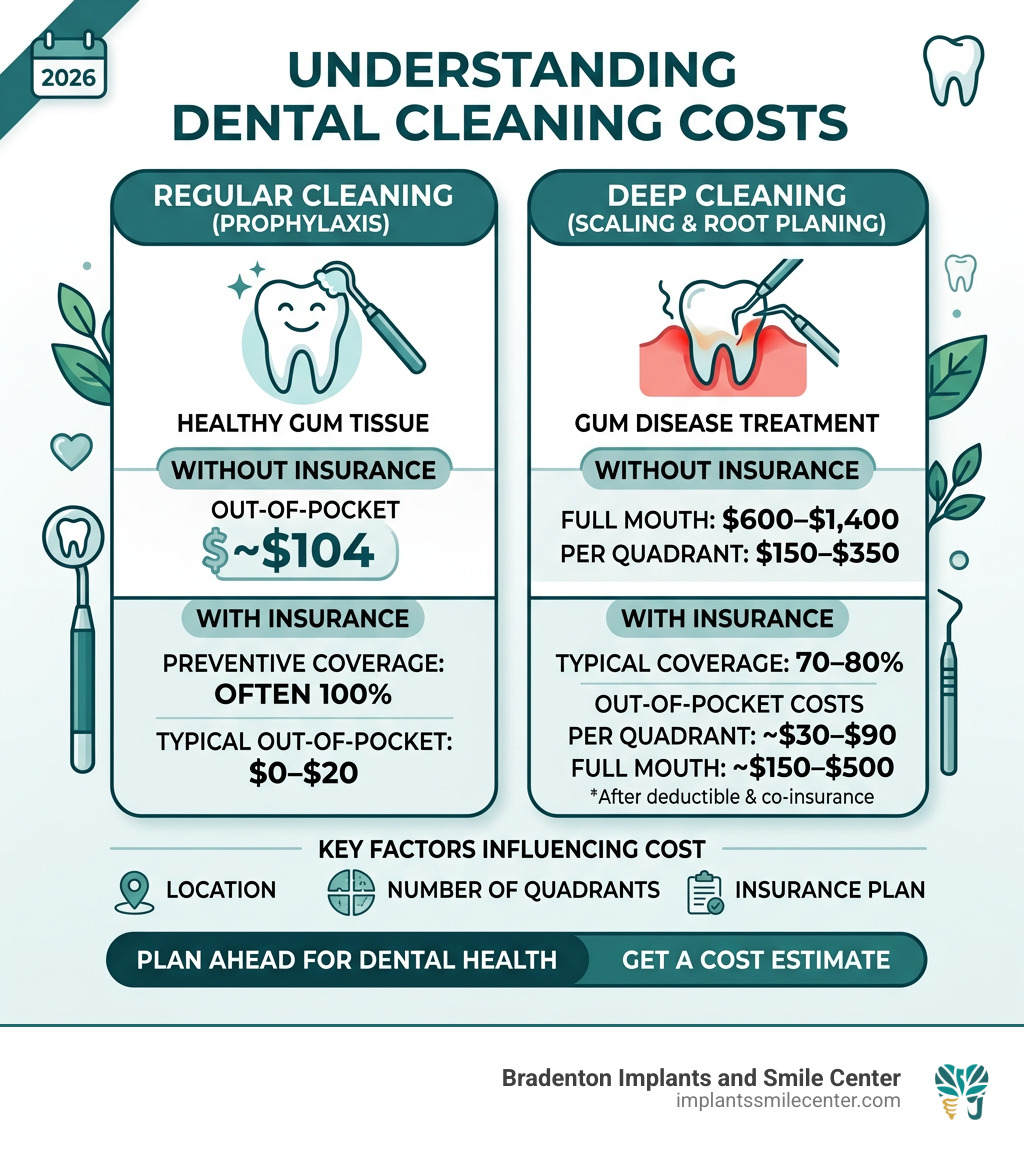
Scenario Typical Cost Regular cleaning (prophylaxis) ~$104 out-of-pocket without insurance Deep cleaning per quadrant, no insurance $150–$350 Full mouth deep cleaning, no insurance $600–$1,400 Deep cleaning per quadrant, with insurance ~$30–$90 out-of-pocket (after 70–80% coverage) Periodontal maintenance visit, with insurance Varies; avg. ~$120 before insurance adjustments
Most dental insurance plans cover scaling and root planing (the clinical name for a deep cleaning) at 70–80% of the contracted fee after your deductible. That means most patients pay 20–30% out-of-pocket — often somewhere between $150 and $500 total for a full-mouth treatment, depending on your plan.
But costs vary. Your location, how many quadrants need treatment, whether you see a specialist, and your specific plan all play a role.
That $1,000 out-of-pocket quote you may have heard about? A Reddit thread on this exact topic showed that number raised eyebrows — and for good reason. Most patients in typical cases report paying $250 or less out-of-pocket after insurance kicks in.
I'm Dr. John Hegazin, dentist and owner of Bradenton Implants and Smile Center. Over my 8+ years of practice, I've helped countless patients navigate the real-world periodontal cleaning cost with insurance — separating what plans actually cover from what catches patients off guard. In this guide, I'll walk you through everything you need to know to plan ahead financially and protect your gum health.
Understanding Periodontal Cleaning vs. Regular Cleaning
When you visit us at Bradenton Implants & Smile Center for a standard checkup, you typically receive what we call a "prophylaxis." This is a preventive treatment intended for patients with healthy gum tissue. However, if we detect signs of gum disease (periodontitis), a standard "polishing" isn't enough.

Prophylaxis vs. Therapeutic Treatment
A regular cleaning focuses on the crowns of the teeth—the part you see when you smile. A periodontal cleaning, or Deep Cleaning, is a therapeutic procedure. It is designed to treat an active infection. While a regular cleaning takes about 30 to 60 minutes, a deep cleaning is much more involved, often requiring 90 to 120 minutes per half of the mouth.
Subgingival Tartar and Root Surface Smoothing
The primary goal of a deep cleaning is to remove subgingival tartar (calculus) that has hardened below the gumline. This material cannot be removed by brushing or flossing at home. During the procedure, we perform:
Scaling: Scraping away plaque and tartar from the tooth surface and beneath the gumline.
Root Planing: Smoothing out the root surfaces to help the gum tissue reattach to the teeth.
Medical Necessity and Pocket Depths
Insurance companies view deep cleanings differently than routine ones. To justify the periodontal cleaning cost with insurance, we must document medical necessity. This is usually done through pocket depth measurements. If your gum pockets are deeper than 4mm, it indicates that bone loss and infection are occurring, making a deep cleaning essential to prevent tooth loss.
Average Periodontal Cleaning Cost With Insurance and Without
Navigating dental bills can feel like trying to read a different language. To help you plan, we’ve broken down the typical costs you might see in the Bradenton, Florida area.
Procedure Type Cost Without Insurance (Full Mouth) Estimated Out-of-Pocket With Insurance Scaling & Root Planing (D4341) $600 – $1,400 $120 – $400 Periodontal Maintenance (D4910) $115 – $200 $25 – $60 Full Mouth Debridement (D4355) $150 – $300 $30 – $90
Deductibles and Annual Maximums
Most patients are used to their Dental Cleanings being covered at 100%. However, because a deep cleaning is "Basic" or "Restorative" care, you will likely have to meet your annual deductible first (usually $50–$100). Once that is met, the insurance pays its percentage—typically 70% to 80%—up until you hit your annual maximum (often $1,000–$2,000).
ADA Procedure Codes and Contracted Fees
We use specific ADA procedure codes for billing. Code D4341 is used when four or more teeth in a quadrant require treatment, while D4342 is used for one to three teeth. If you are in-network, the dentist agrees to a "contracted fee," which is usually lower than the standard office price, further reducing your periodontal cleaning cost with insurance.
How major providers handle periodontal cleaning cost with insurance
Major insurers like Cigna and Humana have specific protocols for approving deep cleanings. They don't just take our word for it; they require "proof of loss."
X-ray Evidence: Insurers look for visible bone loss on your radiographs.
Periodontal Charting: They require a full map of your pocket depths (the 4mm+ rule mentioned earlier).
Frequency Limits: Most plans will only pay for a deep cleaning once every 24 to 36 months.
Managing the periodontal cleaning cost with insurance for maintenance
Once the initial deep cleaning is done, you move into the "maintenance" phase. This is billed under code D4910.
Intervals: Because gum disease is a chronic condition, you’ll likely need these cleanings every 3–4 months instead of every 6 months.
Coverage Tiers: Some insurance plans cover maintenance at 100% as a preventive service, but many classify it as a basic service covered at 80%. It is vital to check if your specific plan allows for three or four maintenance visits per year.
Factors That Influence Your Final Bill
No two mouths are the same, and neither are the bills. Several variables can push your periodontal cleaning cost with insurance up or down.
Number of Quadrants
The mouth is divided into four quadrants. If you only have localized gum disease, you might only need one or two quadrants treated, significantly lowering the cost. A full-mouth treatment (all four quadrants) is the most common scenario for advanced periodontitis.
Severity of Infection and Antibiotic Therapy
In some cases, scaling and root planing alone aren't enough. We may recommend:
Arestin or Antibiotic Beads: These are placed directly into the gum pockets to kill lingering bacteria.
Antimicrobial Rinses: Prescription-strength mouthwashes to use at home. These are often billed separately and may not always be covered by standard insurance plans.
Local Anesthetic and Sedation
To ensure you are comfortable, we use a local anesthetic to numb the area. While local numbing is usually included in the procedure fee, if you have dental anxiety and request nitrous oxide (laughing gas) or IV sedation, those will incur additional out-of-pocket costs.
Geographic Location
Costs in Bradenton, FL, are generally reflective of regional averages. For instance, data shows that in some high-cost areas, scaling and root planing can cost over $300 per quadrant, whereas Florida averages often sit in the $150–$250 range for in-network providers.
Ways to Reduce Your Out-of-Pocket Expenses
We believe that financial concerns should never stand in the way of a healthy smile. Here are several strategies we recommend to our patients at Bradenton Implants & Smile Center to manage costs:
Stay In-Network: Using an in-network dentist ensures you benefit from pre-negotiated lower rates.
Use HSA or FSA Funds: Periodontal treatments are qualified medical expenses. Using pre-tax dollars from a Health Savings Account can save you roughly 20–30% depending on your tax bracket.
Third-Party Financing: We partner with services like CareCredit, which allow you to break up your periodontal cleaning cost with insurance into manageable monthly payments, often with 0% interest for a set period.
Timing is Everything: If you need a full-mouth deep cleaning but are close to your annual insurance limit, we can sometimes split the treatment between December and January to utilize two years' worth of benefits.
In-Office Membership Plans: For our patients without traditional insurance, we offer internal membership plans that provide significant discounts on periodontal treatments and maintenance.
Frequently Asked Questions about Periodontal Costs
Is a deep cleaning really necessary if my teeth don't hurt?
Yes! Periodontal disease is often called a "silent killer" of smiles because it rarely hurts until it is in the very advanced stages. By the time your teeth feel loose or painful, you may have already lost significant jawbone. A deep cleaning is a proactive way to save your natural teeth.
Does insurance cover the cost of sedation for periodontal work?
Generally, no. Most dental insurance plans consider sedation "elective" for non-surgical procedures like scaling and root planing. However, we can check your specific policy to see if there are exceptions for certain medical conditions.
Why is periodontal maintenance more expensive than a regular cleaning?
Periodontal maintenance (D4910) involves cleaning deeper into the pockets and monitoring the attachment levels of your gums. It requires more time, specialized tools, and higher clinical expertise than a standard prophylaxis.
Conclusion
At Bradenton Implants & Smile Center, we are dedicated to providing personalized, compassionate care using the most advanced techniques available. We understand that the periodontal cleaning cost with insurance can be a source of stress, which is why our team works tirelessly to help you maximize your benefits and find a payment solution that fits your budget.
Investing in a deep cleaning today is the best way to prevent the need for much more expensive treatments later, such as extractions, bone grafts, or dental implants. Don't let gum disease progress—your smile is worth the investment.
Schedule your deep cleaning today by calling our Bradenton office. We look forward to helping you achieve a lifetime of healthy smiles!