
Why Permanent Implants are the Best Choice for Your Mouth
What Are Permanent Teeth Implants — and Are They Right for You?
Permanent teeth implants are titanium posts surgically placed into the jawbone to replace missing tooth roots, supporting a natural-looking crown, bridge, or full arch of teeth.
Quick answer for common questions:
Question Answer What are they? Titanium posts fused to the jawbone that hold artificial teeth How long do they last? 25+ years — often a lifetime with proper care Success rate Up to 98% Who qualifies? Adults with healthy gums and sufficient jawbone density Can they replace all teeth? Yes — options like All-on-4 replace a full arch Are they painful? Minimal — done under anesthesia, manageable recovery
Tooth loss does more than change your smile. It quietly damages your jawbone, shifts your remaining teeth, and can affect how you eat, speak, and feel about yourself. According to the American Academy of Implant Dentistry, more than 3 million people in the U.S. have dental implants, a number that grows by 500,000 every year.
Unlike dentures or bridges, permanent implants actually replace the tooth root, not just the visible tooth. That makes them the only restorative option that actively preserves your jawbone over time.
If you're in your 40s, 50s, or 60s and weighing your options for missing or failing teeth, this guide will help you make a confident, informed decision.
I'm Dr. John Hegazin, owner of Bradenton Implants and Smile Center, with over 8 years of experience helping patients restore their smiles using permanent teeth implants and other advanced restorative solutions. In the sections ahead, I'll walk you through everything you need to know — from how implants work to what the process actually looks and feels like.
Understanding Permanent Teeth Implants and How They Work
When we talk about permanent teeth implants, we aren't just talking about a "fake tooth." We are talking about a sophisticated medical device designed to mimic the biology of your mouth. Unlike traditional bridges that rely on neighboring teeth for support, or dentures that sit on top of the gums, implants become a part of you.
The magic happens through a process called osseointegration. This is a fancy scientific term for when your jawbone actually grows into and fuses with the surface of the titanium post. Because titanium is highly biocompatible, your body doesn't see it as a foreign object. Instead, it treats the post like a natural tooth root. This bond is so strong that it provides a foundation as stable as the original teeth you were born with.
According to the American Dental Association (ADA), dental implants are a safe and effective way to restore your ability to chew and speak. Beyond aesthetics, they prevent the rapid bone loss that occurs when a tooth root is missing. Without that root to stimulate the bone, the jaw begins to resorb or "shrink," which can eventually change the shape of your face.
If you're looking for a way to get back to eating steak, biting into apples, and laughing without worrying about your teeth slipping, you can learn more about our restorative services to see how we can help.
The Three Components of a Permanent Tooth Implant
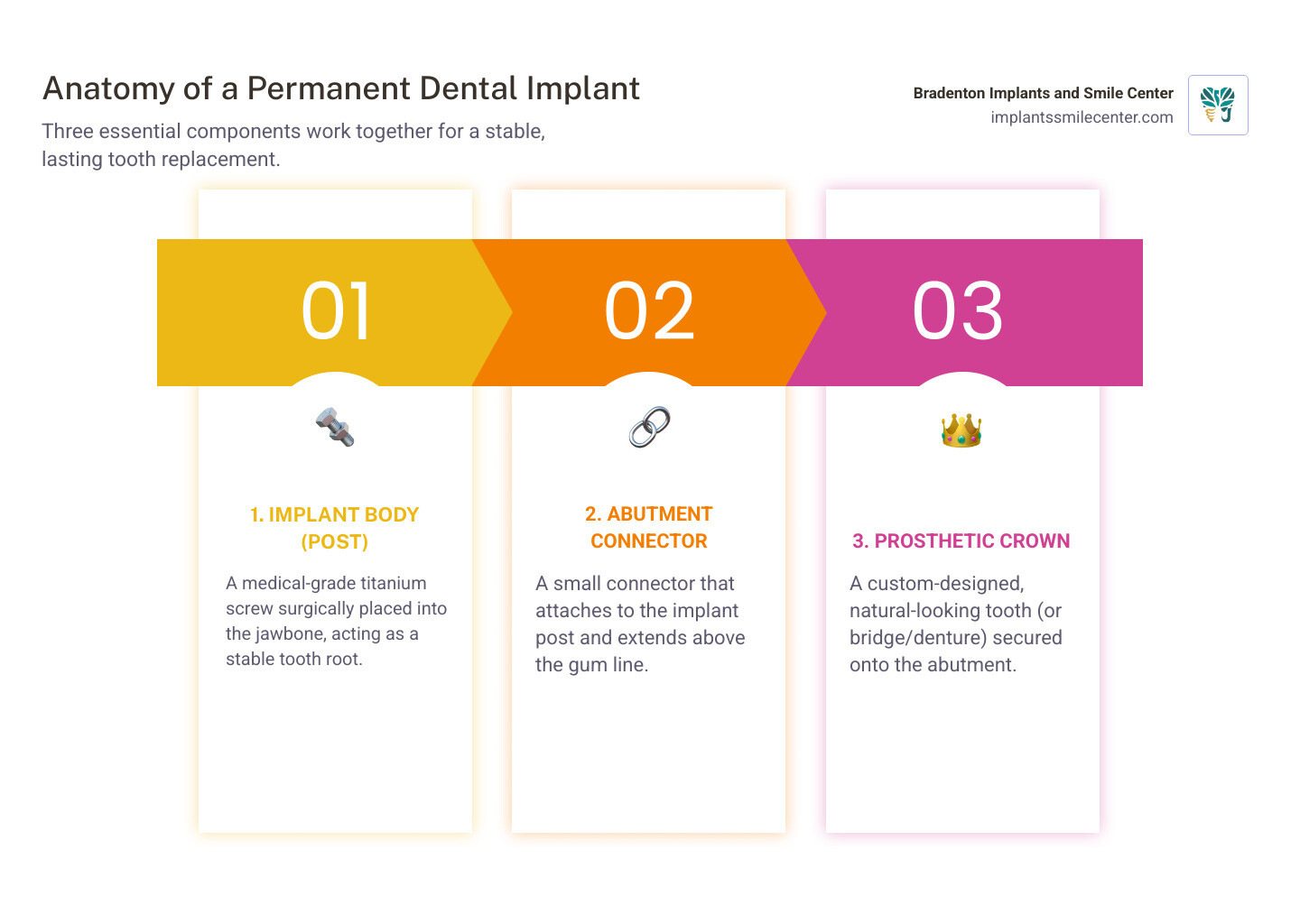
To understand why these are so durable, it helps to look at the three specific parts that make up the system:
The Implant Body: This is the screw-like post that is surgically placed into your jawbone. Most are made of medical-grade titanium, though zirconia options exist for those with specific metal sensitivities or aesthetic needs in areas with thin gum tissue.
The Abutment: This is a small connector piece that sits right at the gum line. It screws into the implant body and serves as the "anchor" for your new tooth.
The Custom Prosthetic: This is the part you see—the crown, bridge, or full-arch denture. We custom-craft this to match the color, shape, and size of your natural teeth so perfectly that even you might forget which one is the implant!
Types of Implant Systems: Endosteal vs. Subperiosteal
Not every mouth is the same, which is why there are different ways to place permanent teeth implants.
Endosteal Implants: These are the most common type. They are placed directly into the jawbone. If you have a healthy, thick jawbone, this is likely the route we will take.
Subperiosteal Implants: These are used for patients who don't have enough jawbone height and aren't candidates for bone grafting. Instead of going into the bone, a metal frame is placed on top of the bone but under the gum tissue.
Mini Implants: These are smaller than standard implants and are often used to stabilize lower dentures or to fill very narrow gaps where a full-sized post won't fit.
The American Academy of Periodontology (AAP) notes that the choice between these systems depends on your unique anatomy and the number of teeth being replaced.
The Step-by-Step Procedure and Healing Timeline
We know that the idea of "dental surgery" can make some people a little nervous. However, at Bradenton Implants & Smile Center, we use modern technology to make the process incredibly predictable and comfortable.
The journey starts with a comprehensive consultation. We use 3D CBCT imaging to create a digital map of your mouth. This allows us to see your bone density, nerve pathways, and sinus cavities in three dimensions before we ever start the procedure. It’s like having a GPS for your surgery!
According to the Mayo Clinic's guide to dental implant surgery, the process is usually performed in stages to allow for proper healing.
Stage What Happens Timeline Consultation Exam, 3D X-rays, and customized plan Day 1 Preparation Extractions or bone grafting (if needed) Varies Placement The titanium post is placed in the jaw 1 - 2 hours Osseointegration Bone fuses to the implant 3 - 6 months Abutment Connector is attached to the post 1 day (plus 2 weeks healing) Final Restoration Your custom crown or bridge is attached Final visit
Preparing for Your Permanent Teeth Implants
In some cases, your jawbone might need a little extra "bulk" to support an implant. This is where bone grafting comes in. If a tooth has been missing for a long time, the bone may have thinned out. We can add grafting material (which can be your own bone, synthetic material, or donor bone) to strengthen the site.
If we are working on the upper jaw near the back, you might need a sinus lift. This simply means we gently move the sinus floor up to make room for the bone graft and the implant. At our practice, we focus on personalized care to ensure these preparatory steps are handled with the utmost compassion and skill.
Recovery and the Osseointegration Phase
After the implant is placed, the "waiting game" begins. This is the 3-to-9-month window where osseointegration happens. During the first week, you’ll stick to a soft food diet (hello, smoothies and mashed potatoes!) and follow our aftercare instructions to manage any minor swelling.
Don't worry—you won't be toothless during this time! We can often provide a temporary tooth or "flipper" so you can keep smiling while your bone does the hard work of fusing to the post. You can see some of our Before & After results to see the life-changing transformations our patients have experienced.
Benefits of Permanent Implants vs. Traditional Dentures
If you’ve ever used traditional dentures, you know the struggle: the messy adhesives, the fear of them slipping while you're talking, and the fact that they need to be replaced or relined every few years. Permanent teeth implants offer a completely different experience.
Longevity: While dentures last about 5 to 10 years, implants are designed to last 25 years or a lifetime.
Success Rate: Titanium implants have a success rate of 97% to 98%.
Bone Health: Implants are the only solution that stops bone loss.
Functionality: You regain up to 90% of your natural biting force, significantly more than with traditional dentures. No more skipping the corn on the cob!
Speech: Unlike bulky dentures that can cause a lisp, implants feel and function like natural teeth, allowing for clear speech.
Research from Cochrane Oral Health supports the effectiveness of dental implants as a successful long-term option for replacing missing teeth.
All-on-4 and Same-Day Smile Options
For patients missing an entire arch of teeth, we offer All-on-4. This technique uses just four strategically angled implants to support a full, fixed bridge. In many cases, we can provide you with a "Same-Day Smile," where you walk in with failing teeth and walk out with a beautiful, functional temporary set of teeth while your implants heal. It is a game-changer for those who want a permanent solution without the long wait.
Who is a Candidate for Permanent Teeth Implants?
Most adults in good health are excellent candidates. The primary requirements are:
Sufficient Jawbone: You need enough bone to hold the "anchor." (If not, grafting is an option!)
Healthy Gums: Periodontal disease must be treated before we can place implants.
Non-Smoking Status: Smoking can slow down the healing process and increase the risk of implant failure.
Controlled Chronic Conditions: Conditions like diabetes should be well-managed to ensure proper healing.
Age is rarely a factor! We have successfully placed implants for patients in their 80s and 90s, helping them enjoy their golden years with a full, healthy smile.
Cost Factors and Long-Term Maintenance
We often hear the question: "Are they worth the investment?" While the upfront cost of permanent teeth implants is higher than a bridge or denture, they are often more cost-effective over a lifetime. Think about it: a bridge might need replacing every 7 years, and dentures every 5. Those costs add up! An implant is a one-time investment in your health.
Factors that affect the price include:
The number of implants needed.
The material of the final crown (zirconia vs. porcelain).
Whether you need preparatory work like bone grafting.
Your insurance coverage (many plans now cover a portion of the procedure).
We believe everyone deserves a smile they love, which is why we offer various financing options and Special Offers to help fit this life-changing care into your budget.
How to Care for Your Investment
Caring for your implants is remarkably simple because you treat them just like natural teeth!
Brush twice daily with a soft-bristle toothbrush.
Floss daily. We often recommend a water flosser to easily clean around the implant posts.
Professional Cleanings: Visit us every six months so we can check the health of the surrounding gum tissue.
Protect Your Teeth: If you grind your teeth at night, we’ll fit you for a custom nightguard to protect your new smile.
Avoid Hard Objects: Don't chew on ice or use your teeth as tools (no opening packages with your mouth!).
Frequently Asked Questions about Dental Implants
Are dental implants painful?
Actually, most patients tell us the procedure was much easier than they expected! We use local anesthesia to completely numb the area. For those who are extra anxious, we offer sedation options to keep you relaxed. After the surgery, any discomfort is usually managed with over-the-counter pain relievers like ibuprofen and disappears within a few days.
How long do permanent implants actually last?
The titanium post itself is designed to last a lifetime. Clinical data suggests that dental implants can last 25 years or more when maintained with proper oral hygiene. The crown (the visible tooth) may experience normal wear and tear and might need to be refreshed after 10–15 years, just like a standard crown on a natural tooth.
Can dental implants fail?
While rare (failure rates are only about 2-3%), it can happen. The biggest risks are smoking, untreated gum disease, or certain medical conditions that hinder bone healing. By choosing an experienced team and following your aftercare instructions, you give your implant the best possible chance of success.
Conclusion
At Bradenton Implants & Smile Center, we don't just fix teeth—we restore confidence. Whether you are missing a single tooth or looking for a full-mouth transformation, our team is here to provide personalized, compassionate care using the latest dental technology.
Located right here at 7270 55th Ave E, Bradenton, FL 34203, we are proud to serve our local community with advanced techniques that make a "forever smile" possible. Don't let missing teeth hold you back from the life you deserve.
Ready to see if you're a candidate? Start your journey with full-mouth dental implants by scheduling a consultation with us today. We can’t wait to see you smile!