
Everything You Need to Know About Snap-On Dentures
What Are Snap-On Dentures? A Quick Answer Before We Dive In
What are snap on dentures is one of the most common questions we hear from patients exploring tooth replacement options — and the answer is simpler than you might think.
Snap-on dentures (also called implant-supported dentures or overdentures) are removable dentures that snap securely onto small titanium implants placed in your jawbone. Unlike traditional dentures that rely on suction or adhesive, snap-on dentures lock into place mechanically — giving you a stable, confident fit without the slipping or clicking.
Here's a quick breakdown:
Feature Snap-On Dentures How they attach Snap onto 2-6 dental implants in the jawbone Removable? Yes — taken out nightly for cleaning Stability Much higher than traditional dentures Bone preservation Yes — implants stimulate the jawbone Who they're for Adults missing all or most teeth in an arch
They sit in the middle ground between basic traditional dentures and fully fixed implant bridges — offering real stability at a lower cost than a permanent solution.
With over 2.3 billion people worldwide affected by tooth decay and tooth loss, the demand for reliable, comfortable tooth replacement has never been higher. And snap-on dentures have quickly become one of the most popular answers to that problem.
I'm Dr. John Hegazin, Dentist and Owner of Bradenton Implants and Smile Center, and with over 8 years of hands-on experience in implant dentistry — including snap-on dentures — I've helped many patients find stable, affordable solutions for tooth loss. In this guide, I'll walk you through everything you need to know about what are snap on dentures, from how they work to what they cost and whether you're a good candidate.
What Are Snap On Dentures and How Do They Work?
At their core, snap-on dentures are a hybrid of two worlds: the familiarity of a traditional denture and the rock-solid foundation of dental implants. To understand how they work, you have to look under the "hood"—or in this case, the underside of the acrylic base.
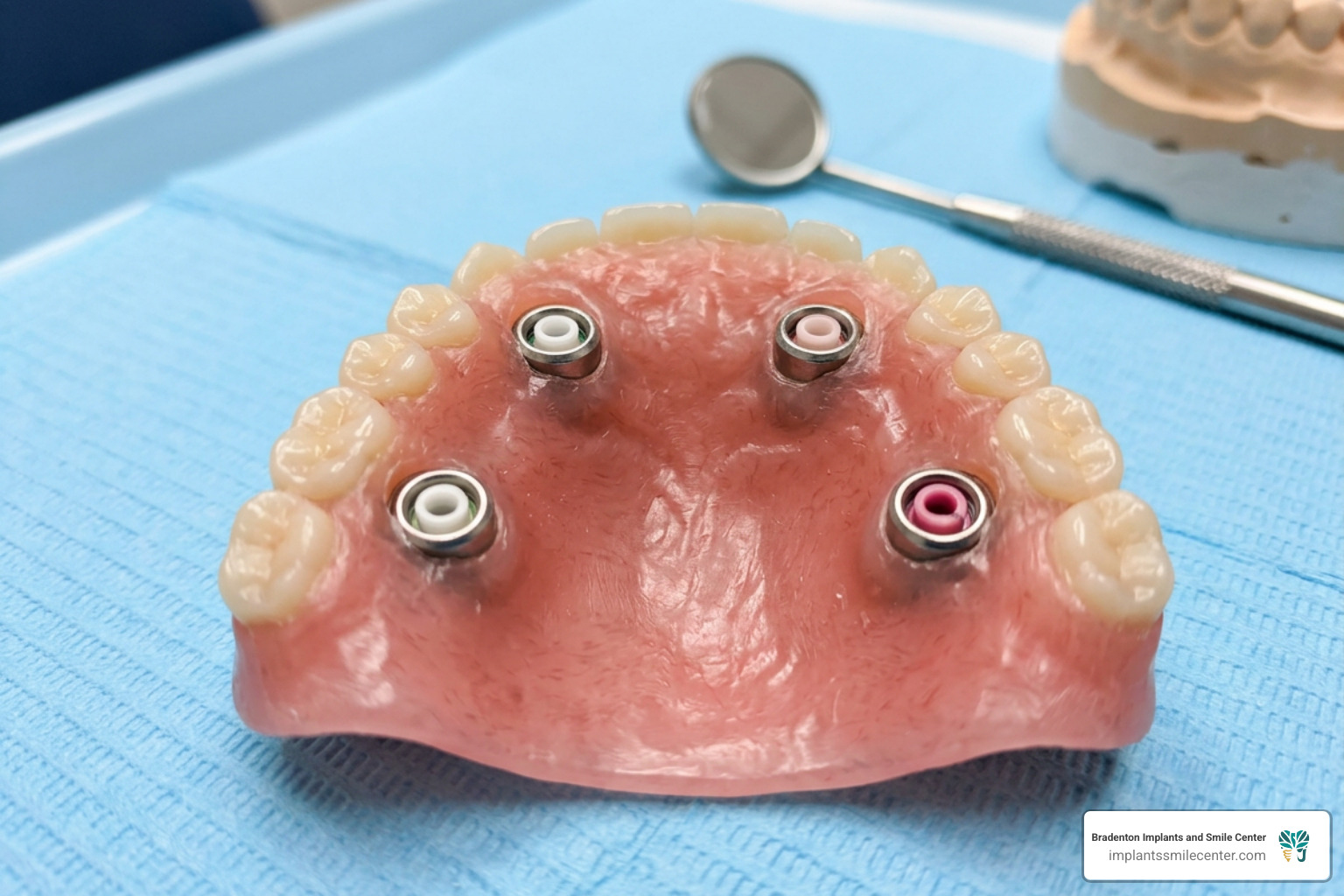
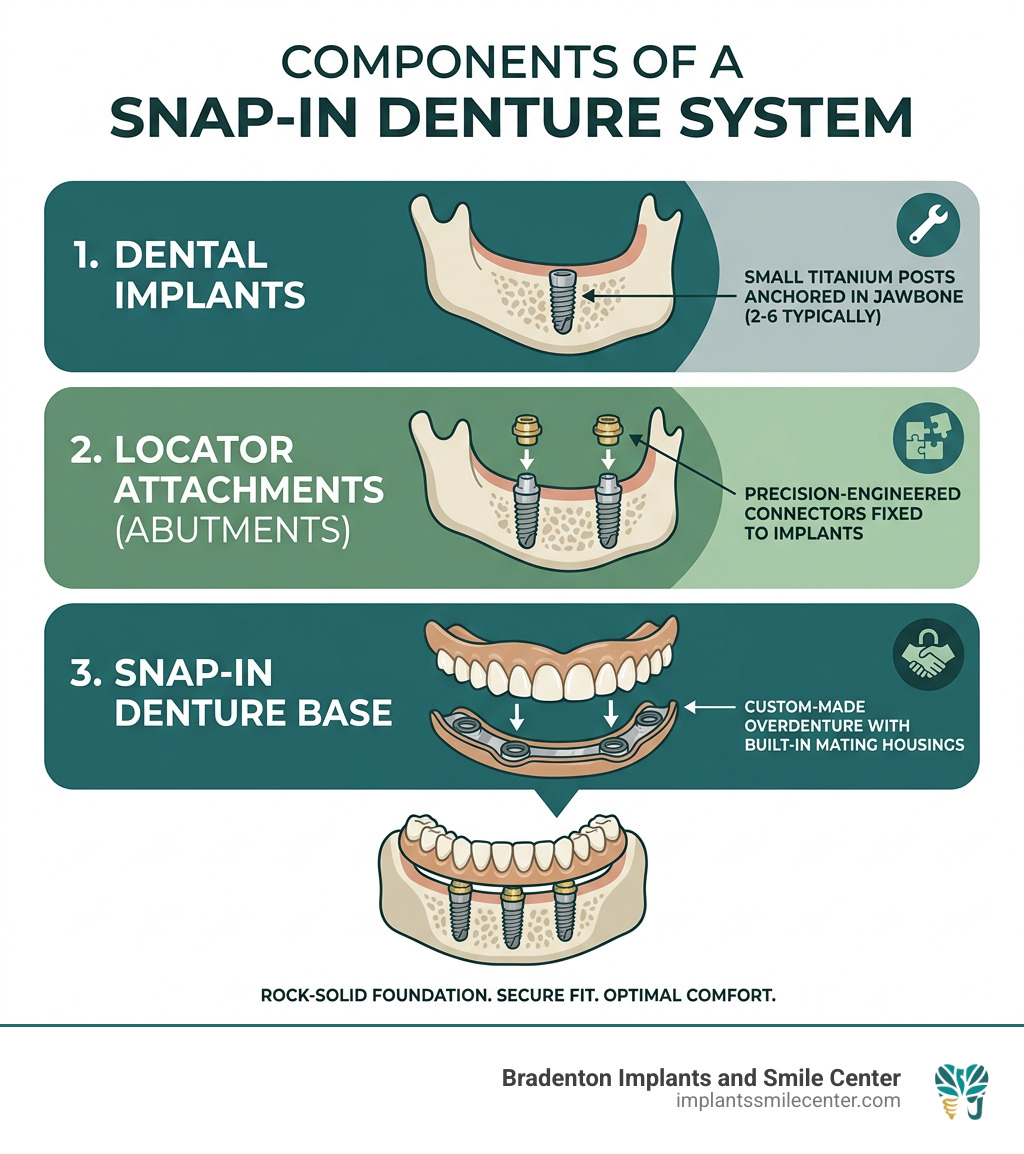
The system relies on small titanium posts that we surgically place into your jawbone. These posts act as artificial tooth roots. Through a natural process called osseointegration, your bone actually grows around these posts, locking them into place forever. Once these implants are stable, we attach specialized "locators" or connectors to them. The denture itself has matching sockets that click onto these connectors. It’s very similar to the snap on a jacket—once it’s clicked in, it isn’t going anywhere until you decide to pull it off.
How snap on dentures differ from traditional dentures
If you’ve ever worn traditional dentures, you know the "suction" struggle. Traditional dentures sit on top of the gums and rely on a thin seal of saliva or messy adhesives to stay put. This often leads to clicking sounds when you talk or the embarrassing fear that your teeth might slip while you're laughing at a dinner party.
According to the American Dental Association research on denture types, there are three main categories: immediate, conventional, and overdentures (which includes snap-ons). Snap-on dentures offer several key upgrades over the conventional variety:
Mechanical Attachment: Instead of suction, they use physical anchors.
Reduced Palate Coverage: For the upper arch, traditional dentures must cover the entire roof of your mouth to create suction. Snap-on versions can often be designed in a "horseshoe" shape, leaving your palate open so you can actually taste your food and feel its temperature.
Stability: Because they are anchored to the bone, they don't shift or rub against the gums, which significantly reduces the risk of painful mouth sores.
Understanding the attachment systems for what are snap on dentures
Not all "snaps" are created equal. Depending on your specific jaw anatomy and budget, we might use one of several attachment systems:
Locator Attachments: The industry standard. These are low-profile "buttons" that sit on the implants. They use replaceable nylon inserts inside the denture to provide different levels of "hold."
Ball-and-Socket: An older but effective method where a ball-shaped abutment on the implant fits into a socket with an O-ring inside the denture.
Bar-Retained Systems: A thin metal bar follows the curve of your jaw and connects all the implants. The denture then clips onto this bar. This provides extreme stability but requires a bit more space in the mouth.
Benefits and Drawbacks of Implant-Supported Overdentures
When considering what are snap on dentures, it is important to weigh the life-changing benefits against the practical realities of the procedure.
The Advantages
The biggest "win" for our patients is the restoration of function. While traditional dentures only provide about 10-20% of your original chewing power, snap-in dentures restore about 60-70% of natural chewing ability. This means steak, apples, and corn on the cob are back on the menu!
Furthermore, the Foundation for Oral Rehabilitation highlights that implant-supported dentures are superior for bone preservation. When you lose teeth, your jawbone naturally begins to shrink (resorption) because it no longer has roots to stimulate it. Implants provide that stimulation, helping to maintain your facial structure and preventing that "sunken" look often associated with long-term denture wear.
The Drawbacks
Nothing is perfect, and we believe in being 100% transparent. The primary drawbacks include:
Surgical Requirement: You do have to undergo a minor surgery to place the implants.
Upfront Cost: They are more expensive than basic dentures.
Maintenance: The nylon inserts and O-rings do wear out and need to be replaced every 12 to 24 months.
Comparison Metric Traditional Dentures Snap-On Dentures Stability Low (slips often) High (snaps in place) Chewing Power 10-20% 60-70% Palate Coverage Full (blocks taste) Partial/Open (better taste) Bone Health Bone continues to shrink Prevents bone loss Initial Cost $1,500 - $4,000 $6,000 - $15,000+
The Step-by-Step Procedure and Recovery Timeline
Getting snap-on dentures isn't an overnight process—it’s a journey toward a better smile. At Bradenton Implants and Smile Center, we use a meticulous approach to ensure your results are both beautiful and functional.
Phase 1: Consultation and Planning
Everything starts with a 3D CT scan. This allows us to see your bone density and nerve locations in high definition. We’ll discuss your goals and determine if you need any preliminary work, such as full mouth reconstruction or extractions.
Phase 2: Implant Placement Surgery
During this visit, we surgically place the titanium posts into your jaw. We offer various sedation options to make sure you are completely comfortable. The surgery for a full arch usually takes less than 90 minutes.
Phase 3: Osseointegration (The Waiting Game)
This is the most critical phase. According to the American Academy of Periodontology, it typically takes 2 to 6 months for the implants to fully fuse with your bone. During this time, you’ll wear a temporary denture so you’re never without teeth.
Phase 4: Attachment and Final Fitting
Once the implants are "rock solid," we attach the locators and take final impressions. Our lab then crafts your custom denture. At the final appointment, we snap them in, check your bite, and teach you how to remove and clean them.
Recovery Tip: Most patients return to normal activities within 2 to 3 days after the initial surgery. While there might be some minor swelling or bruising, it is usually managed easily with over-the-counter pain relief.
Cost, Maintenance, and Longevity Expectations
We know that budget is a major factor when researching what are snap on dentures. Because every mouth is different, the price can vary based on how many implants you need and if you require bone grafting.
Price Breakdown
In the United States, the cost for a snap-on denture typically ranges from $6,000 to $12,000 per arch (lower jaw) and can go up to $20,000 for the upper arch if more implants are required. While the upfront cost is higher, many patients find them more cost-effective over a 10-year period because they don't require the constant relines and expensive adhesives that traditional dentures do.
Regarding insurance, many plans will cover the "denture" portion of the treatment but may not cover the "implant" portion. Our team at Bradenton Implants & Smile Center is expert at navigating insurance and offering financing options—in fact, 99% of patients who apply for third-party financing are approved! You can find more details on our Snap-on Dentures service page.
Daily Care and Maintenance
To keep your smile fresh and your implants healthy, follow this routine:
Nightly Removal: Always take your dentures out at night to give your gums a rest.
Cleaning: Use a non-abrasive denture cleaner and antibacterial soap. Never use toothpaste on the denture itself, as it can create microscopic scratches that harbor bacteria.
Brush the Posts: Use a soft-bristled toothbrush to clean around the titanium posts in your mouth. This prevents "peri-implantitis," a form of gum disease that can cause implant failure.
Regular Checkups: Visit us every six months so we can inspect the attachments. The nylon inserts (the "snaps") usually need to be replaced every year or two to keep the fit tight.
How long do they last?
The titanium implants themselves are designed to last a lifetime, with a success rate of over 95% after five years. The acrylic denture teeth and base typically last between 5 and 10 years before they show enough wear and tear to require replacement.
Frequently Asked Questions about what are snap on dentures
How many implants are typically needed for what are snap on dentures?
For a lower arch, we usually recommend 2 to 4 implants. Because the lower jawbone is very dense, two implants are often enough to provide a dramatic improvement in stability. For the upper arch, we typically use 4 to 6 implants. The upper jawbone is softer, and the denture has to fight gravity, so more anchors are needed for a secure hold.
Can snap-in dentures be done in one day?
In some cases, yes! This is often referred to as "teeth in a day." While the final, permanent denture usually comes after the healing period, we can often place the implants and a temporary "healing" denture in a single appointment. This ensures you leave our office with a functional smile.
Who is a good candidate for this procedure?
The best candidates are non-smokers with good overall health and sufficient bone volume. If you have significant bone loss, don't worry—we can often perform a bone graft to "rebuild" the area so it can support an implant. According to the European Federation of Periodontology, regular checkups are vital for all implant candidates to monitor the health of the surrounding tissue.
Conclusion
At Bradenton Implants & Smile Center, we believe that everyone deserves a smile that stays in place. Understanding what are snap on dentures is the first step toward regaining your confidence, your ability to eat your favorite foods, and your zest for life. Whether you are tired of messy adhesives or are facing total tooth loss for the first time, our team is here to provide personalized, compassionate care using the latest dental technology.
If you’re ready to stop worrying about your teeth and start smiling again, we invite you to Schedule a consultation for Snap-on Dentures at our Bradenton, FL office. Let us help you find the perfect balance of stability, comfort, and affordability. Your new smile is just a snap away!