

All About Dental Filling Options and Costs
Why Dental Fillings Matter More Than Most People Realize
Dental fillings are one of the most common restorative treatments in dentistry — and for good reason.
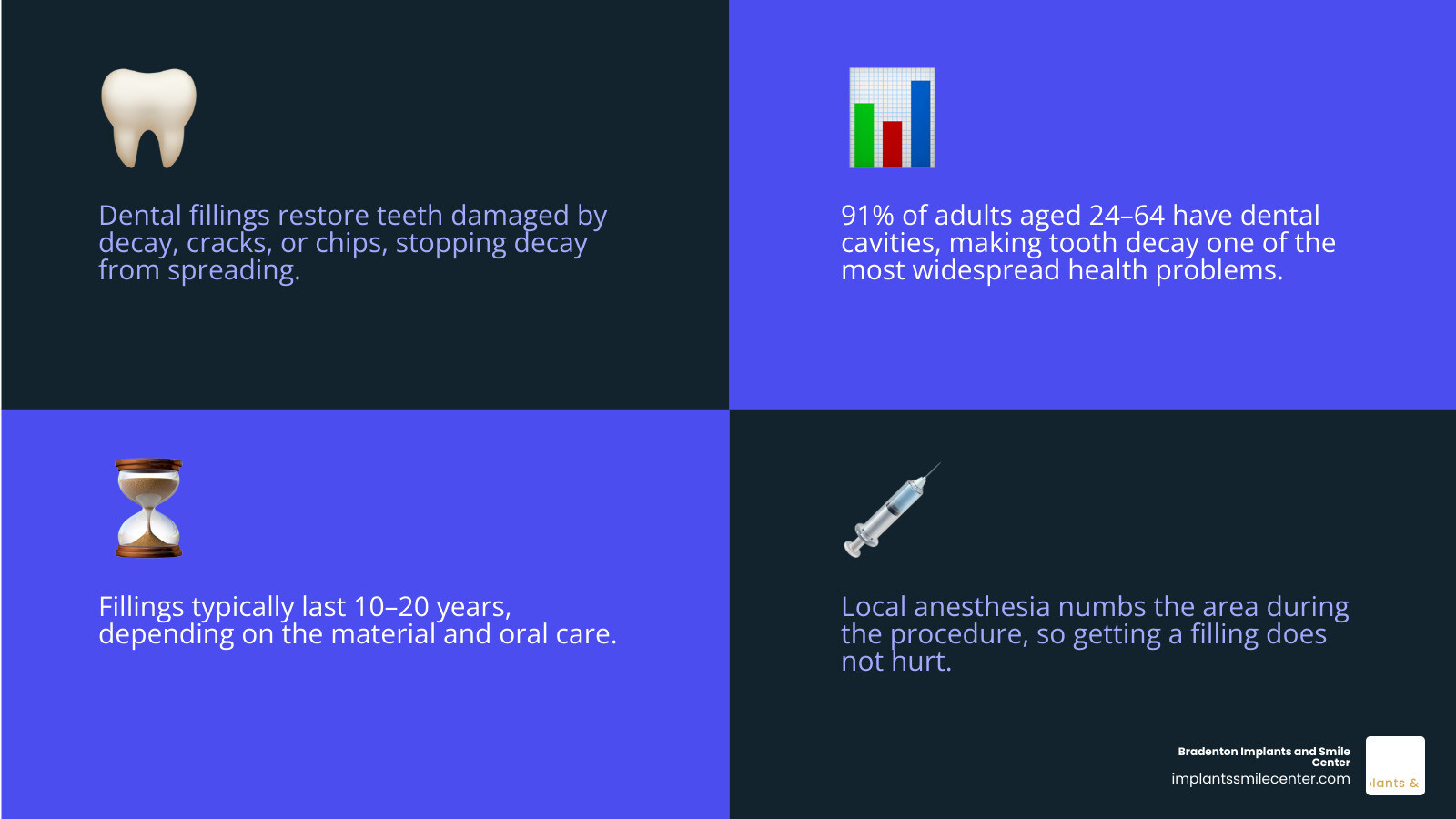
Quick facts about dental fillings:
What they are: A restorative material used to repair teeth damaged by decay, cracks, or chips
Why you need one: To stop decay from spreading and restore normal tooth function
Common materials: Composite resin (tooth-colored), amalgam (silver), gold, ceramic, and glass ionomer
How long they last: Typically 10–20 years, depending on the material and care
Does it hurt? No — local anesthesia is used to numb the area during the procedure
Who needs one: Anyone with a cavity, cracked tooth, or worn-down enamel
Tooth decay is one of the most widespread health problems in the world. In fact, according to the Centers for Disease Control and Prevention (CDC), approximately 90% of adults aged 20 to 64 have had at least one cavity. Left untreated, a small cavity can grow into a serious infection — or even tooth loss.
The good news? Catching decay early makes treatment simple, fast, and affordable.
Early-stage decay can sometimes even be reversed — a white spot on a tooth is a sign that minerals have been lost from the enamel, but saliva and fluoride can actually help rebuild it before a cavity fully forms. Once a physical hole develops, though, a filling is needed to restore the tooth.
I'm Dr. John Hegazin, owner of Bradenton Implants and Smile Center, with over 8 years of experience providing dental fillings and restorative care to patients throughout the Bradenton area. In this guide, I'll walk you through everything you need to know — from filling materials and procedure steps to when a filling is no longer enough.
What Are Dental Fillings and Why Are They Needed?
To understand why we use a dental restoration, it helps to understand how tooth decay occurs. Every day, a sticky film of bacteria called plaque forms on our teeth. When we eat or drink sugars and starches, these bacteria feast on the leftovers and produce acids. These acids attack the hard outer surface of our teeth, known as enamel.
According to the Dental Fillings Information | NIDCR, early tooth decay actually starts as a white spot where minerals have been lost. At this early stage, the damage can be stopped or even reversed. Saliva—which naturally contains minerals like calcium and phosphate—works alongside fluoride from toothpaste or professional applications to remineralize the enamel, effectively self-repairing the tooth before a physical cavity can form.
However, if the acid attacks continue and the demineralization process outpaces remineralization, the enamel breaks down completely, creating a permanent hole or cavity. Once a physical cavity forms, it cannot heal itself.
This is where dental fillings come in. To perform a cavity restoration, we carefully remove the decayed, softened tooth structure and fill the empty space with a biocompatible material. This process:
Restores the physical structure and shape of the tooth.
Seals out bacteria to prevent secondary decay from developing inside the tooth.
Restores your ability to chew, bite, and speak without discomfort.
Preserves the overall health and alignment of your surrounding teeth.
Direct vs. Indirect Restorations
When treating a damaged tooth, we categorize restorations into two primary types: direct and indirect. The choice between these two approaches depends largely on the size of the cavity, the location of the tooth, and the extent of the structural damage.
According to the Cleveland Clinic's guide on Dental Fillings: Types, Materials & What They're For, direct and indirect options serve different clinical purposes.
Direct Dental Fillings
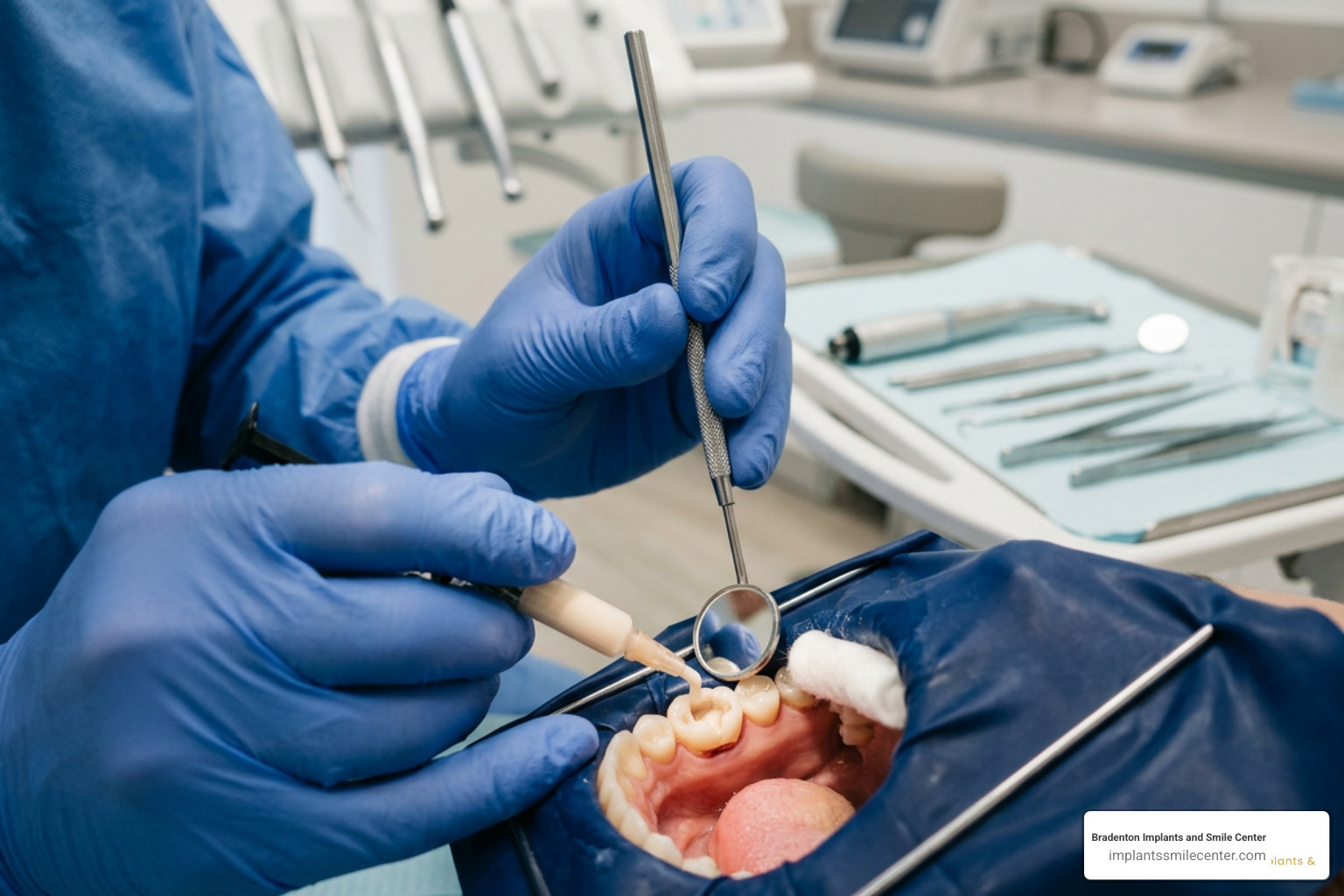
A direct restoration is placed, shaped, and hardened entirely inside your mouth during a single dental appointment. This is the classic "filling" most patients are familiar with.
During our Dental Filling Services at Bradenton Implants & Smile Center, we prepare the tooth by removing the decay, immediately place the soft filling material (such as composite resin, glass ionomer, or dental amalgam) directly into the cavity, and then harden it using a specialized curing light or by allowing it to self-cure. Direct fillings are highly efficient, cost-effective, and ideal for restoring small-to-moderate cavities.
Indirect Dental Fillings
An indirect restoration is fabricated outside of your mouth—either in a specialized dental laboratory or using advanced in-office CAD/CAM milling technology—and then bonded to your tooth. This process typically requires two appointments.
During the first visit, we prepare the tooth, take a highly precise digital or physical impression, and place a temporary restoration. A dental lab then crafts a custom-fit piece that fits your tooth like a tiny, durable puzzle piece. At your second appointment, we cement the permanent restoration in place.
Indirect restorations include:
Inlays: These fit strictly within the grooves (cusps) of your chewing surface.
Onlays: Often called "partial crowns," these cover one or more damaged tooth cusps and are used when a tooth has too much damage for a standard direct filling but not enough to warrant a full dental crown.
Materials Used for Restoring Teeth
Modern dentistry offers several excellent materials to restore teeth. Each material has its own unique set of physical properties, aesthetic qualities, lifespans, and costs.
Material | Primary Uses | Aesthetics | Average Lifespan | Relative Cost | Key Advantage |
|---|---|---|---|---|---|
Composite Resin | Front & back teeth, minor chips | Excellent (matches tooth color) | 5–10 years | Moderate | Natural appearance, bonds directly to enamel |
Dental Amalgam | Back molars, wet environments | Poor (silver/dark metallic) | 10–15 years | Low | Exceptional durability, highly affordable |
Porcelain/Ceramic | Inlays, onlays, crowns | Outstanding (translucent, stain-resistant) | 10–20 years | High | Beautiful aesthetics, highly durable |
Cast Gold | Inlays, onlays, back teeth | Distinctive (gold metallic) | 15–20+ years | Very High | Incredible longevity, will not chip |
Glass Ionomer | Child teeth, below gumline | Fair (opaque tooth-colored) | ~5 years | Low-Moderate | Releases fluoride, bonds to wet surfaces |
Dental Amalgam (Silver Fillings)
Dental amalgam has been used in restorative dentistry for more than 150 years in hundreds of millions of patients worldwide. It is a highly durable, cost-effective mixture of metals consisting of approximately 50% elemental liquid mercury by weight, combined with a powdered alloy of silver, copper, tin, and zinc.
According to the Amalgam | American Dental Association, the unique liquid property of elemental mercury at room temperature is what allows it to bind the alloy particles together into a highly stable, solid, and incredibly strong restoration.
Furthermore, the Dental Amalgam | MouthHealthy - Oral Health Information from the ADA resource notes that amalgam is particularly useful for restoring large cavities in back molars where heavy chewing forces are concentrated, or in hard-to-reach areas below the gumline where moisture control is difficult. Studies show that amalgam restorations typically last 10 to 15 years, outlasting standard composite resins in high-stress clinical scenarios.
Composite Resin and Ceramic Fillings
Composite resin materials are made from a mixture of glass or quartz fillers bound within an organic polymer matrix. These fillings are increasingly preferred by patients because they are entirely tooth-colored and can be meticulously matched to the exact shade of your natural enamel. While standard composite fillings typically last 5 to 10 years, modern material technology continues to improve, significantly closing the durability gap with amalgam.
For patients seeking the absolute best in both aesthetics and long-term durability, porcelain (ceramic) inlays and onlays are the gold standard. These are highly resistant to staining and mimic the natural translucency of tooth enamel beautifully.
While advanced techniques like laser dentistry are growing in popularity, they are not always a magic bullet. For instance, as outlined in our article on Laser Filling of Teeth Disadvantages, dental lasers cannot easily be used to shape or prepare teeth that already have old amalgam fillings, nor can they easily treat decay located deep between adjacent teeth.
Are Amalgam Fillings Safe?
One of the most frequent questions we receive in our Bradenton office is: Are silver fillings safe?
Because dental amalgam is approximately 50% elemental mercury by weight, it naturally releases extremely low levels of mercury vapor (roughly 0.2 to 0.4 micrograms per day per filled tooth surface). This vapor can be inhaled and absorbed by the lungs, leading to low-level bioaccumulation in tissues like the kidneys and brain over time.
However, extensive scientific reviews by major global health organizations—including the FDA, CDC, and World Health Organization (WHO)—have confirmed that these negligible levels of exposure are completely safe for the vast majority of the general population. In fact, allergic reactions to dental amalgam are incredibly rare, occurring in less than 1% of the treated population.

Despite this safety profile, the FDA issued updated safety communications recommending that certain high-risk populations avoid receiving new amalgam fillings whenever possible, opting instead for mercury-free alternatives like composite resins or glass ionomers.
According to the NIDCR's Q&A, Ask the Expert: What Do I Need to Know About Silver Fillings?, these sensitive groups include:
Pregnant women and those planning to become pregnant.
Nursing mothers and their infants.
Children under the age of six (due to their developing neurological systems).
Individuals with pre-existing neurological conditions, such as Multiple Sclerosis, Alzheimer's disease, or Parkinson's disease.
People with impaired kidney function.
Anyone with a known allergy to mercury or other metals in the amalgam alloy.
An Important Note on Amalgam Removal: If you already have silver fillings in your mouth and they are in good, functional condition, the FDA strongly advises against having them removed. The process of drilling out an intact amalgam filling actually releases a temporary spike of mercury vapor and requires us to remove healthy, supportive tooth structure. Unless a silver filling is cracked, decaying underneath, or causing an allergic reaction, leaving it alone is the safest and healthiest choice.
The Dental Filling Procedure: What to Expect
If you need a direct dental filling, there is absolutely no reason to feel anxious. The procedure is highly routine, straightforward, and entirely pain-free. Here is exactly what you can expect during your appointment:
Numbing the Area: First, we apply a highly effective topical numbing gel to your gums, followed by a local anesthetic injection. This completely blocks the pain pathways around the target tooth. You might feel a slight pinch, but within minutes, the entire area will be completely numb.
Isolating the Tooth: We often place a dental dam (a thin rubber sheet) around the tooth. This keeps the tooth completely dry and clean, which is especially critical for composite fillings, as moisture from saliva can interfere with the bonding process.
Removing the Decay: Using a precision dental drill or a specialized dental laser, we carefully remove all decayed, softened, and bacteria-ridden portions of the tooth. We also shape the remaining cavity to ensure the filling material locks securely in place.
Etching and Bonding (for Composite Fillings): If we are placing a tooth-colored composite filling, we apply a mild acidic gel to "etch" the microscopic surface of the enamel and dentin. This creates a rough texture that helps the liquid bonding agent adhere. We then apply the bonding resin and cure it with a specialized blue light.
Placing the Material: We pack the filling material into the prepared cavity in thin layers. For composite resins, we use a specialized curing light (operating at a wavelength of 460–480 nm to excite the photoinitiator camphorquinone) to instantly harden each layer in seconds.
Bite Adjustment and Polishing: Once the cavity is completely filled, we check your bite using a thin piece of carbon paper (articulating paper). If the filling feels "high" when you bite down, we carefully shave down the excess. Finally, we polish the restoration until it is incredibly smooth, matching the natural contours of your tooth.

When a Filling Is Not Enough: Crowns and Root Canals
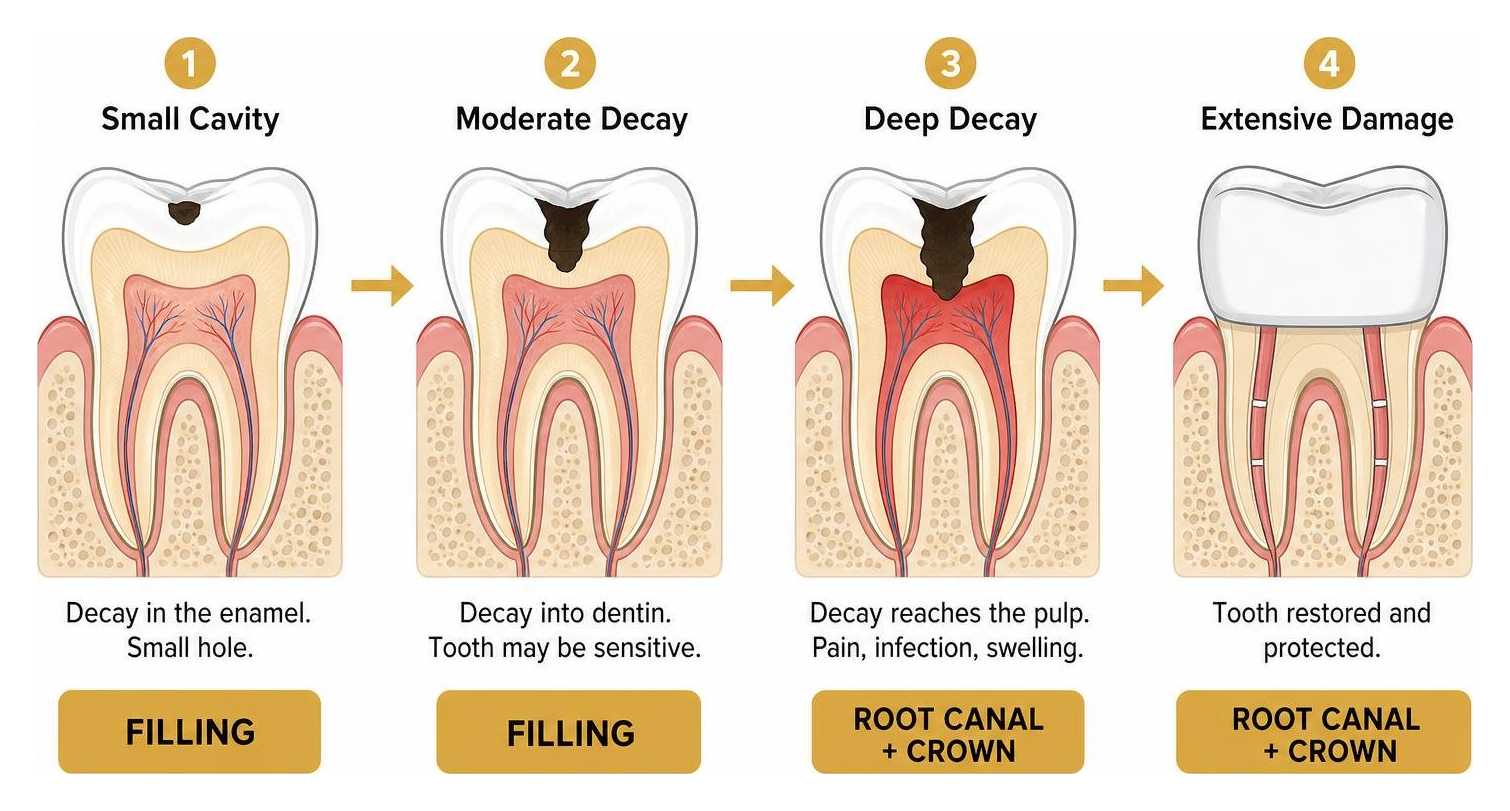
While dental fillings are incredible for treating mild-to-moderate cavities, they do have structural limitations. If a cavity is left untreated for too long, it will eventually destroy so much of the tooth's structure that a simple filling can no longer support the forces of chewing.
In these advanced cases, we must recommend alternative restorative treatments to save the tooth:
Dental Crowns: When more than half of a tooth's natural structure is lost to decay or a fracture, a filling is no longer sufficient. A dental crown acts as a custom-fitted "cap" that completely covers the visible portion of the tooth. This restores its shape, size, and strength while protecting the weakened structure underneath from splitting. Learn more about how we design these restorations on our Dental Crowns service page.
Root Canal Therapy: If decay is allowed to penetrate deep past the enamel and dentin, it will eventually reach the pulp—the soft inner chamber of the tooth containing nerves and blood vessels. When bacteria infect the pulp, it causes intense pain, swelling, and sometimes abscesses. At this stage, a filling cannot save the tooth. We must perform Root Canal Therapy to carefully clear out the infected pulp, sanitize the root canals, seal them with a rubbery material, and then place a protective crown over the tooth to restore its function.
Frequently Asked Questions About Cavity Restorations
How long do cavity restorations last?
Dental fillings are highly durable, but they do not last a lifetime. Over time, the constant pressure of chewing, clenching, or grinding will cause fillings to wear down, chip, or pull away from the tooth structure.
On average, dental amalgam fillings typically last 10 to 15 years, while standard composite resin fillings generally last 5 to 10 years. However, with meticulous oral hygiene, a balanced diet low in sugars, and regular dental cleanings, many of our patients' composite fillings can last well over 10 years.
Does getting a cavity restoration hurt?
No, the procedure itself should be completely painless. We utilize highly effective local anesthetics to completely numb the tooth and surrounding tissues before we begin.
After the anesthetic wears off, it is entirely normal to experience some mild, temporary sensitivity to hot or cold temperatures or slight gum soreness for a few days. This can easily be managed with over-the-counter pain relievers like ibuprofen. If you experience severe pain or a high bite when chewing, simply call us so we can make a quick, painless adjustment to your filling.
What are the signs that a restoration needs to be replaced?
Because decay can silently reoccur underneath an old, failing restoration, it is vital to know the warning signs that a filling needs to be replaced:
Sharp pain or throbbing: A persistent ache often indicates that decay has reached the nerve.
Sensitivity: New or worsening sensitivity to hot, cold, or sweet foods.
Visible cracks or chips: Physical damage to the filling material itself.
A "rough" feeling: Feeling a sharp edge with your tongue or noticing that dental floss catches or shreds when cleaning between those teeth.
Dark margins: Dark lines or discoloration forming around the edges of a tooth-colored filling, which indicates that the seal has broken and bacteria are leaking underneath.
Conclusion
Keeping your smile healthy, functional, and beautiful is our absolute priority. Whether you suspect you have a new cavity or need to have an old, worn-out filling evaluated, our compassionate team at Bradenton Implants & Smile Center is here to help.
We utilize state-of-the-art diagnostic technology and gentle techniques to provide top-tier General Dentistry in Bradenton, FL. By addressing dental issues early with conservative Dental Filling Services, we can help you avoid complex, costly treatments down the road and preserve your natural smile for life.
If you are in the Bradenton, FL area and are ready to experience personalized, high-quality dental care, contact us today to schedule your comprehensive exam!