
Full Mouth Dental Implants: A Comprehensive Guide
When Tooth Loss Takes Over Your Life, Full Mouth Dental Implants Can Give It Back
Dental implants for entire mouth replacement are titanium posts surgically placed into the jawbone that support a full arch — or two — of permanent, natural-looking teeth.
Here is a quick summary of what you need to know:
Question Quick Answer What are they? Titanium implants that anchor a full set of replacement teeth to your jawbone Main types All-on-4, All-on-X, snap-in dentures, implant-supported bridges Cost range (2026) ~$12,500–$70,000+ depending on treatment type and both arches Same-day teeth? Yes — many patients leave surgery with temporary teeth the same day How long do they last? 25 years or more with proper care; up to 98% success rate Covered by insurance? Partially in some cases; financing options widely available
About 3 million Americans already have dental implants, and that number grows by 500,000 every year — and it is easy to understand why. Conventional dentures slip, limit what you can eat, and do nothing to stop the jawbone from shrinking over time. Full mouth implants solve all of those problems at once.
If you have been living with missing teeth, failing crowns, or uncomfortable dentures, this guide walks you through everything — from how the procedure works to what it realistically costs in 2026.
I'm Dr. John Hegazin, owner of Bradenton Implants and Smile Center, with over 8 years of experience in implant dentistry including dental implants for entire mouth restoration, Teeth in a Day, and full arch reconstruction. I have helped patients across Bradenton and Sarasota reclaim their smiles using the latest technology and advanced sedation options, and I will walk you through exactly what to expect.
What Are Dental Implants for Entire Mouth and How Do They Work?
To understand how full mouth dental implants work, it helps to think of them as a structural engineering project for your mouth. Instead of replacing every single missing tooth with an individual implant post—which would be incredibly painful, highly impractical, and prohibitively expensive—we use a strategic number of titanium posts (usually four to six per arch) to support a complete, custom-designed bridge of teeth.
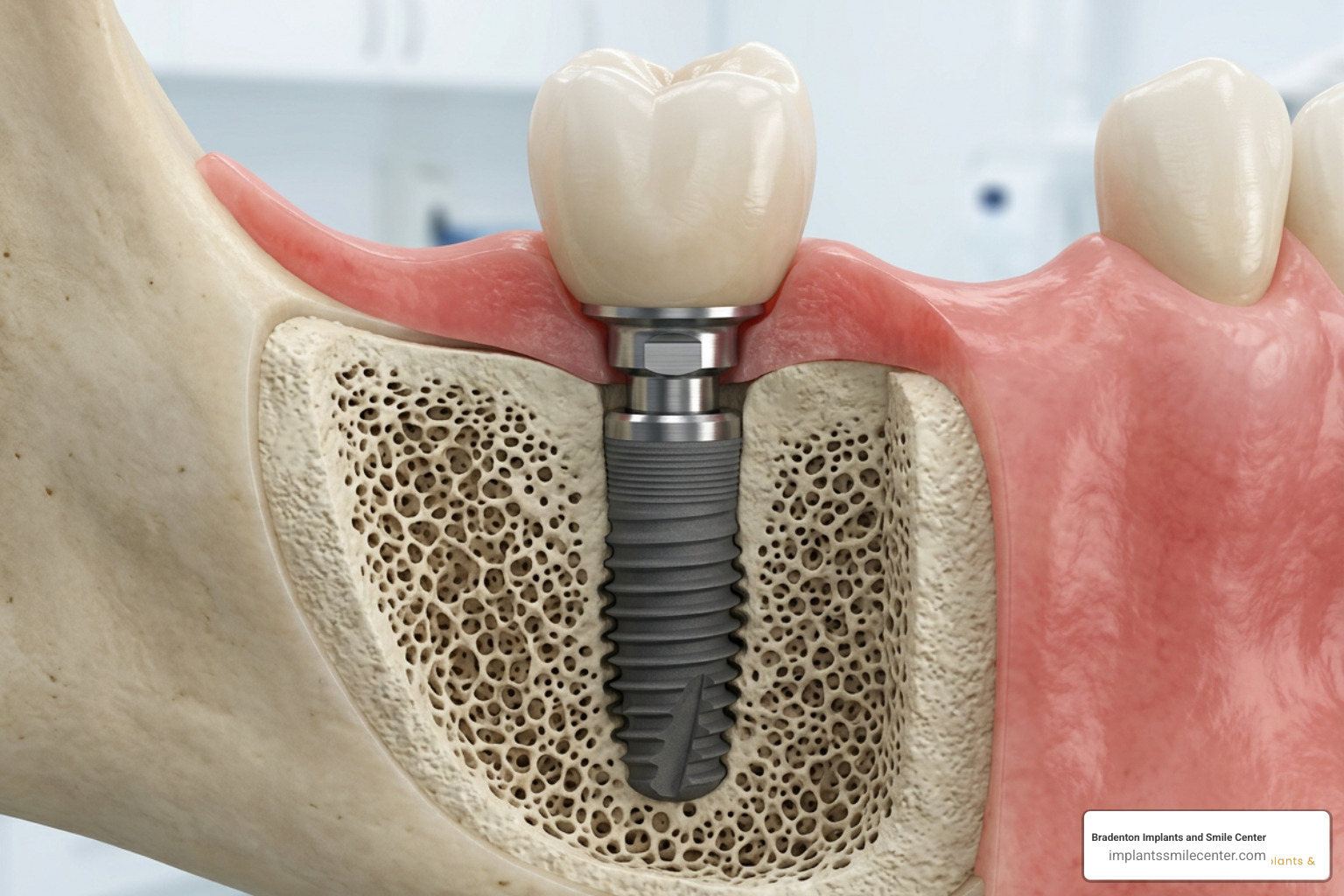
A standard full-mouth dental implant system consists of three fundamental components:
The Implant Post: A small titanium screw surgically embedded directly into your jawbone. This acts as a replacement root. Because titanium is biocompatible, your bone fuses directly to it.
The Abutment: A tiny connector piece that sits on top of the implant post, rising just above the gum line. This serves as the anchor point for your new teeth.
The Prosthetic Teeth: A custom-crafted, full-arch bridge that looks, feels, and functions exactly like a natural set of teeth.
The secret to the longevity and stability of this system is a biological process called osseointegration. Over a period of three to six months, your jawbone grows around the titanium posts, locking them permanently into place.
Once this fusion occurs, the implants act just like natural tooth roots. They stimulate your jawbone when you chew, sending signals to your body to keep the bone dense and healthy. Traditional dentures cannot do this, which is why denture wearers often experience a sunken facial appearance over time as their jawbone slowly resorbs.
For a deeper look into how this biology works, check out our Full Mouth Dental Implants Complete Guide.
Main Types of Full Mouth Dental Implant Solutions
When exploring dental implants for entire mouth restoration, you will find that there is no "one-size-fits-all" solution. Depending on your budget, bone density, and lifestyle goals, we typically recommend one of three primary configurations:
All-on-4 / All-on-X (Fixed Full-Arch Implants): This is the gold standard for permanent tooth replacement. We place four, five, or six titanium implants at strategic angles to maximize support from your existing bone. A fully customized, non-removable bridge is then screwed tightly onto these implants. You do not take them out at night; you simply brush and floss them right in your mouth. You can learn more about this approach on our Full Mouth Implants page.
Implant-Supported Dentures (Snap-In Dentures): This is a semi-removable hybrid option. We place two to four implants per arch, and your custom denture "snaps" securely onto them. While they are far more stable than traditional dentures and will not slip when you talk or eat, you still need to remove them at night for cleaning.
Zirconia Full-Arch Bridges: This refers to the premium material used for the final teeth. Instead of using acrylic (plastic) teeth over a metal frame, the entire bridge is milled from a solid block of zirconia. Zirconia is incredibly strong, highly stain-resistant, and reflects light just like natural tooth enamel, giving you the most aesthetic and durable smile possible.
Advantages of Dental Implants for Entire Mouth vs. Traditional Dentures
If you have ever worn traditional dentures, you already know the struggles: the messy adhesives, the fear of them slipping out during a laugh, and the inability to bite into a crisp apple or a juicy steak.
When you choose dental implants for entire mouth restoration, you are investing in a completely different quality of life. Let's look at how they compare side-by-side:
Feature Traditional Dentures Full Mouth Fixed Implants Snap-In Dentures Bite Force ~10% to 20% of natural strength ~80% to 95% of natural strength ~50% to 60% of natural strength Stability Slips, slides, requires adhesives Completely fixed; will not budge Snaps in tight; removable Bone Preservation None (leads to bone loss) Excellent (prevents bone resorption) Moderate Palate Coverage Covers upper palate (restricts taste) Open-palate design (full taste) Open-palate design Longevity Must be replaced every 5-7 years Can last 25+ years to a lifetime Denture piece replaced every 5-7 years Maintenance Daily removal, soaking, scrubbing Brush and floss like natural teeth Remove nightly to clean
The Cost of Full Mouth Dental Implants in 2026
Let's talk about the elephant in the treatment room: the financial investment. In 2026, the national average cost of full mouth dental implants spans a wide range depending on the specific treatment type, materials used, and your unique oral anatomy.
Snap-In / Implant-Supported Dentures: Typically range from $6,000 to $30,000 for a full mouth (both arches).
Fixed All-on-4 / All-on-X (Acrylic/Titanium): Typically ranges from $25,000 to $32,000 per arch, or $46,000 to $60,000 for a dual-arch restoration.
Premium Fixed All-on-X (Solid Zirconia): Typically ranges from $32,000 to $45,000+ per arch, or $60,000 to $90,000 for a full-mouth restoration.
While these numbers can seem intimidating at first glance, it is important to look at the 15-year lifetime cost. Traditional dentures must be remade every few years as your jawbone shrinks, and they require ongoing costs for adhesives, relines, and special cleaners. Acrylic implant bridges also wear down and often need to be replaced every 5 to 10 years (costing $7,000 to $10,000 per replacement).
By contrast, a premium zirconia bridge is designed to last decades without needing replacement, often making it the most cost-effective solution in the long run. For a comprehensive breakdown of these numbers, take a look at our Cost of Full Mouth Dental Implants Guide 2026 and explore our detailed Dental Implants Full Mouth Price guide.
Key Factors Affecting the Total Cost
When you receive a quote for full mouth reconstruction, the final price tag is influenced by several distinct variables. It is always wise to ask for a line-item breakdown so you know exactly what is included.
Preparatory Treatments: If you have failing teeth that need to be removed, the cost of extractions will add to your total.
Bone Grafting and Sinus Lifts: If you have been missing teeth for a long time, your jawbone may have deteriorated. We may need to perform a bone graft or a sinus lift to build up a solid foundation for the implants.
Number of Implants: An All-on-4 configuration is generally more affordable than an All-on-6 or All-on-8 configuration because it uses fewer implant fixtures.
Prosthetic Materials: Acrylic teeth are the most budget-friendly upfront, while solid zirconia is a premium, highly durable material that adds to the initial cost.
Sedation and Anesthesia: Choosing IV sedation or general anesthesia managed by a dedicated professional ensures a completely pain-free experience but will impact the overall cost.
Geographic Location: Dental fees vary by region. If you are looking for local care in Manatee County, you can read our localized pricing analysis: Average Cost of Dental Implants for the Entire Mouth Near 34203.
Insurance, Financing, and Affordable Options
Because dental implants are often classified as "cosmetic" or "major" restorations by insurance companies, standard dental insurance policies rarely cover the entire cost. However, many plans will cover a portion of the preparatory work (like extractions or 3D imaging) or pay a flat lifetime maximum (usually between $1,000 and $2,500).
Medicare and Medicaid generally do not cover dental implants unless there is a specific, medically necessary reconstructive requirement following an accident or oral cancer treatment.
To make this life-changing care accessible, we offer several flexible pathways:
Third-Party Financing: We partner with reputable healthcare lenders like CareCredit, which offer low-interest and interest-free payment plans. This allows you to break the total cost down into manageable monthly payments.
HSA and FSA Funds: You can use your Health Savings Account or Flexible Spending Account pre-tax dollars to pay for your implant surgery.
In-House Payment Options: We work closely with our patients to structure payment phases that align with their treatment timeline.
To find out how we keep treatments within reach, explore our guides on Cheap Full Mouth Dental Implants and the Ultimate Affordable Full Mouth Dental Implants Guide.
The Treatment Process, Recovery, and Longevity
Getting a brand-new smile is a journey, but with modern computer-guided technology, it is smoother and more predictable than ever before.
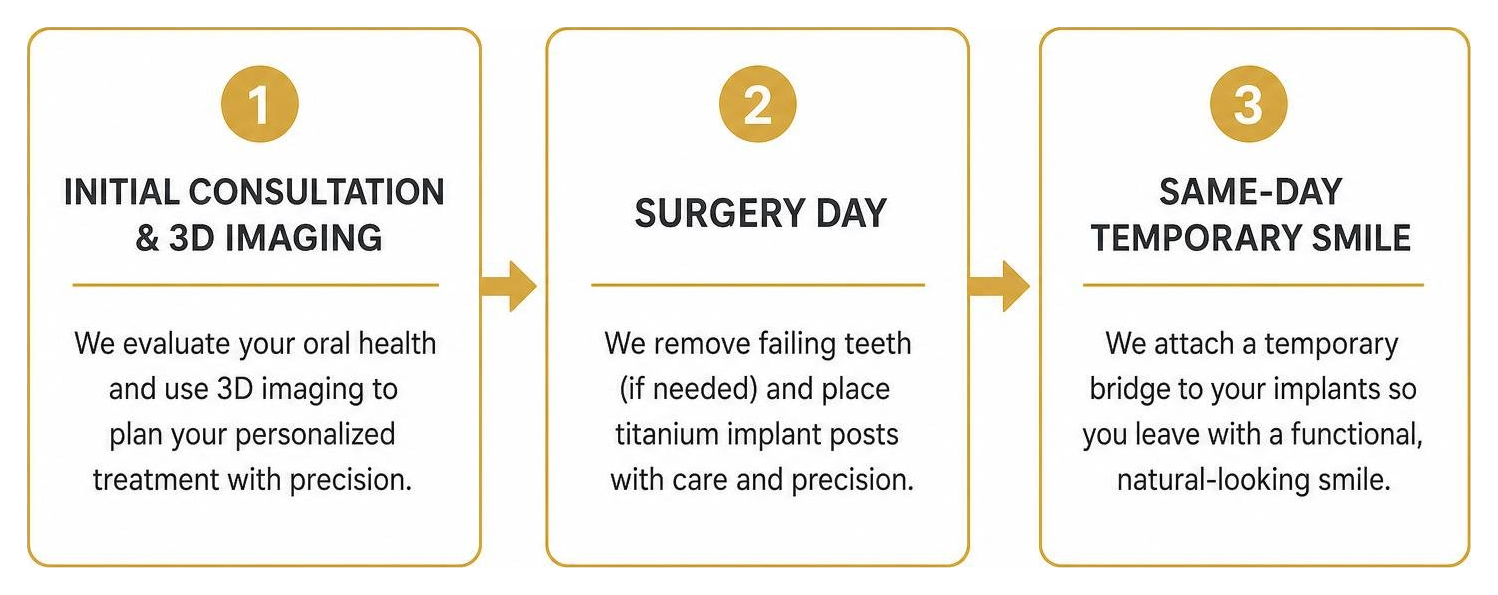
Here is exactly what you can expect when you partner with us:
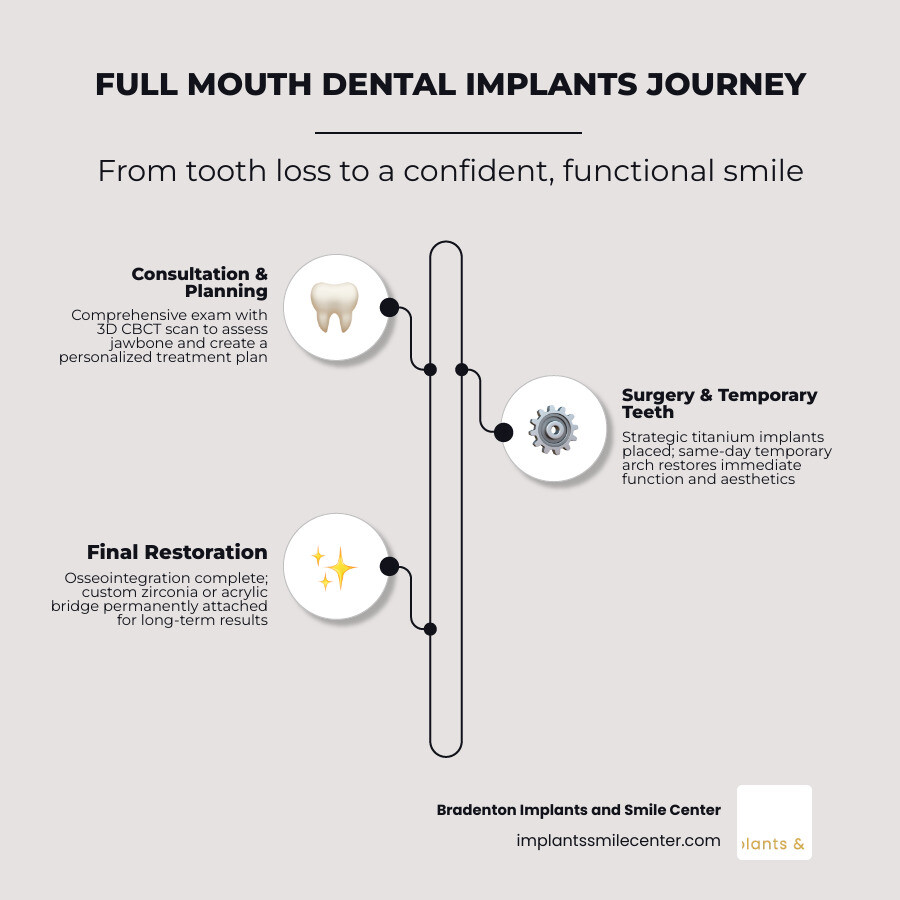
The Initial Consultation & 3D Imaging: We begin with an in-depth exam and a 3D CBCT scan. This advanced imaging allows us to see your jawbone structure, nerve pathways, and sinus cavities in high-definition 3D. Using this data, we plan your exact surgery virtually before we ever touch a dental instrument.
Surgery Day: On the day of your procedure, we make sure you are completely comfortable under your chosen level of sedation. We gently extract any remaining failing teeth, clean out any active infections, and place your titanium implant posts.
Your Same-Day Temporary Smile: In most cases, we attach a beautiful, lightweight temporary bridge (provisional arch) to your implants on the very same day. You walk out of our office with a functional, complete set of teeth—no running around toothless!
The Healing Phase (Osseointegration): Over the next three to six months, your implants will quietly fuse with your bone. During this time, you will eat a soft-food diet to avoid putting too much pressure on the healing implants.
The Final Restoration: Once healing is complete, we take highly accurate digital impressions of your mouth. We then craft your final, permanent bridge (typically out of solid zirconia) and securely screw it into place.
Candidacy and Myths About Dental Implants for Entire Mouth
Many patients come to us believing they cannot get dental implants. Let's bust some of the most common myths surrounding candidacy:
Myth 1: "I'm too old for dental implants."
The Reality: Age is rarely a barrier. As long as you are in relatively good health and can undergo a routine dental extraction, you can safely receive implants. We have successfully restored smiles for patients in their 80s and 90s!
Myth 2: "I don't have enough bone density."
The Reality: While sufficient bone is necessary, advanced techniques like angling the rear implants (All-on-4) allow us to utilize your existing bone without needing extensive bone grafts. Even if you do have severe bone loss, modern bone grafting and sinus lifts can rebuild the foundation beautifully.
Myth 3: "My diabetes means I can't get them."
The Reality: If your diabetes is well-controlled, your success rate is virtually identical to a non-diabetic patient. We simply coordinate with your primary care physician to ensure safe healing.
The primary requirements for candidacy are healthy gum tissues, a commitment to good daily oral hygiene, and being free of untreated periodontal disease.
Recovery Timeline, Aftercare, and Long-Term Maintenance
Recovering from full mouth implant surgery is surprisingly manageable. Most patients report that the discomfort is far less than they anticipated, often comparing it to a simple tooth extraction.
During the first 7 to 10 days, you may experience some mild swelling, bruising, and minor soreness, which can be easily managed with over-the-counter pain relievers or prescribed medications.
To protect your investment and ensure your implants last 25 years or more, we recommend following these post-operative care steps:
Follow a Soft-Food Diet: Stick to soft, nutrient-dense foods (like smoothies, scrambled eggs, yogurt, and mashed potatoes) for the first 8 to 12 weeks while osseointegration takes place.
Ditch the Tobacco: Smoking significantly reduces blood flow to your gums and bone, which can double the risk of implant failure. We strongly advise pausing or quitting smoking during your healing journey.
Keep It Clean: Once your gums heal, brush your new teeth twice a day with a soft-bristled toothbrush.
Use a Water Flosser: A water flosser (like a Waterpik) is your best friend. It gently flushes out food particles and plaque from beneath your implant bridge where traditional floss cannot reach.
Visit Us Regularly: Come in for routine checkups and professional cleanings every six months so we can monitor your bone health and keep your smile in pristine condition.
Frequently Asked Questions About Full Mouth Restoration
Deciding to restore your entire mouth is a major decision, and it is completely normal to have questions. Here are the answers to the questions we hear most often at Bradenton Implants & Smile Center.
Can I get teeth the same day as my surgery?
Yes! Through a process called immediate loading, we are usually able to attach a provisional (temporary) bridge to your implants on the exact same day as your surgery. This means you will never have to go home without teeth, and you can smile, speak, and eat soft foods with confidence while your implants heal.
What are the risks and complications of full mouth implants?
While full mouth dental implants boast an incredible success rate of up to 98%, they are still a surgical procedure, which means minor risks do exist. These can include:
Infection: Known as peri-implantitis, this is an infection of the gums surrounding the implant, usually caused by poor oral hygiene or smoking.
Implant Failure: In rare cases (less than 2%), the bone fails to fuse properly with the titanium post. If this happens, we can usually remove the implant, let the area heal, and place a new one.
Nerve Sensitivity: Highly uncommon when using advanced 3D CBCT surgical guides, but minor nerve irritation can cause temporary numbness in the lip or chin.
Which material is better for final teeth: zirconia or acrylic?
Hands down, solid zirconia is the premier choice for your final teeth. While acrylic (plastic) teeth fused to a titanium bar are lighter and more budget-friendly upfront, they are prone to chipping, wearing down, and staining over time.
Zirconia is virtually indestructible, highly resistant to chipping, completely non-porous (meaning it will never absorb odors or stain), and offers an incredibly lifelike, translucent appearance. For the ultimate peace of mind and long-term durability, zirconia is always our professional recommendation.
Conclusion
Investing in dental implants for entire mouth replacement is about so much more than just aesthetics. It is about reclaiming your health, your self-esteem, and the simple joy of sharing a meal with the people you love.
When choosing a provider for this life-altering procedure, you deserve a team that combines advanced technical expertise with genuine, compassionate care. At Bradenton Implants & Smile Center, we utilize state-of-the-art 3D imaging, computer-guided surgery, and comfortable sedation options to deliver world-class dental restorations.
Whether you are ready to take the next step or simply want a second opinion on an existing treatment plan, we invite you to reach out.
Ready to start your journey toward a permanent, beautiful smile? Visit our Full Mouth Dental Implants Service page to schedule your personalized consultation with our warm and experienced team today!