
How to Get Dental Work Done Now and Pay Later
Why So Many Patients Are Searching for Dentists That Do Payment Plans
Dentists that do payment plans are more common than you might think — and finding one could be the difference between getting the care you need now or putting it off until a small problem becomes a big one.
Here's a quick answer to what most people want to know:
How do dental payment plans work?
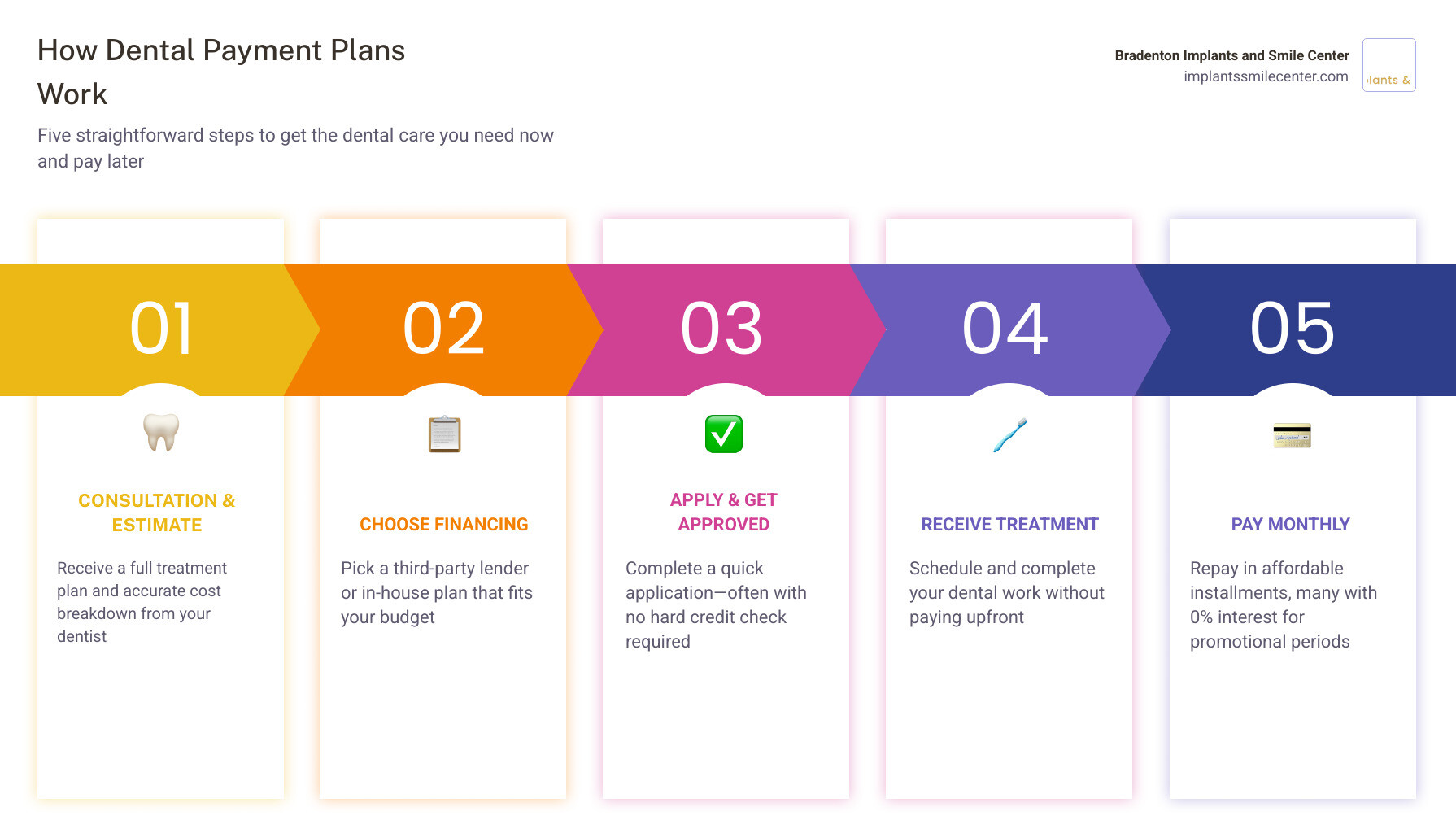
Most dentists partner with third-party lenders like CareCredit, Cherry, Sunbit, or Proceed Finance
You apply (often with no hard credit check), get approved, and pay for treatment in monthly installments
Many plans offer 0% APR for a promotional period (typically 6–24 months)
Some offices also offer in-house payment plans directly through the practice
You do not need dental insurance to qualify
Many patients qualify for $0-down options
Dental care is expensive. A single crown can cost up to $1,399. A single complete dental implant typically costs between $3,000 and $6,000, while complex multi-tooth restorations can run over $12,000. For most patients — especially those between 45 and 70 managing tooth loss or restorative needs — paying that kind of money upfront simply isn't realistic.
The good news? Flexible financing has made it easier than ever to say yes to treatment without draining your savings.
I'm Dr. John Hegazin, owner of Bradenton Implants and Smile Center, with over 8 years of experience helping patients access the restorative care they need through flexible, patient-friendly financing. I've worked with countless patients searching for dentists that do payment plans who were surprised to discover how straightforward and accessible their options really were.
Understanding Dental Financing and Payment Plan Options
When you begin looking into how to manage the cost of your oral health care, it helps to understand that you are not limited to a single payment method. Dental financing is designed to act as a bridge between the treatment you need today and your monthly household budget.

Many patients are surprised to learn that dental loans operate much like traditional personal loans but are specifically tailored for healthcare expenses. When you apply for a dental loan or a specialized healthcare credit line, the lender evaluates your application using a soft credit check for prequalification. This means you can explore your monthly payment options and see what interest rates or repayment terms you qualify for without hurting your credit score.
Once approved, these plans generally offer fixed monthly payments over a set repayment term, which can range from a brief 3-month promotional window to an extended 96-month period for major restorative procedures. The Annual Percentage Rate (APR) on these plans varies widely depending on your credit profile and the specific financing partner. Some plans offer 0% interest promotional periods, while others feature interest-bearing terms with APRs starting around 5.99% and going upward based on credit risk. Before signing, it is important to read the full financing agreement carefully, especially for deferred-interest offers. The Consumer Financial Protection Bureau explains medical credit cards and healthcare payment plans and recommends reviewing financial assistance, insurance coverage, interest terms, and payment obligations before agreeing to a plan.
For those exploring public assistance or alternative funding routes, looking into Government Loans for Dental Work can provide additional clarity on state and federal programs designed to help low-income families, seniors, and veterans secure necessary treatments.
Third-Party Financing Providers
To make care accessible, modern dental practices partner with specialized third-party financing companies. These companies handle the application, approval, and billing processes, allowing the clinical team to focus entirely on your dental care.
Some of the most common providers you will encounter include:
CareCredit: Operating as a dedicated health and wellness credit card, CareCredit is accepted at over 260,000 healthcare locations nationwide. CareCredit explains that promotional financing may be available for qualifying purchases through participating providers, including healthcare and dental offices.
Cherry: Designed as a modern "buy now, pay later" (BNPL) service for health and wellness, Cherry allows patients to secure approvals up to $10,000. The application takes under a minute, and patients can choose between 0% APR options and low-interest monthly plans. Cherry is highly favored for its seamless digital interface and quick prequalification.
Sunbit: Sunbit is widely recognized for its high approval rate. According to Sunbit's dental financing information for practices, applying does not require a hard credit check and financing can be used across dental specialties, including implants, clear aligners, cosmetic dentistry, periodontal care, and emergency treatment.
Proceed Finance: For major, life-changing dental restorations like full-mouth dental implants, Proceed Finance is a go-to provider. They offer large-ticket financing up to $75,000 with extended repayment terms of up to 96 months. This allows patients to lower their monthly costs to a highly affordable level for major surgeries.
In-House Payment Plans vs. Third-Party Financing
While third-party lenders are incredibly common, some dental practices choose to offer in-house payment plans directly to their patients. Understanding the differences between these two approaches can help you decide which path is right for your financial situation.
Feature In-House Payment Plans Third-Party Financing (CareCredit, Cherry, etc.) Interest Rates Often 0% or low fixed administrative fees Ranges from 0% promotional APR to 29.99%+ based on credit Credit Checks Often no credit check or very lenient in-house reviews Soft credit check for prequalification; hard check upon formal contract Billing Management Managed directly by the dental office administration Managed through the lender's online portal or mobile app Repayment Flexibility Usually shorter terms (3 to 12 months) Highly flexible terms (3 to 96 months depending on the loan size) Max Financing Limit Typically capped at lower amounts for basic treatments High limits (up to $50,000 or $75,000) for major reconstructions
How to Find Dentists That Do Payment Plans
Finding dentists that do payment plans in your local area requires a little bit of research, but it is well worth the effort. The first step is looking for dental offices that actively promote financial transparency on their websites. A high-quality practice will clearly list its accepted insurance plans, payment methods, and third-party financing partners.
When you call a prospective office, don't hesitate to ask direct questions. You can say: "I am planning some dental work and want to know which third-party financing companies you partner with, and if you offer any in-house payment options."
If you live in the Bradenton, FL area, you have access to excellent local resources. At Bradenton Implants and Smile Center, we pride ourselves on helping our patients navigate the financial side of their care with complete transparency. We believe that financial stress should never prevent you from achieving a healthy smile, which is why we work closely with you to find a plan that aligns with your monthly budget.
By choosing a practice that prioritizes clear communication, you can avoid unexpected out-of-pocket costs and focus entirely on your health and recovery.
Finding Dentists That Do Payment Plans for Major Procedures
For extensive dental work, dental payment plans are not just a convenience—they are often an absolute necessity. Major procedures carry significant upfront costs, but they are crucial for your overall health, nutrition, and self-esteem.
Dental Implants: Widely considered the gold standard for tooth replacement, a single complete dental implant typically costs between $3,000 and $6,000, while complex multi-tooth restorations can run over $12,000. Full-mouth restorations like All-on-4 implants typically range from $12,000 to $30,000 per arch. Financing these procedures over 24 to 96 months allows you to replace missing teeth for a reasonable monthly fee. If you are considering this life-changing treatment, reading our detailed Financing Full Mouth Dental Implants Guide will help you understand how to break these large numbers down into manageable steps.
Dentures & Crowns: High-quality dentures and crowns are essential for restoring your ability to chew and speak comfortably. With dental crowns typically ranging between $800 and $1,500, financing makes it simple to get a crown immediately before a cracked tooth requires a root canal (which typically averages $900 to $1,500) or an extraction.
Orthodontics & Clear Aligners: Aligning your teeth prevents uneven wear, jaw pain, and decay. Traditional braces typically range from $3,000 to $7,000, while clear aligners average around $4,000 to $6,000. Third-party partners like Cherry or Sunbit frequently offer interest-free payment options for orthodontic treatments, allowing you to pay for your new smile over the course of your active treatment.
Dentists That Do Payment Plans with No Credit Check
If you have experienced financial hardships, you might worry that a poor credit score or a lack of credit history will disqualify you from receiving dental care. Fortunately, the dental industry has evolved to become highly inclusive.
Many modern third-party lenders utilize proprietary underwriting algorithms that look beyond your traditional FICO score. For instance, providers like Sunbit approve roughly 85% of applicants by focusing on factors like your current income, employment stability, and active banking history rather than just your credit history. They perform a soft credit pull that does not lower your credit rating, making it entirely risk-free to see what you qualify for.
For patients seeking options that completely bypass traditional credit reporting, exploring Dental Loans with No Credit Check can reveal alternative pathways, such as specialized subprime lending programs or in-office membership structures designed to get you into the dentist's chair without a credit barrier.
Dental Savings Plans vs. Traditional Financing
If you do not have traditional dental insurance, or if your current insurance plan has a low annual maximum (which typically caps out at just $1,000 to $2,000 per year), you should consider a dental savings plan (also known as a dental discount plan).
Unlike traditional financing, which is a loan you pay back over time, a dental savings plan is a membership-based program. You pay an affordable annual or monthly fee directly to the practice or a plan administrator, and in exchange, you receive immediate discounts of 20% to 50% on all of your dental treatments.
These plans are highly advantageous because they offer:
No Waiting Periods: You can sign up and save on the exact same day, even for major restorative work.
No Deductibles or Annual Maximums: You never have to worry about running out of benefits or paying a massive out-of-pocket deductible before your coverage kicks in.
Guaranteed Approval: There are no credit checks or health questions to join.
If you are currently uninsured and want to see how we can make your preventive and restorative care immediately affordable, please Contact Bradenton Implants and Smile Center to learn about our current membership options and promotional savings.
Comparing Dental Discount Plans and Insurance
To help you decide which route fits your lifestyle, let's look at how dental discount plans stack up against traditional dental insurance.
Waiting Periods: Traditional dental insurance often imposes a 6-to-12-month waiting period for major work like crowns, bridges, or root canals. Dental savings plans have zero waiting periods.
Preexisting Conditions: If you are already missing a tooth, many traditional insurance policies include a "missing tooth clause" that excludes coverage for replacing it. Dental savings plans do not care about preexisting conditions; you get the discount regardless of when the tooth was lost.
Cosmetic Dentistry: Traditional insurance almost universally excludes cosmetic treatments like teeth whitening or porcelain veneers, viewing them as elective. Many dental savings plans, however, offer members substantial discounts on cosmetic procedures.
Cost Predictability: With insurance, you have to navigate complex copays, deductibles, and pre-authorization forms. With a savings plan, you are given a clear, transparent fee schedule so you know exactly what your discounted cost will be before you sit in the chair.
Frequently Asked Questions About Dental Financing
Navigating the financial side of dental care can feel overwhelming, but getting answers to these common questions can help you make an informed decision.
Do dental payment plans require a down payment?
It depends entirely on the lender and your credit profile. Many patients with good to excellent credit qualify for $0-down options through providers like CareCredit or Cherry. If a down payment is required, it is typically a small percentage of the total treatment cost (such as the first month's payment) and is paid at the time of your appointment using a debit card, credit card, or HSA card.
Can I finance cosmetic dental procedures?
Yes! Because cosmetic procedures like porcelain veneers (which typically range from $1,000 to $2,500 per veneer), professional teeth whitening, and clear aligners are rarely covered by traditional insurance, financing is the most popular way to afford them. Third-party lenders like Cherry and CareCredit happily finance cosmetic dentistry, allowing you to pay for your dream smile in comfortable monthly increments.
What happens if I miss a payment on my dental plan?
If you finance your treatment through a third-party provider, missing a payment can have serious consequences. Lenders like Cherry and CareCredit may report your payment history to major credit bureaus. A missed payment can damage your credit score, incur late fees, and void any 0% APR promotional terms you had, causing interest to accumulate on your remaining balance. If you experience financial difficulty, it is always best to contact the lender immediately to discuss temporary payment modifications before you default. The CFPB's deferred-interest guidance is also a useful resource for understanding how interest may be charged if a promotional balance is not paid in full on time.
Conclusion
Your physical health, confidence, and peace of mind are closely tied to your oral health. Postponing dental treatment due to upfront costs often leads to more severe pain, complex infections, and far more expensive procedures down the road.
At Bradenton Implants & Smile Center, located at 7270 55th Ave E, Bradenton, FL 34203, we are committed to providing personalized, compassionate care utilizing modern dental technology. We believe that high-quality dentistry should be accessible to every adult and senior in our Bradenton community, regardless of their financial starting point.
Whether you are looking to replace missing teeth, restore your ability to chew comfortably, or completely transform your smile, we are here to help you find a flexible payment option that fits your life. To explore your options further, read our guide on Who Are the Top Rated Providers for Dental Implants in Bradenton FL That Offer Flexible Financing Options or visit our Special Offers page to see how we make your first steps toward a healthier smile simple, affordable, and stress-free!