
Full Arch Implants Cost: Breaking Down the Price of a Brand New Smile
What Does Full Arch Implants Cost? (Quick Answer)
full arch implants cost between $15,000 and $60,000+ per arch in the U.S., depending on the treatment type, materials, and your specific needs. Here's a fast snapshot:
Treatment Type Cost Per Arch Both Arches Snap-On Implant Dentures $7,600 – $13,300 $15,000 – $27,000 All-on-4 / All-on-6 (Fixed) $15,000 – $35,000 $30,000 – $70,000 Traditional Full Arch (Zirconia) $30,000 – $60,000+ $60,000 – $100,000+
National average for full mouth dental implants: ~$55,000 (range: $30,000 – $90,000)
If you've been living with missing teeth, broken-down teeth, or ill-fitting dentures, you already know the toll it takes — not just on eating and speaking, but on confidence and daily life. Full arch implants offer a permanent, stable solution. But the wide range of prices online can feel confusing and even a little overwhelming.
One quote says $19,000. Another says $65,000. What's actually in each price — and are you even comparing the same thing?
That's exactly what this guide breaks down. We'll walk you through what drives the cost, what's often left out of low quotes, and how to make a well-informed decision that fits your health goals and budget.
I'm Dr. John Hegazin, owner of Bradenton Implants and Smile Center, with over 8 years of experience placing full mouth dental implants, Teeth in a Day, and snap-on dentures — helping patients understand the real full arch implants cost before they ever sit in the chair. Read on for a clear, honest breakdown of everything that goes into your investment.
What is the Average Full Arch Implants Cost?
When we look at the national landscape, the overall average investment for full mouth dental implants (restoring both the upper and lower jaws) is approximately $55,000, with a typical range between $30,000 and $90,000. If you are only restoring a single arch (just your top teeth or just your bottom teeth), the cost generally ranges from $15,000 to $35,000 for a fixed All-on-4 or All-on-6 system.
Here in Florida, our local pricing closely aligns with these national averages. The average cost for a full mouth restoration in the Sunshine State is about $55,165, which is only a fraction of a percent off the national baseline. However, geographic location is only one piece of the puzzle.
To put these numbers in perspective, replacing an entire mouth of teeth using individual dental implants (where each tooth gets its own screw and crown) is highly inefficient and cost-prohibitive. Since a single restored implant typically costs between $3,000 and $6,000 (with a national average around $4,500), trying to replace 24 to 28 teeth individually would easily exceed $100,000 to $150,000.
This is why modern full-arch systems are such a breakthrough. By strategically placing four to six implants per arch, we can support a complete, custom-crafted bridge of teeth. This drastically reduces both the surgical complexity and your overall financial investment. For a deeper dive into how individual tooth replacements compare to full-arch pricing, check out our More details on dental implants cost and review our comprehensive Cost of Full Mouth Dental Implants Guide 2026.
Comparing Full-Arch Treatment Options and Their Price Tags
Not all full-arch restorations are created equal. The treatment path you choose will dictate your daily comfort, chewing power, and your total out-of-pocket cost.
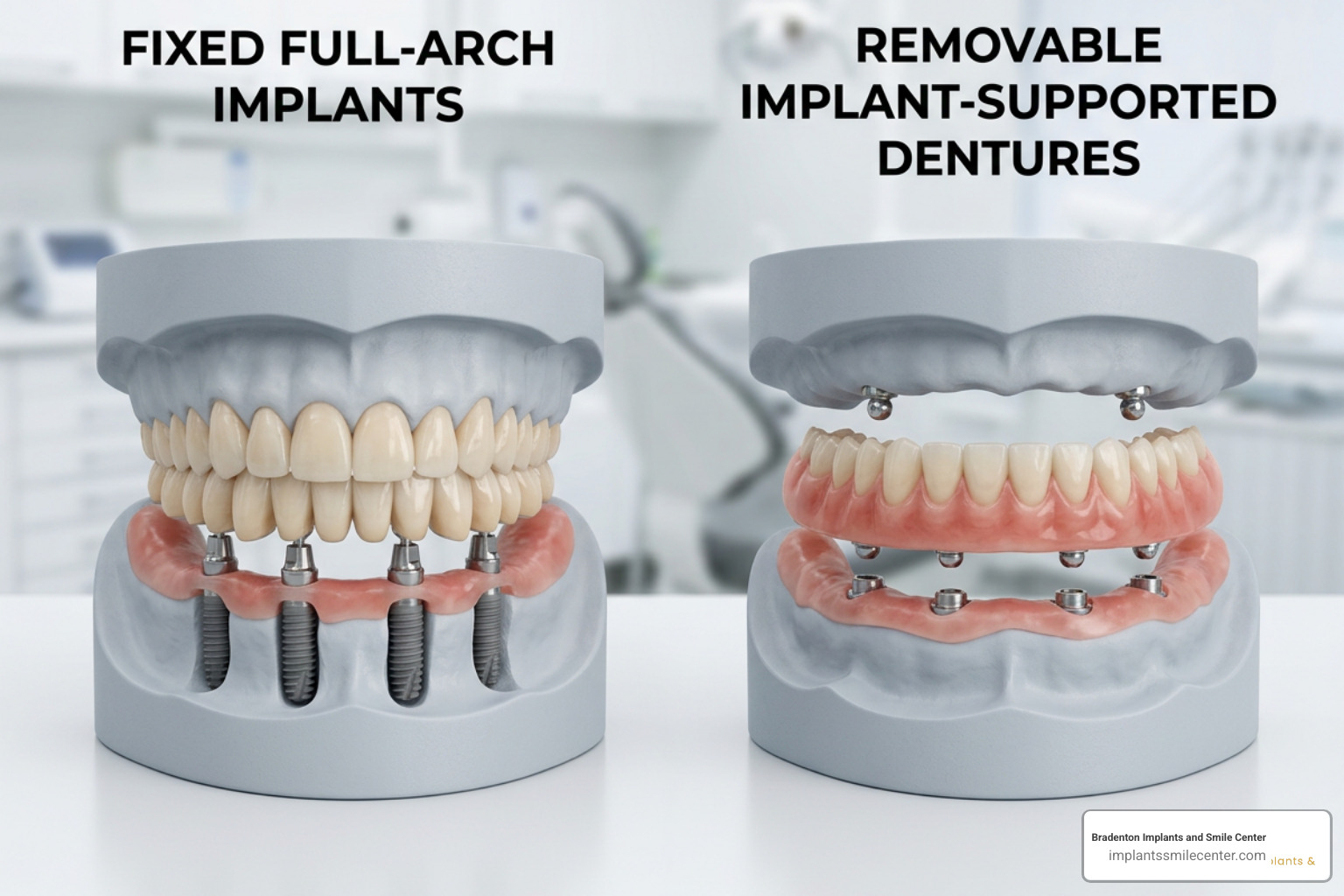
There are three primary categories of full-arch implant restorations:
Fixed Full-Arch Implants (All-on-4 / All-on-X): This is the gold standard for permanent tooth replacement. The prosthetic teeth are screwed directly onto four to six dental implants and can only be removed by a dentist. They look, feel, and function exactly like natural teeth, restoring up to 90% of your original chewing power.
Implant-Supported Snap-On Dentures (Overdentures): This is a semi-removable hybrid option. We place two to four implants per arch, and a custom denture "snaps" onto locator attachments. While you must remove them nightly for cleaning, they are far more stable than traditional floating dentures and do not require messy adhesives.
Individual Implants for Multiple Teeth: In rare cases where a patient has highly localized tooth loss but excellent bone structure, a series of individual implants and multi-unit bridges may be used. However, this is rarely recommended for a completely toothless jaw due to the extreme cost and surgical toll.
To explore which of these pathways aligns best with your lifestyle and budget, take a look at our Ultimate guide to affordable full mouth dental implants.
All-on-4 vs. All-on-6: Balancing Performance and Full Arch Implants Cost
A common question we hear in our Bradenton office is: "Do I need four implants or six?"
The answer depends entirely on your jawbone density and bite force. The All-on-4 technique is highly popular because it places the two rear implants at an angle. This maximizes contact with existing bone and often eliminates the need for expensive bone grafting.
However, if your jawbone is naturally thin or soft (which is common in the upper jaw), or if you have a very strong bite, we may recommend an All-on-6 configuration. Adding two extra implant posts increases stability and distributes the chewing forces more evenly.
While an All-on-6 system increases the full arch implants cost by roughly $2,000 to $5,000 due to the extra hardware and surgical time, it offers a crucial safety net. If one implant fails in an All-on-4 system, the entire bridge loses its foundation. In an All-on-6 system, the remaining five implants can often still support the bridge while we address the issue. You can read more about these structural differences in our guide on More details on All-on-4 pricing.
Implant-Supported Snap-On Dentures vs. Fixed Bridges
If a fixed bridge is outside your current budget, snap-on dentures offer an excellent middle ground.
Snap-On Dentures: Typically cost between $7,600 and $13,300 per arch. They are usually made of acrylic teeth built over a metal or pink acrylic base. They provide about 50% to 60% of natural chewing strength.
Fixed Bridges: Typically cost $15,000 to $35,000+ per arch. They are permanently anchored, do not slide or press against your gums, and allow you to eat tough foods like steak and apples with ease.
While snap-ons require more ongoing maintenance (such as replacing the rubber locator caps every 12 to 18 months), they are a fantastic, budget-friendly way to escape the embarrassment of slipping traditional dentures. Learn more about these cost-saving alternatives in our breakdown of Cheap full mouth dental implants options.
Key Factors That Influence Your Total Investment
Why is there such a massive gap between a $15,000 quote and a $50,000 quote? It rarely comes down to "dentist markups." Instead, several highly variable clinical factors shape the final price tag of your new smile.
The Number of Implants: Each additional titanium post we place adds to the surgical and material cost.
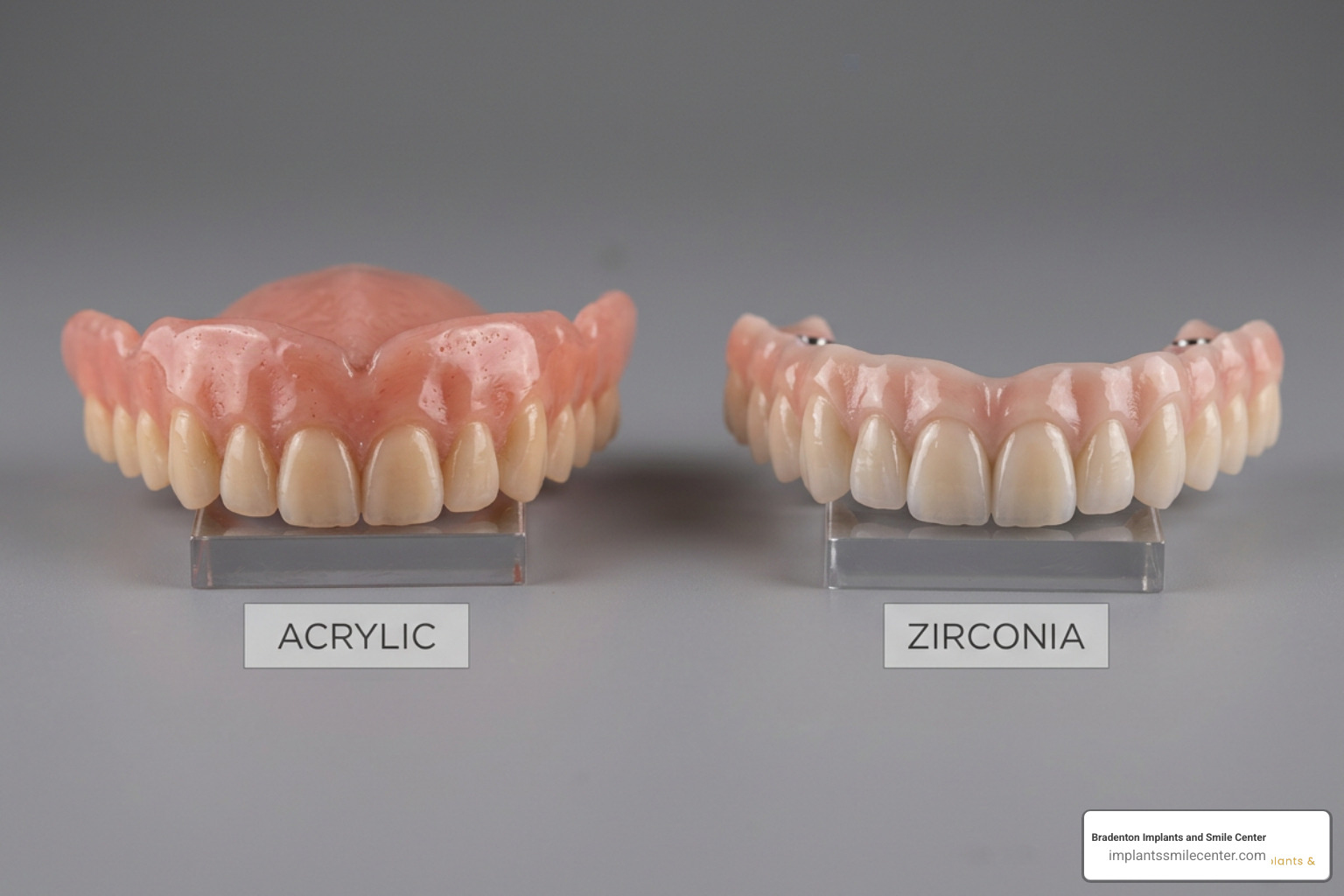
The Materials Used: High-performance materials like zirconia or porcelain-fused-to-metal cost significantly more to manufacture than basic PMMA acrylic.
Provider Expertise: A board-certified periodontist or prosthodontist who has completed three additional years of specialized residency training will charge more than a general dentist. However, specialist placement is associated with lower long-term failure rates.
Geographic Variations: Operating costs, rent, and local taxes vary wildly. Restoring your teeth in a major metropolitan center like Miami or New York will always carry a premium compared to suburban areas. To see how these geographic factors play out across the country, reference the National cost guide data.
Preparatory Procedures and Hidden Fees
Many patients are surprised to learn that the "headline price" they see in advertisements often excludes the preparatory work required to make the surgery a success.
If you have active periodontal disease, failing teeth that must be extracted, or severe bone loss from years of wearing traditional dentures, you will need preparatory treatments:
Tooth Extractions: Simple extractions cost $150 to $500 per tooth. Extracting a full arch of failing teeth can add several thousand dollars to your plan.
Bone Grafting: If your jaw lacks the width or depth to hold an implant, we must place bone grafting material. This costs $300 to $800 per site for minor grafts, and up to $1,500 to $5,000 for extensive reconstructions.
Sinus Lifts: If we are placing implants in the upper jaw and your sinus cavities are too close to the bone, a sinus lift is required, costing $1,500 to $4,500.
Sedation and Anesthesia: While local numbing is included, most patients undergoing full-arch surgery prefer IV sedation or general anesthesia for comfort, which adds $500 to $2,500 to the surgical bill.
Understanding these variables ahead of time prevents "sticker shock" on consultation day. For a complete look at what to expect during the healing and prep phases, read our Guide to full mouth implants.
How Materials Impact the Long-Term Full Arch Implants Cost
The material chosen for your final, permanent bridge is one of the largest variables in your overall investment.
PMMA Acrylic (Hybrid Bridges): This is the traditional option. The teeth are made of acrylic and bonded to a titanium bar. While beautiful and lightweight, acrylic is porous. Over time, it can stain, absorb odors, and wear down from chewing. An acrylic bridge typically costs less upfront but may need to be completely replaced or resurfaced every 5 to 10 years, costing thousands of dollars per replacement.
Prettau Zirconia: Zirconia is an incredibly dense, medical-grade ceramic. It is virtually chip-proof, completely stain-resistant, and does not absorb odors. A zirconia bridge looks remarkably lifelike and can easily last 20 to 30+ years — often a lifetime — with proper care.
While choosing zirconia adds an extra $5,000 to $15,000 per arch to your initial full arch implants cost, it is almost always the more economical choice over a 15-year period because it eliminates the cycle of repairs and replacements. To compare these materials in depth, check out our resource on Affordable permanent teeth options.
Insurance, Financing, and Making Your New Smile Affordable
Let’s address the elephant in the room: Does dental insurance cover full mouth implants?
The short answer is: rarely, and never completely.
Because most traditional insurance companies still classify full-arch implants as a "cosmetic" or "elective" procedure, they do not cover the bulk of the treatment. Even premium dental plans usually have strict annual maximums ranging from $1,500 to $2,500. Once you hit that cap, the insurance stops paying.
However, we can often help you maximize your benefits by:
Using insurance to cover preparatory steps like extractions, 3D imaging, or your initial consultations.
Splitting your treatment across two calendar years (e.g., placing the implants in December and delivering the final bridge in February) to utilize two years of annual insurance maximums.
To bridge the gap, the vast majority of our patients utilize a combination of out-of-pocket strategies:
HSA and FSA Accounts: You can use pre-tax Health Savings Account or Flexible Spending Account dollars to pay for your implants, saving you up to 30% depending on your tax bracket.
Third-Party Financing: Companies like CareCredit, Proceed Finance, and LendingClub offer specialized medical loans. Many of our patients qualify for low-interest or interest-free promotional periods.
In-House Dental Savings Plans: Some practices offer structured payment schedules so you pay in phases as your treatment progresses over several months.
To find a payment strategy that works for your monthly budget, explore our Financing full mouth dental implants guide and learn about specialized options in our resource on Dental loans with no credit check.
Frequently Asked Questions About Full Arch Implants
What is typically included in a full mouth implant quote?
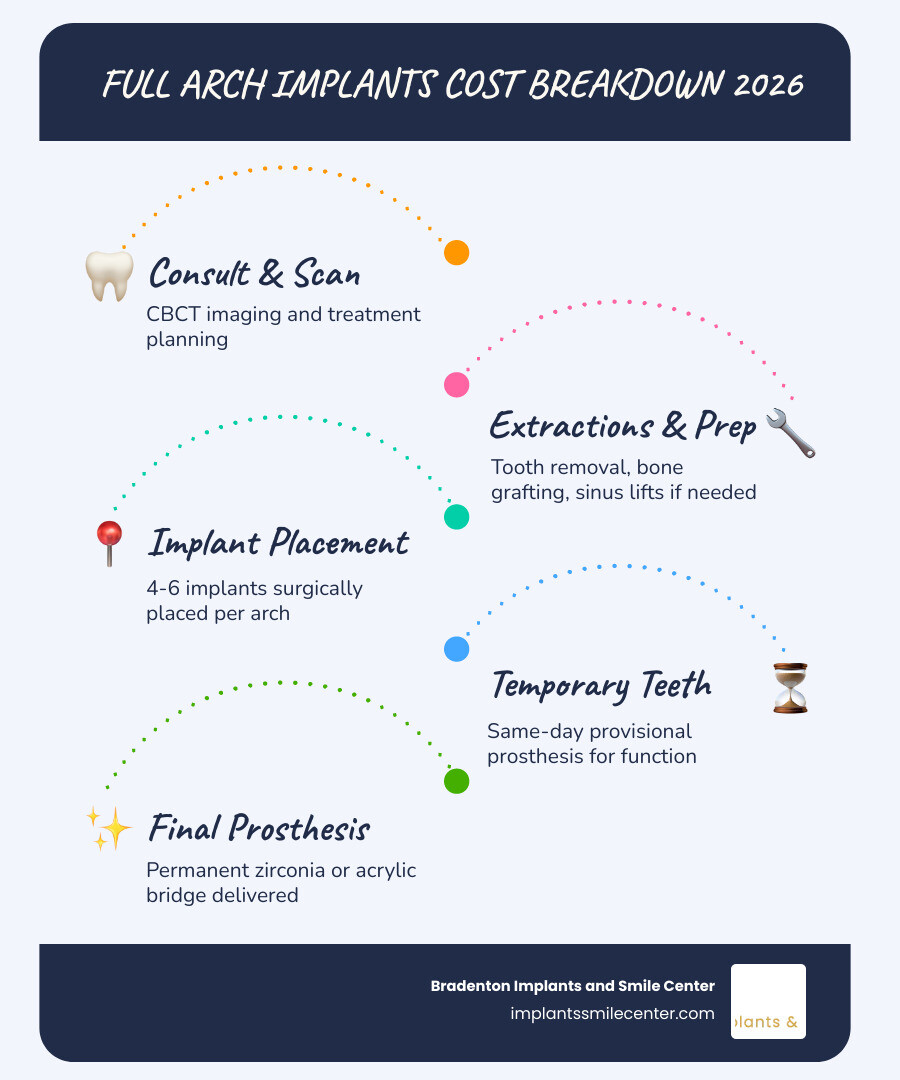
A reputable, transparent dental implant quote should always be "all-inclusive." When you receive a estimate, make sure it explicitly details:
The initial consultation, digital smile design, and 3D CBCT imaging scans.
All surgical fees, including the placement of the titanium implant posts.
The temporary (provisional) teeth worn during the 3-to-6-month healing phase.
The custom-fabricated final permanent bridge (clearly specifying if it is acrylic or zirconia).
All post-operative follow-up appointments and adjustments.
If any of these items are missing or marked as "optional," ask your provider for an itemized revision.
How do full arch implants compare in long-term value to traditional dentures?
Traditional dentures are cheap upfront (typically $1,500 to $5,000 per arch), but they carry significant hidden costs. Because they sit on top of the gums, they do nothing to stimulate the underlying bone. Over time, your jawbone naturally shrinks and deteriorates. This causes the dentures to become loose, requiring painful relines every 1 to 2 years and complete replacements every 5 to 7 years.
Furthermore, dentures only restore about 20% of your chewing power, forcing you to give up nutritious, hard-to-chew foods.
Full arch implants actively fuse with your jawbone, halting bone loss and preserving your youthful facial structure. They restore up to 90% of your chewing power and can last a lifetime. When you factor in the cost of adhesive creams, professional relines, and multiple denture replacements over 15 to 20 years, implants are widely considered the smarter, healthier, and more cost-effective long-term investment. To see local cost projections, read our Bradenton local pricing and financing options.
What are the red flags of a suspiciously low dental implant quote?
If a clinic advertises a fixed full-mouth implant price that seems too good to be true (such as "Full Arch Implants for $9,999"), proceed with extreme caution. Common red flags include:
The "Bait-and-Switch" on Arches: The advertised price is only for one arch, or it only covers the surgical placement of the posts but not the actual teeth (the bridge).
Cheap Materials: The final bridge is made of cheap, non-reinforced plastic that will break within a year.
Inexperienced Providers: The surgery is performed by a general dentist with minimal implant training.
Out-of-Country Risks: Some patients consider "dental tourism" to countries like Mexico or Turkey. However, studies show that foreign dental implants carry up to a 20% higher risk of complications like peri-implantitis (bone infection). Furthermore, most U.S. dentists cannot service or repair foreign implant brands because the specialized tools and parts are not available here.
Conclusion
Investing in a full-arch restoration is about so much more than just buying new teeth. It is about reclaiming your health, your ability to enjoy your favorite meals, and the freedom to smile and laugh without a second thought.
At Bradenton Implants & Smile Center, we believe in complete financial transparency, compassionate care, and utilizing the most advanced dental technology available. Our team works closely with you to design a personalized treatment plan that fits your health goals, lifestyle, and monthly budget.
If you are ready to take the first step toward a healthy, permanent, and beautiful smile, we invite you to Schedule a consultation for full mouth dental implants at our Bradenton office today. Let’s build your new smile together!