

Step-by-Step Guide to Wisdom Teeth Extraction & Recovery
What Is Wisdom Teeth Extraction — and Do You Actually Need It?
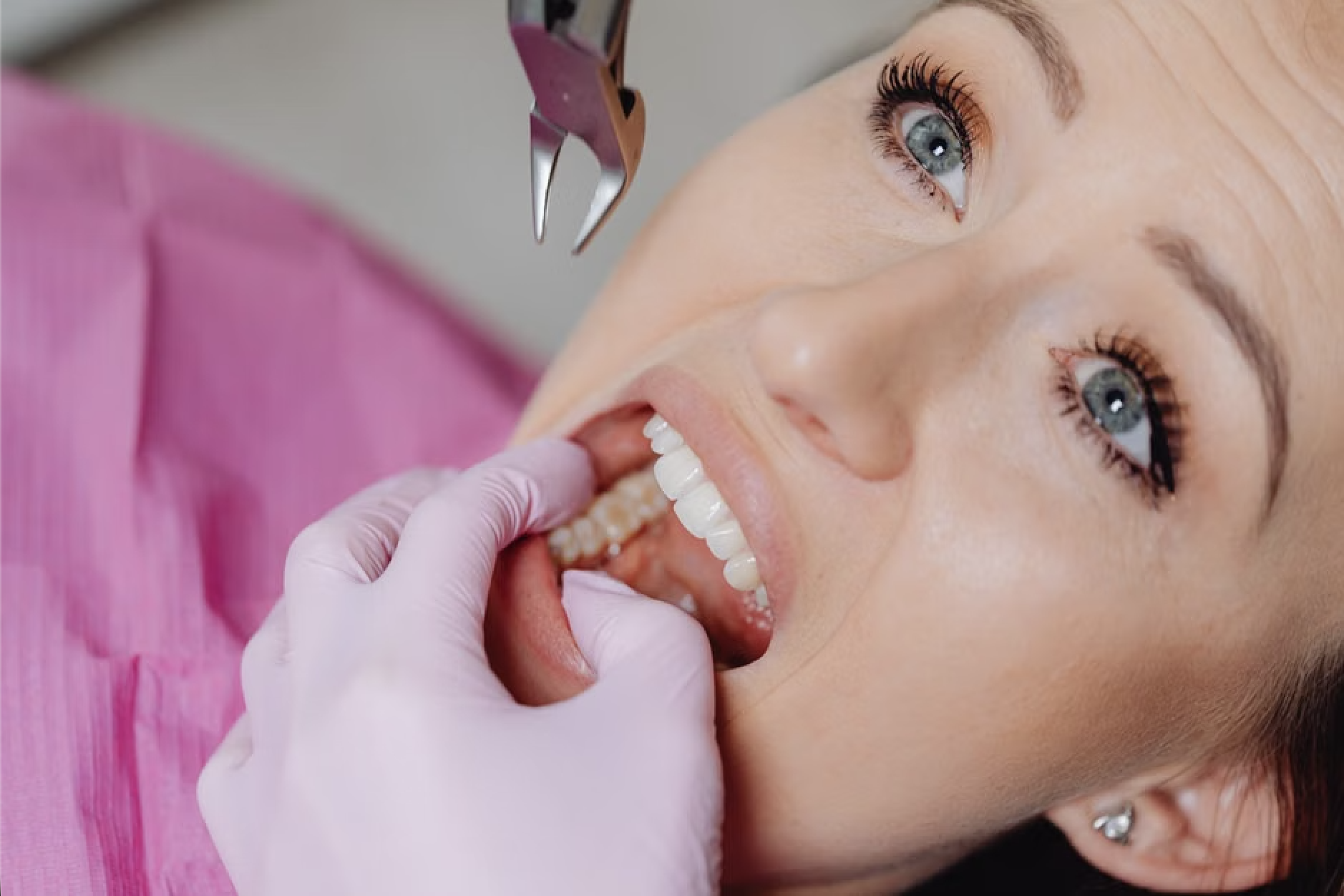
Wisdom teeth extraction is the surgical removal of one or more of your third molars — the last teeth to grow in at the very back of your mouth.
Here's a quick answer to what most people want to know:
Question | Quick Answer |
|---|---|
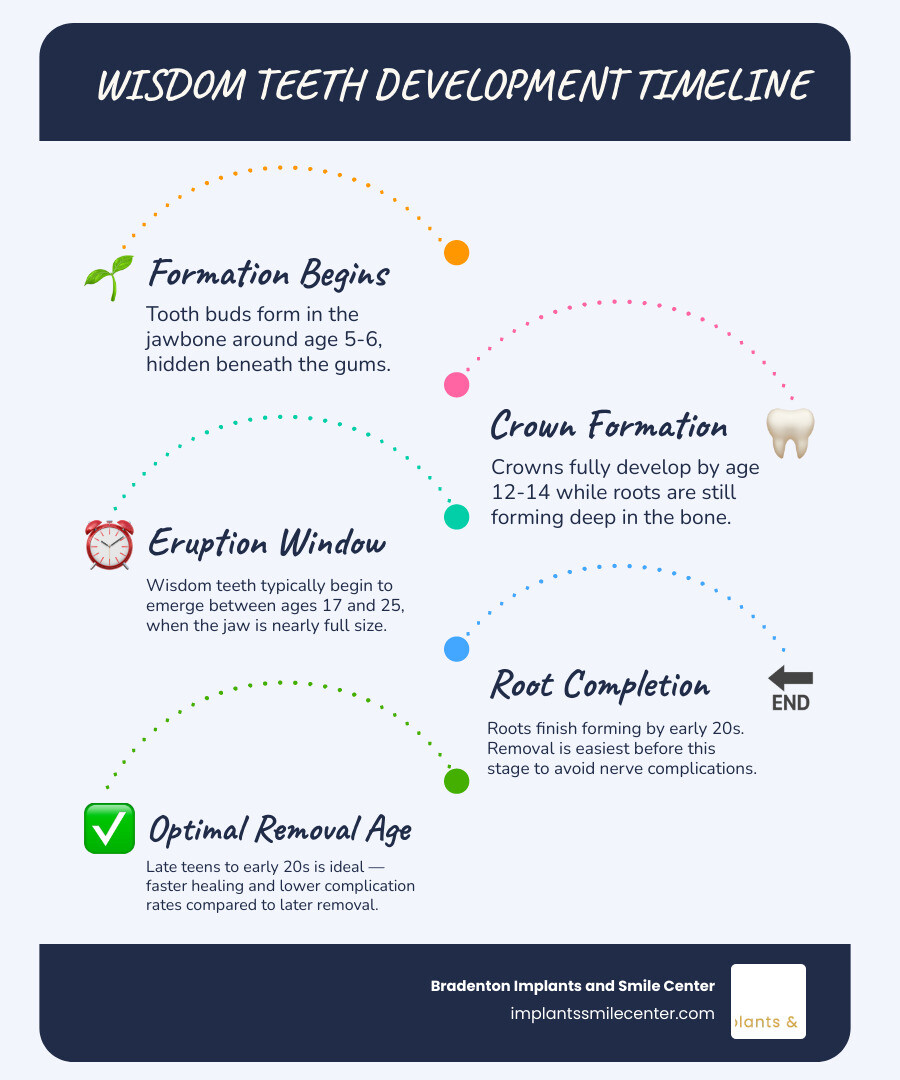
What are wisdom teeth? | Third molars that typically erupt between ages 17 and 25 |
Why are they removed? | Impaction, crowding, pain, infection, or damage to nearby teeth |
Does everyone need removal? | No — but about 85% of people eventually do |
How long is recovery? | 3–5 days to resume normal life; full healing in 1–2 weeks |
Is it painful? | Anesthesia keeps you comfortable during the procedure |
When is the best time? | Late teens to early 20s, before roots fully form |
The average mouth holds only 28 teeth comfortably. But most adults develop 32 — and those last four, the wisdom teeth, often don't have room to grow in properly. That mismatch is the root cause of most wisdom tooth problems.
Many people put off dealing with their wisdom teeth out of anxiety or uncertainty. That's completely understandable. But leaving problematic wisdom teeth in place can lead to infection, damage to neighboring teeth, and more complex surgery down the road.
This guide walks you through everything — from the first signs of trouble, to the procedure itself, to a smooth recovery.
I'm Dr. John Heghazin, owner of Bradenton Implants and Smile Center, with over 8 years of experience performing wisdom teeth extraction and a full range of oral surgical procedures. I'll be your guide through this article, giving you straightforward, clinically accurate information so you can make the best decision for your oral health.
What Are Wisdom Teeth and Why Do They Need to Be Removed?
Wisdom teeth, scientifically known as third molars, are evolutionary leftovers. Our ancient ancestors relied on these heavy-duty grinders to chew raw plants, tough roots, hard nuts, and uncooked meats. However, thanks to the invention of cooking, knives, and forks, our diets have softened significantly over the millennia.
As a result, our jaws have evolved to be smaller, but our genetics haven't entirely caught up. Most of us still develop 32 teeth, even though the average modern human mouth is anatomically designed to hold only 28. When those final four "extra" teeth try to squeeze into the back of your jaw, they often cause crowding, pain, and structural misalignment.
According to the American Association of Oral and Maxillofacial Surgeons, about 85% of third molars will eventually need to be removed to protect long-term oral health. When there isn't enough space, these teeth can become trapped, grow at odd angles, or only partially break through the gums.
Impacted vs. Non-Impacted Wisdom Teeth
When a wisdom tooth has plenty of space and emerges straight through the gumline in perfect alignment with your other teeth, it is considered non-impacted. If you can keep it clean and it isn't causing decay or gum irritation, it may not need to be removed.
But most wisdom teeth become impacted, meaning they are prevented from fully erupting. This impaction can take several forms:
Soft Tissue Impaction: The tooth has penetrated the bone but remains covered by gum tissue, making it incredibly difficult to clean and highly susceptible to infection.
Partial Bony Impaction: The tooth is partially visible but remains partially trapped within the jawbone.
Complete Bony Impaction: The tooth is entirely encased within the jawbone, often lying completely on its side.
Wisdom teeth can grow at highly unusual angles. They may tilt forward toward your second molars (mesioangular inclination), backward toward the throat (distoangular), straight up but trapped (vertical), or completely flat (horizontal).
Research highlights that adolescents exhibit a particularly high rate of mandibular third molar impaction, varying from 69.1% to 95.2% of cases with mesioangular inclination. As we age, the proportion of low-position impactions decreases, and vertical impactions become the most prevalent, accounting for up to 42% of cases. Furthermore, impaction is more common among females, whose reported prevalence is 1.16 to 1.5 times higher than that among males. To explore the clinical research behind these patterns, you can read the Expert consensus on the management of third molar health.
Signs and Symptoms That Require Wisdom Teeth Extraction
While some impacted teeth remain quiet for years, many people present with symptoms during early to mid-adulthood, particularly between the ages of 20 and 40. Common warning signs that it is time to consider an extraction include:
Persistent Jaw Pain or Pressure: A dull ache at the back of your jaw that can radiate to your ear or neck.
Gum Swelling and Redness: Inflamed, tender gums around the back molars.
Pericoronitis: A localized infection of the gum tissue surrounding a partially erupted tooth, which occurs in up to 82.41% of mandibular third molar cases.
Difficulty Opening Your Mouth: Jaw stiffness or restriction of movement caused by localized inflammation.
Chronic Bad Breath: Trapped food particles and bacteria under the gum flap that are impossible to reach with a toothbrush.
Damage to Adjacent Teeth: Impacted wisdom teeth pressing directly against your second molars, which can lead to root resorption or cavities. In fact, approximately 19.5% of patients with impacted third molars present with cavities on the adjacent second molars.
If you are experiencing any of these symptoms, it is crucial to address them promptly. You can learn more about how we handle these situations on our Tooth Extractions service page to understand your options.
Preparing for Your Wisdom Teeth Extraction
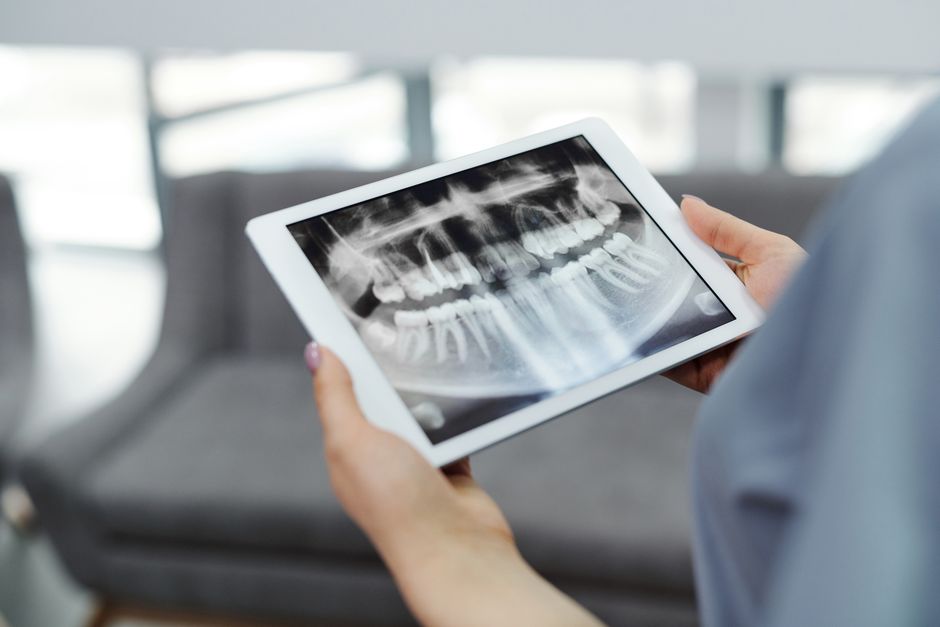
Preparation is key to a smooth, stress-free surgical experience. Your journey begins with a comprehensive dental consultation. During this visit, we perform a thorough clinical examination and take digital images to map out the exact position of your teeth and their proximity to vital facial nerves.
While standard panoramic X-rays are the typical starting point, we sometimes utilize advanced 3D Cone-Beam Computed Tomography (CBCT) scans for complex or high-risk cases. This technology provides a highly detailed three-dimensional view of your jawbone and nerve pathways, allowing us to plan the safest surgical approach.
Once your surgery is scheduled, we will provide you with personalized pre-operative instructions, which typically include:
Fasting Guidelines: If you are undergoing IV sedation or general anesthesia, you must avoid eating or drinking anything (including water) for at least six to eight hours before your procedure.
Medication Review: Provide us with a complete list of all medications, vitamins, and supplements you take. We will let you know which ones are safe to take on the morning of your surgery.
Arranging Transportation: Because sedation impairs your reflexes and cognitive function, you must arrange for a responsible adult driver to bring you to our Bradenton office, stay during the procedure, and drive you home safely.
Understanding Your Dental Sedation Options
At Bradenton Implants & Smile Center, we understand that dental anxiety is very real. We prioritize your comfort and offer a variety of anesthesia and sedation options tailored to your specific needs and anxiety levels:
Local Anesthesia: We numb the extraction site with a local anesthetic. You remain fully awake and aware, but you will not feel any pain—only some pressure.
Nitrous Oxide (Laughing Gas): Administered through a small mask over your nose, this gas helps you feel relaxed and slightly euphoric while remaining conscious.
IV Sedation (Twilight Anesthesia): Delivered through an intravenous line, this option puts you in a state of deep relaxation. You will be drift in and out of sleep, able to respond to simple instructions, but you will have little to no memory of the procedure. Most patients breathe completely on their own during IV sedation.
General Anesthesia: Reserved for highly complex cases, this puts you into a completely unconscious state.
To learn more about how we keep you comfortable, explore our guide on Advanced Sedation Options or read our comprehensive Ultimate Guide Advanced Sedation Dentistry. We also offer localized resources for patients seeking Sedation Dentistry Bradenton FL, Bradenton FL Dental Sedation, and specialized Dental Anxiety Solutions to make your visit as peaceful as possible.
What Happens During the Wisdom Teeth Extraction Procedure?
A standard wisdom teeth extraction is a highly routine outpatient procedure that typically takes an hour or less to complete. Once your chosen sedation or anesthesia has taken full effect, the surgical process begins.
Our primary goal is to remove the teeth gently while preserving the surrounding bone and gum tissue. To make the extraction as gentle as possible, we often use a "tooth sectioning" technique, cutting the tooth into two or three smaller pieces. This prevents us from having to remove excess jawbone and minimizes post-operative swelling and discomfort.
Step-by-Step Surgical Process of Wisdom Teeth Extraction
To help demystify the surgery, here is exactly what happens during the procedure:
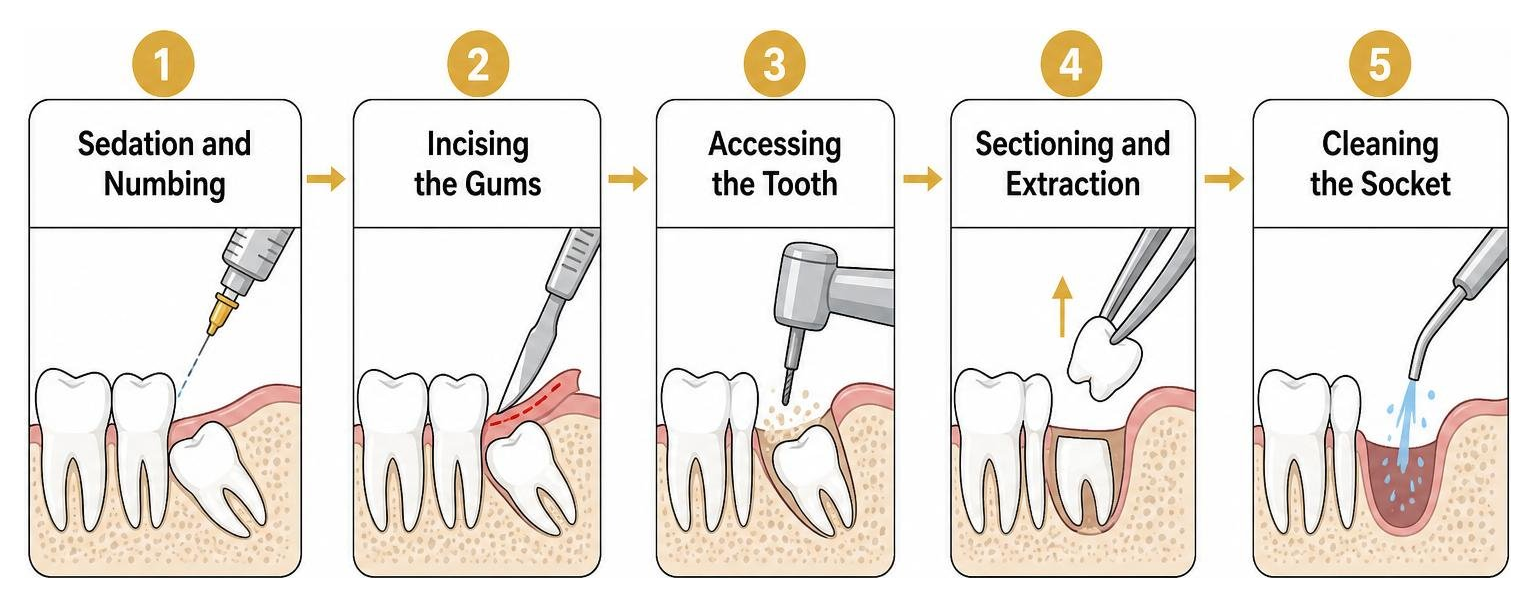
Sedation and Numbing: We administer your chosen sedation and thoroughly numb the surgical areas with local anesthetic.
Incising the Gums: If the tooth is impacted, we make a small, precise incision in the gum tissue to expose the tooth and underlying bone.
Accessing the Tooth: We carefully remove any small amount of bone blocking our access to the tooth roots.
Sectioning and Extraction: The tooth is sectioned into smaller pieces and gently lifted from its socket.
Cleaning the Socket: We meticulously clean and irrigate the empty socket with sterile saline to remove any debris or bacteria.
Stitching the Gums: If necessary, we place dissolvable stitches to close the gum tissue. These stitches will break down on their own over the next week, so you won't need a follow-up appointment to have them removed.
Gauze Placement: We place a clean cotton gauze pad over the site and ask you to bite down with gentle, steady pressure to help a protective blood clot form.
For a broader clinical overview of what to expect, you can consult the Cleveland Clinic's resource on Wisdom Teeth Removal: Procedure & Recovery.
The Recovery Timeline: What to Expect After Surgery
Your body's natural healing process begins the moment the extraction is complete. While full healing of the gum tissue and jawbone takes about two weeks, most patients can resume school, work, and light daily routines within three to five days.
Here is a general day-by-day recovery timeline:
Day 1 (The First 24 Hours): Focus on resting. You will experience some oozing of blood and mild numbness as the anesthesia wears off. Keep your head elevated.
Days 2–3: Swelling and bruising typically peak during this window. You may feel jaw stiffness, which is a normal response to holding your mouth open during surgery.
Day 4: Many people find that the third or fourth day is when pain and swelling peak before steadily improving.
Days 5–7: Swelling should subside significantly, jaw movement will begin to return to normal, and you can gradually transition to semi-soft foods.
Week 2: Your sockets will continue to close and heal. You can resume normal physical activities and regular oral hygiene.
Managing Pain, Swelling, and Bleeding Post-Extraction
Managing your post-operative symptoms effectively is crucial for a comfortable recovery.
Swelling Control: Apply an ice pack wrapped in a clean towel to the side of your face for 20 minutes on, 20 minutes off, during the first 24 to 48 hours. After 48 hours, transition to warm, moist compresses to soothe tight jaw muscles.
Pain Relief: Take your prescribed pain medications or over-the-counter NSAIDs (like ibuprofen) exactly as directed. Do not wait for the pain to become severe before taking your first dose.
Bleeding Management: Keep the initial gauze pad in place for about 30 minutes post-surgery, biting down gently. If bleeding continues, replace it with a fresh, slightly damp gauze pad or a damp black tea bag (the natural tannins in tea help blood vessels constrict).
For expert strategies on minimizing downtime and healing quickly, check out our guide on Fast Wisdom Teeth Recovery.
The Dos and Don'ts of Post-Operative Care
To protect the fragile blood clot forming in your extraction socket, you must follow strict post-operative guidelines. Dislodging this clot can lead to a highly painful condition known as dry socket.
What to DO | What to AVOID |
|---|---|
Eat soft foods: Stick to yogurt, applesauce, pudding, mashed potatoes, and cooled soups. | Avoid hard, crunchy, or hot foods: Stay away from chips, nuts, seeds, and extremely hot foods. |
Stay hydrated: Drink plenty of water and cool, nutritious liquids. | Do NOT use straws: The suction can dislodge the healing blood clot. |
Keep your head elevated: Use extra pillows when resting to reduce swelling. | Do NOT smoke or use tobacco: Avoid smoking for at least 72 hours and chewing tobacco for a week. |
Practice gentle hygiene: After 24 hours, gently rinse with warm salt water every 2 hours. | Do NOT spit or rinse vigorously: Lean over the sink and let the water fall out of your mouth instead. |
You can find additional post-operative recovery support and standard care protocols outlined in the Wisdom tooth removal - NHS guidelines.
Potential Risks and Complications of Wisdom Teeth Removal
While wisdom teeth extraction is a highly safe and common procedure, all surgical interventions carry some degree of risk. Understanding these potential complications can help you identify them early:
Dry Socket (Alveolar Osteitis): This occurs when the protective blood clot fails to form or is dislodged prematurely, exposing the underlying bone and nerves to air, food, and fluids. It causes severe, throbbing pain that typically starts three to four days after surgery.
Infection: Indicated by worsening swelling, a high fever, or pus draining from the extraction site.
Paresthesia (Nerve Injury): The roots of lower wisdom teeth occasionally sit very close to the inferior alveolar nerve. If this nerve is bruised during surgery, it can cause temporary (and very rarely permanent) numbness or tingling in your lower lip, chin, or tongue.
Sinus Issues: The roots of upper wisdom teeth are located close to your maxillary sinuses. In rare cases, an opening can form between the tooth socket and the sinus cavity, which requires specialized care to close.
When to Call Your Dentist or Oral Surgeon
While mild discomfort, swelling, and light oozing are perfectly normal parts of the healing process, certain symptoms require immediate medical attention. Contact us or seek care immediately if you experience any of the following:
A fever higher than 102°F (38.8°C)
Difficulty breathing or swallowing
Uncontrollable bleeding that does not slow down after biting on gauze
Severe, throbbing pain that is not relieved by pain medication (a sign of dry socket)
Worsening swelling or pain after the fourth day
If you find yourself facing an unexpected post-operative issue, please refer to our guide on Dental Emergencies to get immediate help.
Frequently Asked Questions about Wisdom Teeth Extraction
At what age is wisdom teeth removal typically recommended?
Wisdom teeth extraction is most commonly recommended for teenagers and young adults between the ages of 17 and 22. At this developmental stage, the tooth roots are only partially formed (usually about two-thirds complete) and the surrounding jawbone is more flexible. This makes the extraction significantly less complex, reduces the risk of nerve injury, and allows for a much faster, more comfortable recovery. As we age, the roots fully mature and the jawbone becomes denser, which can increase surgical complexity and extend recovery times.
Is wisdom teeth extraction always necessary?
No, extraction is not universally mandatory. If your wisdom teeth are completely healthy, fully erupted, aligned correctly with your bite, and easily accessible for daily brushing and flossing, they can often be left in place.
However, even symptom-free wisdom teeth can harbor silent dental disease, such as deep decay or localized gum disease, because they are incredibly difficult to keep clean. For this reason, many dental specialists recommend proactive removal during young adulthood to prevent future complications. To understand both sides of this clinical discussion, you can read the article Do You Have to Get Wisdom Teeth Removed? or consult the clinical guidelines on Diagnosis and treatment - Mayo Clinic.
How much does wisdom teeth removal cost and does insurance cover it?
The cost of removing wisdom teeth varies widely based on several factors, including:
The number of teeth being extracted
The type of impaction (simple vs. complex surgical extraction)
The type of sedation or anesthesia utilized
Fortunately, most dental insurance plans cover a significant portion of wisdom teeth extraction, especially when the procedure is deemed medically necessary to prevent pain, infection, or damage to adjacent teeth. Our team at Bradenton Implants & Smile Center will work closely with your insurance provider to maximize your benefits, and we offer flexible financing options to help manage any out-of-pocket costs.
Conclusion
Taking care of your wisdom teeth is a vital step in maintaining a healthy, pain-free smile for life. While the thought of oral surgery can feel intimidating, modern techniques, advanced sedation options, and structured post-operative care make the process highly manageable and comfortable.
At Bradenton Implants & Smile Center, we are dedicated to providing personalized, compassionate care using state-of-the-art technology. If you are experiencing jaw pain, crowding, or suspect it is time to have your third molars evaluated, we are here to help.
If you are ready to schedule an evaluation or have questions about your oral health, please visit Bradenton Implants & Smile Center or explore our options for Wisdom Teeth Extraction. We look forward to helping you smile with confidence!