

A Practical Guide to Full Set of Teeth Implants Cost & Options
Average Full Set of Teeth Implants Cost in 2026
When evaluating full-arch restoration, understanding the overall financial landscape helps prevent unexpected expenses. In 2026, standard complete-arch procedures usually cost between $30,000 and $90,000 across the country, with national averages hovering around $55,000. For comprehensive resource breakdowns, you can view the Full Mouth Dental Implant Cost Guide and our Cost Of Full Mouth Dental Implants Guide 2026.
To understand where your investment goes, it helps to examine the average component breakdown:
Implant materials and hardware: ~35%
Surgical placement and clinician fees: ~35%
Facility and surgical suite expenses: ~15%
Sedation and anesthesia: ~8%
3D imaging, lab work, and diagnostics: ~7%
Attempting to replace all 28 functional adult teeth with individual implants and separate crowns quickly becomes cost-prohibitive, often climbing from $84,000 to over $168,000. Full-arch bridge options achieve superior stability at a fraction of that cost by anchoring a full set of handcrafted teeth onto four to six strategically placed posts.
Factors Driving the Full Set of Teeth Implants Cost
No two smiles are built exactly alike, which means total treatment fees fluctuate based on specific clinical needs. Major variables influencing price include:
Preparatory Procedures: Patients with long-term tooth loss often experience jawbone resorption. Placing implants into compromised bone risks failure, necessitating specialized preparation. Learn more about structural prep in our guide on Bone Grafting For Implants. Extractions typically cost $150–$650 per tooth, standard bone grafts run $500–$3,000, and complex sinus lifts average $1,500–$5,000.
Provider Qualifications: Oral surgeons and prosthodontists who undergo three years of advanced specialty residency training post-dental school bring elite surgical expertise to complex full-mouth cases.
Anesthesia Preferences: While local anesthesia is included in surgical quotes, IV conscious sedation usually adds $3,000 to $5,700 depending on surgery length.
Comparing Both Arches vs Single Arch Full Set of Teeth Implants Cost
Many patients suffer widespread decay or severe breakdown across both upper and lower jaws simultaneously. However, treating a single jaw is always an option if one arch retains healthy natural teeth.
Replacing one upper or lower jaw via an All-on-4 bridge generally costs $14,000 to $28,000. Restoring both arches in a dual-arch transformation scales from $25,000 to $60,000+. Choosing dual-arch reconstruction during a single surgical session delivers cost savings on facility fees, single-use surgical supplies, and total anesthesia fees while consolidating your healing timeframe into a single recovery period. Detailed pricing variations are detailed in our guide to Full Arch Implants Cost.
Main Types of Full-Mouth Implants and Pricing Comparisons
Choosing the ideal structural approach directly balances personal lifestyle goals against budget parameters. The chart below demonstrates how major full-arch approaches compare side-by-side:
Treatment Type Fixation Type Implants Per Arch Est. Lifespan (Restoration) Cost Range (Both Arches) Implant Overdentures Removable (Snap-in) 2 to 4 5–10 Years $16,000 – $40,000 All-on-4 Bridges Fixed (Non-removable) 4 15–20+ Years $25,000 – $60,000+ All-on-6 Bridges Fixed (Non-removable) 6 15–20+ Years $36,000 – $72,000+ Individual Implants Fixed (Single Crowns) 12 to 14 15–20+ Years $84,000 – $168,000+
Explore additional procedural details in the All-on-4 Dental Implants Cost in 2026: Procedure, Pricing & What to Expect guide.
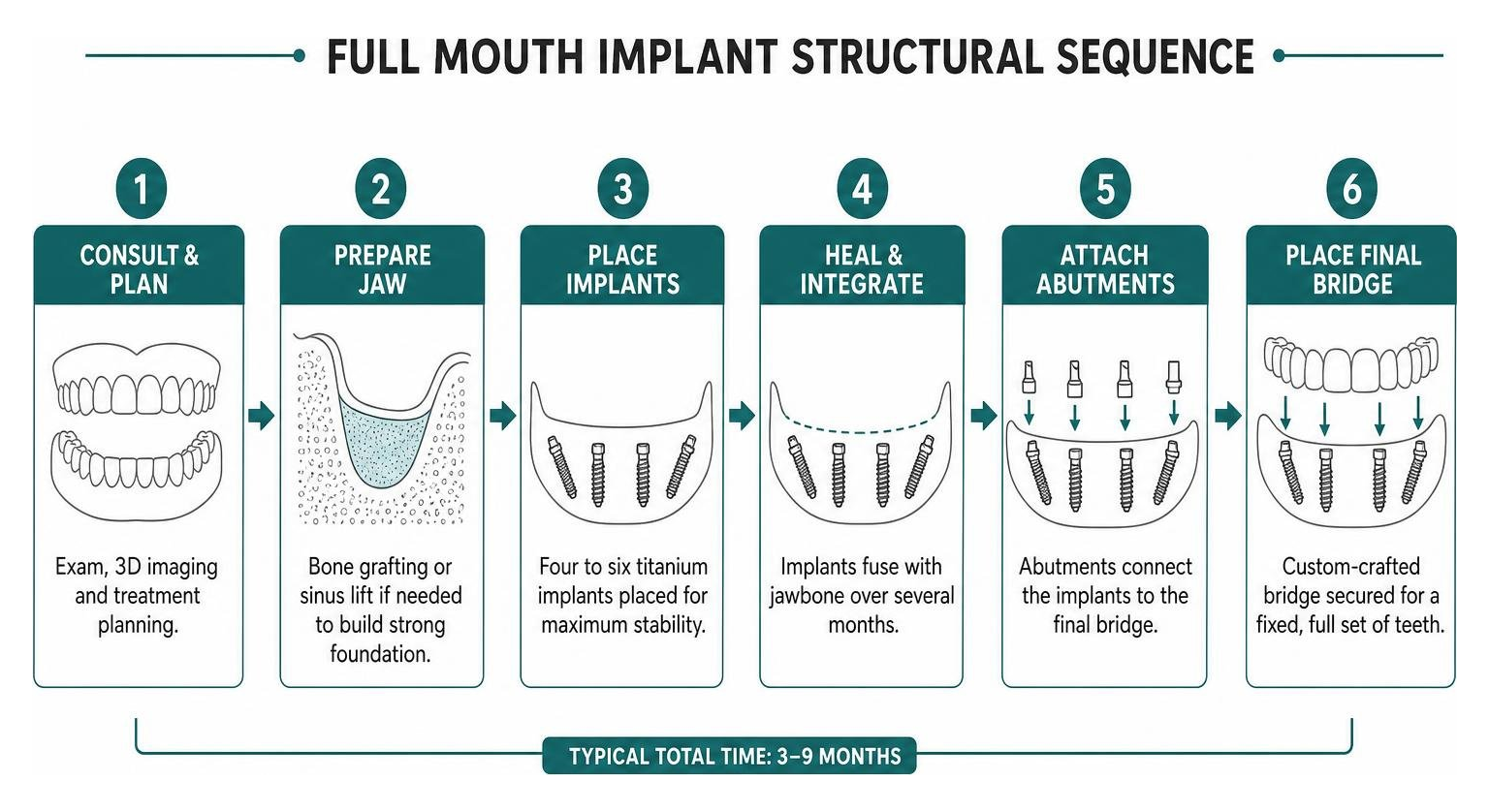
All-on-4 and All-on-6 Implant Bridges
Fixed implant-supported bridges offer the gold standard for full-mouth rehabilitation. By angling rear implant posts at precise 45-degree angles, clinicians utilize denser frontal jawbone structures, frequently bypassing the extra costs and extended wait times of bone grafting.
While All-on-4 ($14,000–$28,000 per arch) provides excellent stability, upgrading to All-on-6 ($18,000–$36,000 per arch) places two extra titanium anchors. This distributes heavy chewing forces over six anchor points—an ideal choice for patients with high bite force or low bone density. Discover all the nuances in our breakdown of All On Four Dental Implants Price.
Implant-Supported Overdentures and Snap-In Options
For patients seeking maximum affordability without sacrificing stability, removable snap-in overdentures bridge the gap between traditional plates and fixed bridges. Anchor posts fitted with specialized locator attachments allow a custom acrylic denture to snap securely into place.
Overdentures anchored by two implants run roughly $8,000 to $15,000 per arch, while four-implant bar-retained systems average $12,000 to $20,000 per arch. They restore significantly higher chewing efficiency than traditional dentures and eliminate shifting, though you remove them nightly for cleaning. Review total pricing breakdowns in our Snap On Dentures Cost resource.
Prosthetic Material Choices: Acrylic vs. Zirconia
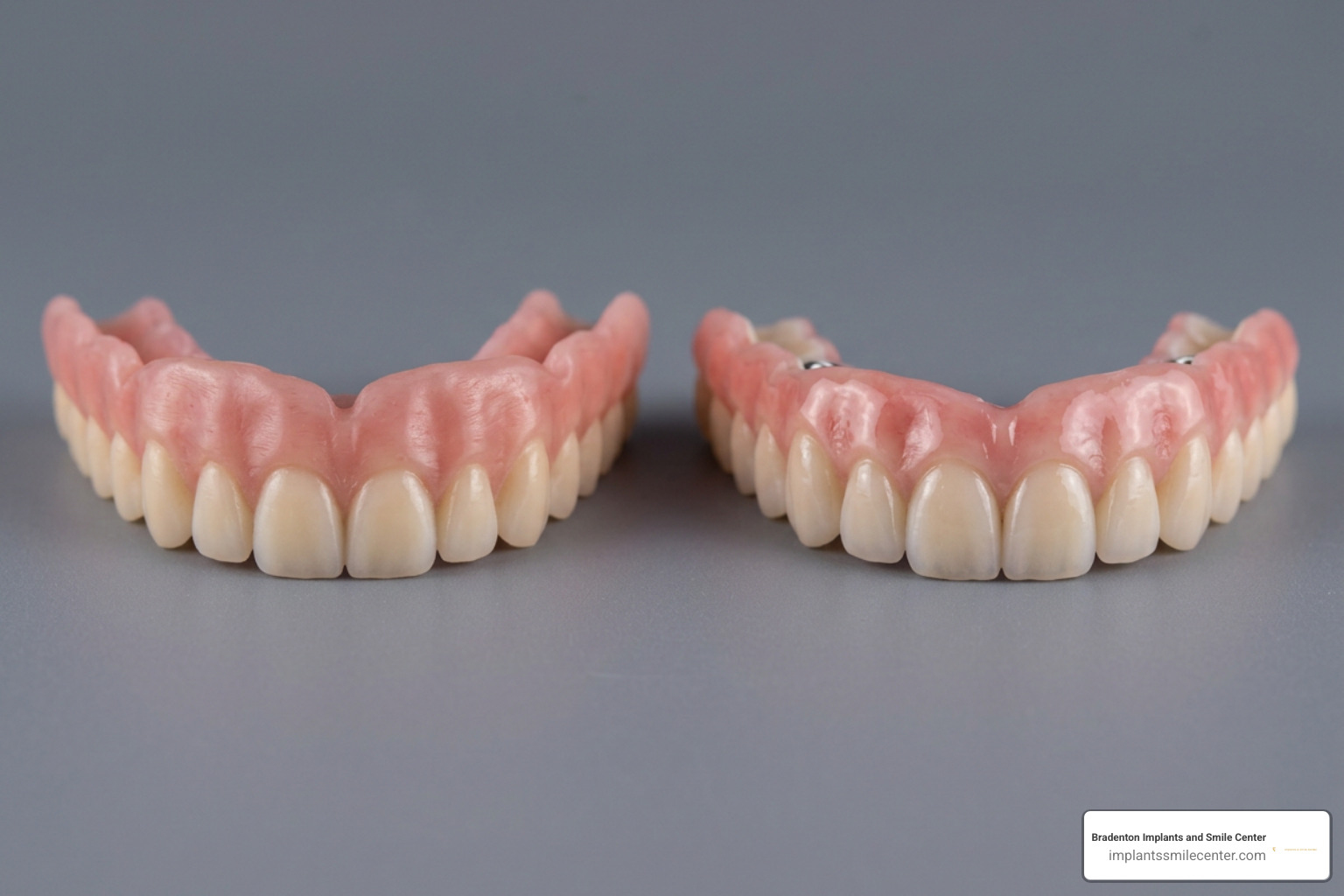
The physical dynamic of your new smile is heavily governed by your choice of final prosthetic material.
PMMA Acrylic (Polymethyl Methacrylate): Lightweight and cost-effective, acrylic teeth attached to titanium frames are commonly used for interim temporary arches during post-surgery healing. When chosen for final restorations, acrylic keeps upfront costs low but is softer, prone to staining, and subject to teeth-chipping under intense grinding forces.
Solid Zirconia: Milled from a single ceramic block, monolithic zirconia represents modern dental engineering at its finest. It resists chipping, stains, and odors, and perfectly mimics natural enamel translucency. Zirconia adds $5,000 to $15,000 per arch over acrylic, but its extraordinary strength makes it the superior choice for long-term endurance. Read more about permanent materials in Permanent Teeth Implants.
Long-Term Value and Maintenance
While PMMA acrylic arches carry a lower price tag on day one, they typically require replacement or major re-lining every 5 to 10 years. Each replacement adds thousands in lab and clinical fees.
In contrast, solid zirconia bridges routinely perform smoothly for 15 to 20 years or longer with minimal wear. When factoring in the expense of repeated acrylic repairs, high-grade zirconia usually offers greater lifetime economic value.
Timeline, Recovery, and Long-Term Cost vs. Traditional Dentures
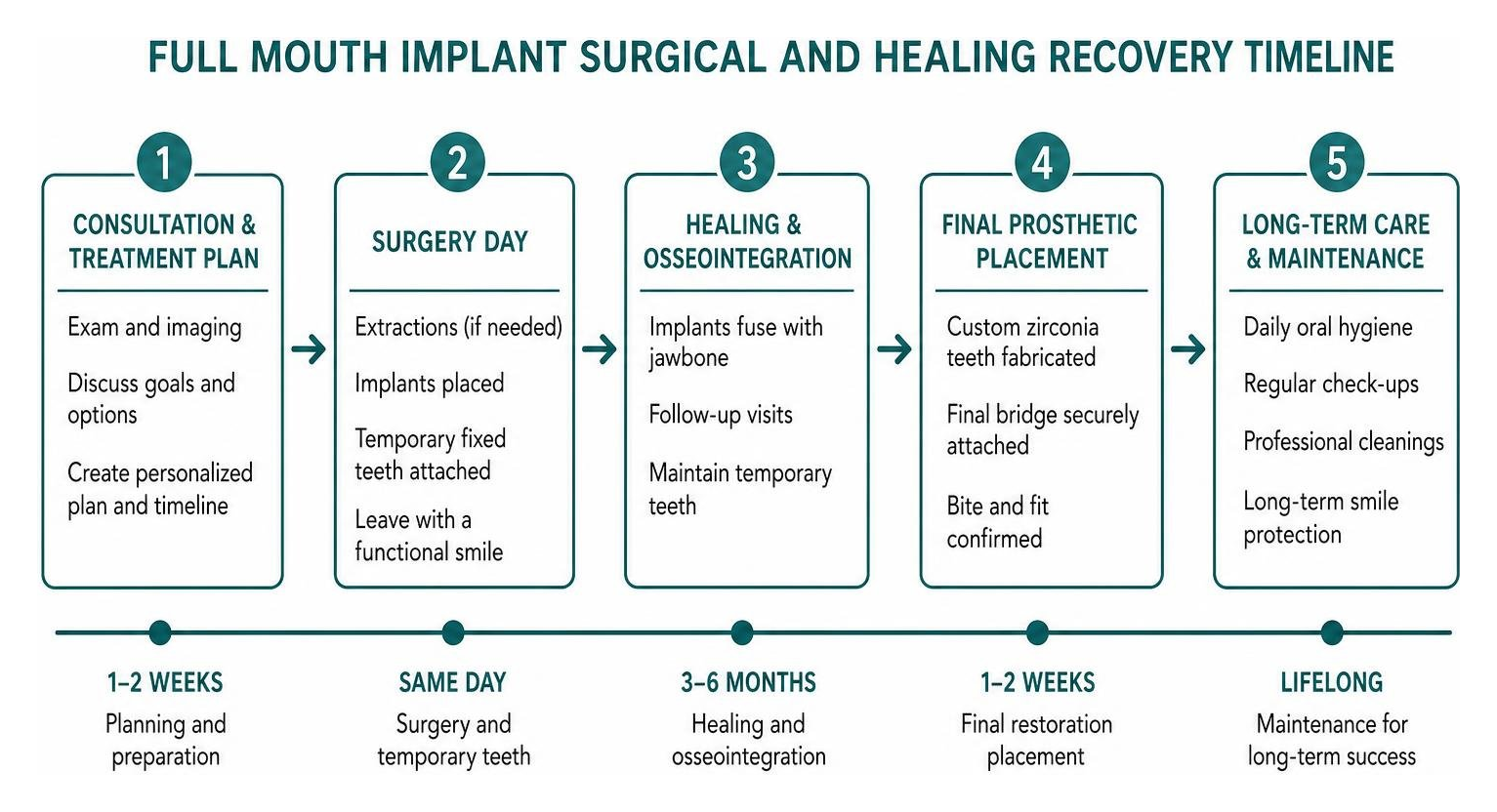
The journey to permanent teeth unfolds over several distinct stages. On surgery day, extractions occur, implants are anchored, and temporary non-removable teeth are attached so you never leave without a functional smile. Over the following 3 to 6 months, an essential natural process called osseointegration occurs, wherein your jawbone permanently fuses to the titanium threads. Once integrated, custom-milled final zirconia teeth are securely torqued into place. Detailed procedural phases are outlined in our Dental Implants Procedure Complete Guide.
When evaluating long-term expenses over a 20-year horizon, traditional removable dentures are rarely as inexpensive as they appear upfront:
Traditional Dentures: Initial placement costs $2,000–$5,000 per arch. However, because unanchored gums continuously suffer bone loss, dentures require professional re-lines every 1–2 years ($300–$600 each), complete remakes every 5–7 years, adhesives, and special cleansers. Over 20 years, a single arch of traditional dentures easily accumulates $15,000 to $25,000 in ongoing upkeep while steadily losing chewing power.
Full-Arch Implants: Though initial placement costs are higher, implant anchors preserve facial bone structure, prevent sunken cheeks, and last a lifetime with normal brushing, flossing, and semi-annual dental visits.
Insurance, Financing, and Affordable Implant Solutions
Navigating payment options can help bring high-end care within reach. For deeper context on national costs and urban pricing models, consult the Full Mouth Dental Implants Cost: $55,000 Avg in 2026 ($30,000–$90,000) summary, Dental Implant Cost Calculator - Full Arch & All-on-4 , and Dental Implant Costs in 2026: The Complete Pricing Guide by City and Provider Type — DentCost .
To reduce out-of-pocket costs, consider these practical strategies:
Insurance Maximization: Dental insurance PPO plans generally limit yearly benefits to $1,000–$2,500. By splitting multi-stage treatments across two calendar years (e.g., placing implants in December and attaching final prosthetics in January), you apply two annual maximum caps. Additionally, medical insurance may reimburse surgical portions if tooth loss stems from traumatic injury or cancer treatments.
Tax-Advantaged Savings: Utilizing pre-tax dollars via Health Savings Accounts (HSA) or Flexible Spending Accounts (FSA) can save you 22% to 37% in effective tax offsets on total surgical costs.
Third-Party Healthcare Financing: Specialized lenders offer 24- to 82-month repayment schedules. Paying off promotional balance windows prior to expiration avoids deferred interest penalties. Explore option plans inside our Financing Full Mouth Dental Implants Guide.
Local Dental Teaching Clinics: Receiving treatment from residency programs under elite prosthodontic supervision can reduce total costs by 30% to 50%. Additional savings strategies are explored in our guide to Affordable Dental Implants Guide 2026.
Frequently Asked Questions About Full Mouth Implants
How long do full-mouth dental implants last?
The titanium implant posts embedded within your jawbone are designed to last a lifetime, holding clinical success rates above 95%. Final prosthetic arches vary by material choice: PMMA acrylic prosthetics typically last 5 to 10 years before requiring structural refreshing, while solid zirconia arches routinely last 15 to 20 years or more with proper hygiene.
Are fixed implant solutions better than removable snap-in dentures?
Fixed bridges (All-on-4 or All-on-6) offer superior biting power, restoring roughly 90% of natural chewing force compared to ~50% with snap-in overdentures and ~20% with traditional dentures. Fixed bridges stay screwed in place permanently, requiring no daily removal. Snap-in dentures offer a lower upfront price point but must be snapped out nightly for cleaning.
Does insurance cover any part of full set implant procedures?
While standard dental insurance policies rarely pay for entire full-mouth restorations, they frequently contribute toward supporting steps such as diagnostic 3D CBCT scans, tooth extractions, or temporary arches. If tooth loss resulted from trauma or systemic disease, medical insurance pre-authorization may cover portions of the surgical phase.
Conclusion
Restoring a smile with full-mouth dental implants is a life-changing investment in health, function, and daily confidence. While the full set of teeth implants cost involves a significant upfront financial commitment, avoiding the continuous repurchasing and discomfort associated with temporary dental fixes makes permanent implants a wise long-term decision.
At Bradenton Implants & Smile Center, located at 7270 55th Ave E, Bradenton, FL 34203, we blend advanced surgical technology with personalized care to create custom treatment plans tailored to your budget. To explore your options and learn more about our comprehensive restorative offerings, schedule your personalized consultation today by visiting our Dental Implants Services page.