
Demystifying the Dental Implant Procedure from Start to Finish
What the Dental Implants Procedure Actually Involves (And What to Expect)
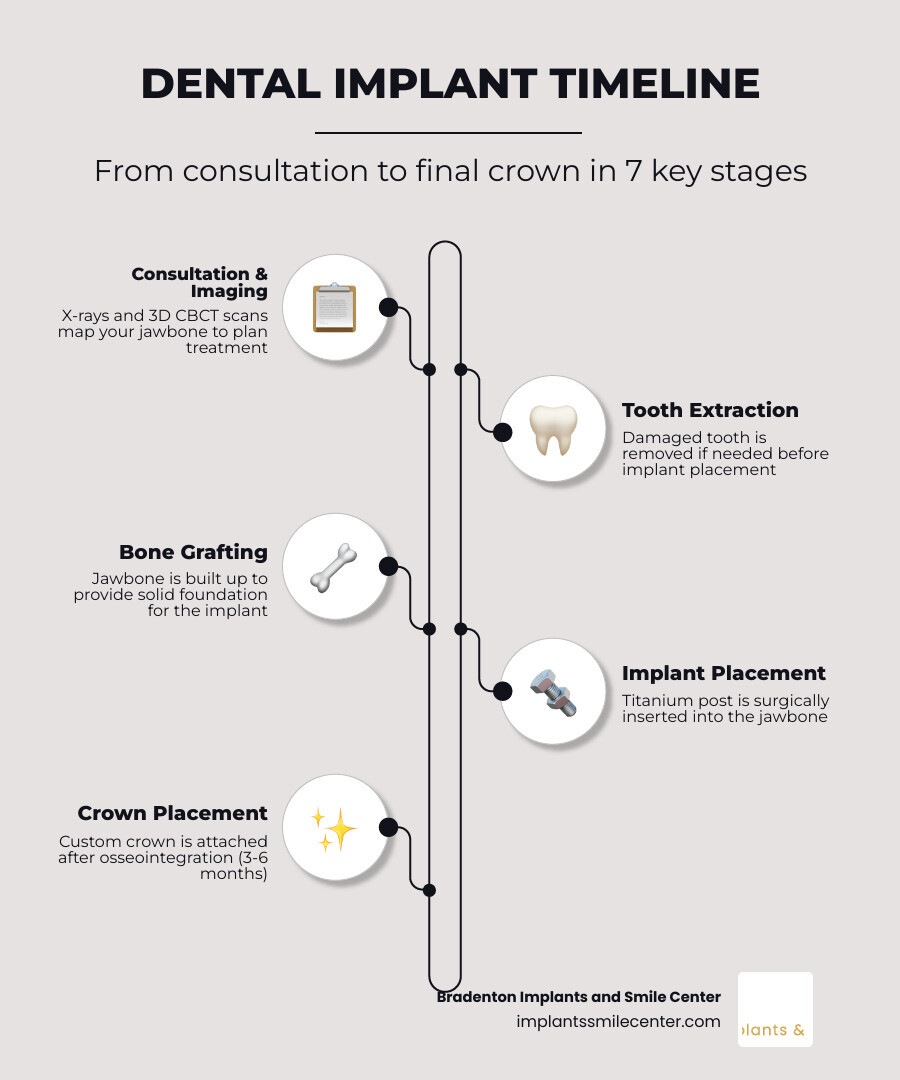
The dental implants procedure is a multi-stage surgical process that replaces a missing tooth root with a titanium post, which is then topped with a custom crown — giving you a permanent, natural-looking tooth. Here is a quick overview:
Consultation and imaging — X-rays and 3D scans map your jawbone
Tooth extraction (if needed) — damaged tooth is removed
Bone grafting (if needed) — jawbone is built up to support the implant
Implant placement — a titanium post is surgically placed into the jawbone
Osseointegration — the bone fuses to the post over 3–6 months
Abutment placement — a connector piece is attached to the post
Crown placement — a custom tooth is fixed on top
Total treatment time: roughly 3–9 months, depending on your healing needs.
Losing a tooth affects more than just your smile. It changes how you eat, how you speak, and how confident you feel. The good news is that dental implants are designed to fix all of that — permanently. Yet for many patients, especially those dealing with dental anxiety or years of avoiding the dentist, the surgical process feels intimidating simply because it is unfamiliar.
This guide walks you through every stage so you know exactly what is happening and why.
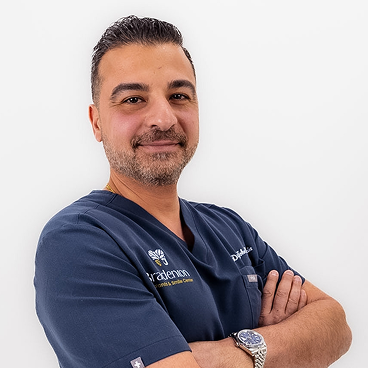
I'm Dr. John Hegazin, owner of Bradenton Implants and Smile Center, with over 8 years of experience performing the dental implants procedure for patients across the Bradenton area. From bone grafting to crown placement, I'll guide you through each step so you can move forward with confidence.
Understanding Dental Implants and Candidacy
To demystify the dental implants procedure, it helps to understand what a dental implant actually is. Unlike traditional dentures or dental bridges that sit on top of your gums or rely on neighboring teeth, a dental implant mimics the natural structure of a tooth.
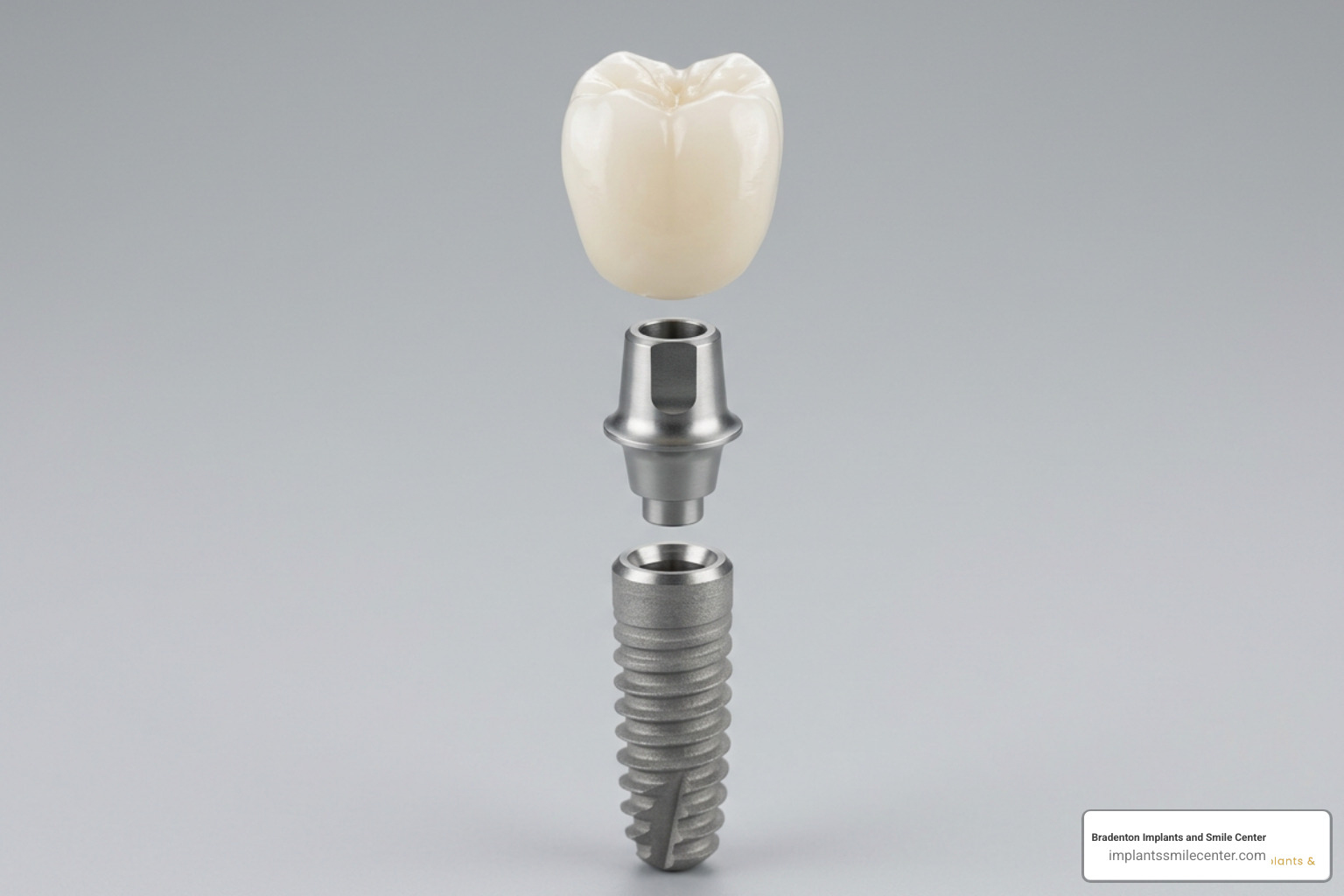
An implant consists of three main components:
The Titanium Post (Implant Body): This is a small, screw-like post made of biocompatible titanium. It is surgically placed directly into the jawbone, where it acts as an artificial tooth root.
The Abutment: This is a small connector piece that screws into the titanium post. It sits right at the gum line and serves as the anchor for your new tooth.
The Crown: The visible part of the restoration. This custom-made ceramic or zirconia tooth is matched to the exact color, shape, and size of your surrounding teeth.
According to the American Academy of Implant Dentistry, dental providers in the United States place over 3 million implants each year. They have become the modern gold standard for tooth replacement because they look, feel, and function just like your natural teeth.
To learn more about the engineering and mechanics behind these devices, you can read our Dental Implants Complete Guide.
But is everyone a candidate for this life-changing procedure? While dental implants have incredibly high success rates, certain medical and anatomical criteria must be met. According to the medical literature on the clinical indications for dental implants, a good candidate generally meets the following requirements:
Sufficient Jawbone Density: Because the implant relies on the surrounding bone for support, you must have enough bone height and width. If you have experienced bone loss due to periodontal disease or long-term tooth loss, you may require preparatory bone grafting.
Healthy Gums: Active periodontal (gum) disease must be treated and fully resolved before we can place an implant. Healthy gum tissues protect the implant's foundation.
Good Overall Health: Since this is a surgical procedure, conditions that significantly impair healing (such as uncontrolled diabetes, active cancer treatments, or severe cardiovascular diseases) can affect success.
Non-Smoking Status (or Willingness to Pause): Tobacco use restricts blood flow to the gums and bone, which can double the risk of implant failure. We strongly advise patients to stop smoking during the healing phases.
Fully Developed Jawbone: This procedure is not suitable for children or adolescents whose jawbones are still growing.
When you visit us at Bradenton Implants & Smile Center, we evaluate all of these factors to design a treatment plan customized to your unique oral anatomy and lifestyle. To learn more about how we assess your smile, read our comprehensive Dental Implants page.
Preparing for Your Dental Implants Procedure
A successful dental implants procedure begins long before the day of surgery. Thorough preparation is key to ensuring a smooth, safe, and highly predictable outcome.

The preparation process involves several essential steps:
1. Comprehensive Dental Exam and 3D Imaging
We begin with a detailed clinical exam. Rather than relying solely on traditional 2D flat X-rays, we utilize advanced 3D Cone-Beam Computed Tomography (CBCT) scanning. This state-of-the-art imaging allows us to view 3D reconstructions of your jawbone, teeth, sinuses, and nerve pathways. We use this precise data to map out the exact angle, depth, and placement of your implant post, ensuring we avoid vital structures like the mandibular nerve or the maxillary sinuses.
2. Medical History Review
We review your complete medical history. It is vital to disclose all medical conditions, allergies, and medications you are currently taking, including over-the-counter supplements and blood thinners. If you have certain heart conditions or orthopedic implants, we may prescribe pre-operative antibiotics to prevent infection.
3. Anesthesia and Sedation Options
We understand that the thought of oral surgery can cause anxiety. We offer a range of anesthesia and comfort options tailored to your needs:
Local Anesthesia: For single implant placements, we can completely numb the surgical area. You will remain awake and alert, but you will not feel any pain—only mild pressure.
Oral Sedation: We prescribe a prescription sedative pill to take shortly before your appointment, which helps you feel deeply relaxed and drowsy.
IV Sedation: Administered directly into the bloodstream, intravenous sedation allows you to enter a state of "twilight sleep." You will be completely relaxed, will have little to no memory of the procedure, and can still respond to simple instructions.
If you struggle with dental phobia, explore our Dental Anxiety Solutions to see how we keep you comfortable. For a deeper look at our advanced sedation options, read our guides on IV Sedation Dental Implants and the Ultimate Guide Advanced Sedation Dentistry.
Step-by-Step Breakdown of the Surgical Process
Now, let's pull back the curtain on what actually happens during the surgical stages of the dental implants procedure. While the entire journey is spread out over several months to allow your body to heal, the active surgical appointments are highly controlled, outpatient procedures designed for maximum patient comfort.
Step 1: Tooth Extraction and Bone Grafting
If the tooth to be replaced is still present but severely decayed, cracked, or structurally compromised, the first step is a gentle extraction.
In some cases, if the surrounding bone is thick and healthy, we can place the implant post immediately after extraction (known as an immediate implant). However, if there has been bone loss, or if the tooth has been missing for a long time, we will perform bone grafting.
During a bone graft, we place specialized bone grafting material (which can be synthetic, or sourced from human or animal donors) into the socket. This material acts as a scaffold, encouraging your body to grow new, dense bone over the next 3 to 6 months. To understand this preparatory step better, read about our Bone Grafting services and explore the Types Of Bone Graft In Dentistry.
Step 2: Placing the Post During the Dental Implants Procedure
Once your jawbone is strong enough, we proceed with the implant placement surgery. Here is what you can expect during this visit:
Numbing and Sedation: We administer your chosen sedation and local anesthetic to ensure you are completely comfortable.
Incision: A small, precise incision is made in the gum tissue to expose the underlying jawbone.
Creating the Osteotomy: Using specialized, low-speed drills cooled by a continuous flow of sterile, cool saline, we create a small, precise guide hole in the bone. Keeping the bone temperature below 47°C is critical to prevent thermal damage to the bone cells.
Implant Insertion: The titanium implant post is gently threaded into the prepared bone site.
Closing the Site: We close the gum tissue over the implant with small sutures. In many cases, we place a tiny healing cap or a temporary crown so that you never have to walk out of our office with a gap in your smile.
For official medical details regarding this surgical stage, you can review the Mayo Clinic's overview of dental implant surgery.
Step 3: Osseointegration and Healing
This is the most critical phase of the entire dental implants procedure, yet it requires the least active effort from you. Osseointegration is the biological process where your natural jawbone grows directly into and fuses with the microscopically textured titanium surface of the implant post.
This phase typically takes between 3 to 6 months. Think of it as building a rock-solid foundation for a house; we must wait for the concrete to fully cure before building the structure on top. During this time, you will wear a temporary restoration so you can eat, speak, and smile normally. You can read more about how these permanent foundations function in our article on Permanent Teeth Implants.
Step 4: Abutment and Crown Placement in the Dental Implants Procedure
Once we confirm that the implant has successfully integrated with your bone, it is time for the final restoration phase.
This stage involves:
Exposing the Implant: A minor, quick procedure is performed under local anesthesia to make a tiny opening in the gum tissue, exposing the top of the titanium post.
Attaching the Abutment: We screw the connector piece (the abutment) into the implant post.
Taking Impressions: We take highly accurate digital scans or traditional impressions of your mouth. These are sent to our specialized dental laboratory, where technicians craft a custom ceramic crown that perfectly matches the shade and contours of your natural teeth.
Final Placement: A couple of weeks later, you return to our office. We check the fit, bite, and aesthetics of your custom crown, and then permanently cement or screw it onto the abutment.
Your dental implant is now complete!
Comparing Implants to Dentures and Dental Bridges
When deciding how to replace missing teeth, it is helpful to look at how dental implants stack up against traditional options like removable dentures and fixed dental bridges.
Feature Dental Implants Traditional Fixed Bridges Removable Dentures Lifespan Can last a lifetime (20+ years) with proper care Typically 10 to 15 years; requires replacement Typically 5 to 7 years; requires regular relining Bone Preservation Yes. Stimulates the jawbone, preventing bone loss No. Bone beneath the missing tooth continues to shrink No. Accelerated bone loss due to constant pressure on gums Damage to Adjacent Teeth None. Leaves neighboring teeth completely untouched High. Neighboring healthy teeth must be ground down to support crowns Moderate. Metal clasps can wear down and stress anchor teeth Stability & Function 100% bite force; no slipping, clicking, or shifting Good stability, but susceptible to decay underneath the crowns Lower bite force; can slip, click, or require messy adhesives Maintenance Brush and floss just like natural teeth Requires special threaders to clean under the bridge Must be removed nightly, brushed, and soaked in solution
While dental bridges and dentures are excellent, time-tested treatments, they do not prevent jawbone deterioration. When you lose a tooth, the bone that once held its root in place begins to resorb (shrink) over time. Because dental implants replace the root itself, they preserve your natural facial structure and keep your jaw strong.
For patients who are missing multiple teeth or an entire arch, we often combine the stability of implants with the coverage of a bridge or denture. You can learn more about these full-arch solutions by exploring our articles on Full Mouth Dental Implants, Full Mouth Implants, and Teeth In A Day.
Recovery, Aftercare, and Long-Term Maintenance
What does recovery look like after the dental implants procedure? Most patients are pleasantly surprised by how comfortable and manageable the healing phase actually is. In fact, many patients report that the discomfort of getting an implant is milder than that of a standard tooth extraction.
Immediate Post-Operative Care (Days 1–7)
For the first few days after your placement surgery, you may experience mild swelling, minor bruising, and a dull ache around the surgical site. These symptoms are completely normal and peak around 48 to 72 hours before rapidly improving.
Manage Discomfort: Over-the-counter anti-inflammatory medications like ibuprofen are usually highly effective at managing post-operative soreness.
Diet Restrictions: Stick to soft, nutrient-rich foods that do not require heavy chewing. Excellent options include smoothies, yogurt, soups (make sure they are lukewarm, not hot), scrambled eggs, mashed potatoes, and oatmeal. Avoid hard, crunchy, or sticky foods (like nuts, chips, and caramel) that could irritate the surgical site.
Oral Hygiene: Keep your mouth clean to prevent infection, but be incredibly gentle. Do not brush directly over the surgical site for the first week. Instead, use a warm salt-water rinse (half a teaspoon of salt in a glass of warm water) to gently rinse your mouth 3 to 4 times a day, especially after eating.
No Straws or Smoking: Avoid using straws or smoking, as the suction created in your mouth can dislodge blood clots and delay healing.
Long-Term Maintenance
Once your custom crown is placed, caring for your dental implant is simple: treat it just like a natural tooth! While the implant materials cannot decay, the surrounding gum and bone tissue can still fall victim to periodontal infections (a condition known as peri-implantitis).
To ensure your implant lasts a lifetime:
Brush twice a day with a soft-bristled toothbrush.
Floss daily, using specialized implant floss or a water flosser to clean the hard-to-reach areas around the abutment.
Avoid chewing on non-food items like ice, pens, or hard candies that could chip your custom ceramic crown.
Schedule regular professional cleanings and examinations at Bradenton Implants & Smile Center every six months.
Frequently Asked Questions about Dental Implants
We hear many of the same questions from our patients in Bradenton, FL. Here are the answers to some of the most common queries:
How long does the entire dental implant process take?
On average, the entire process takes between 3 to 9 months. If you have strong jawbone density and do not require bone grafting, we can complete the process closer to the 3-month mark. If significant bone grafting or sinus lifts are required, the timeline extends to allow your body to build healthy new bone before we place the implant.
Is the dental implant surgery painful?
No, you should not feel any pain during the surgery. We use advanced local anesthetics to completely numb the area, and we offer customized sedation options to keep you deeply relaxed. After the anesthesia wears off, you will experience some mild soreness and swelling, but this is easily managed with standard pain relievers and resolves within a few days.
How much do dental implants cost and is financing available?
The cost of dental implants varies based on several factors, including whether you need extractions, bone grafting, and the type of final restoration (single crown vs. full-arch bridge). Nationally, a complete single-tooth implant ranges from $3,000 to $6,000.
Because we believe high-quality dental care should be accessible to everyone in our community, we offer transparent, flexible financing plans. To learn more about managing costs and exploring payment plans, check out our Financing Full Mouth Dental Implants Guide, explore Dental Loans With No Credit Check, and read about the All On Four Dental Implants Price.
Conclusion
The dental implants procedure doesn't have to be a mystery. By breaking down the process into clear, manageable steps—from the initial 3D imaging to the final custom crown placement—we hope to show you that restoring your smile is a highly predictable, comfortable, and life-changing journey.
At Bradenton Implants & Smile Center, we combine advanced dental technology with compassionate, personalized care to make your treatment as smooth and stress-free as possible. Located at 7270 55th Ave E, Bradenton, FL 34203, we are proud to serve adults and seniors across the Bradenton area.
Ready to take the first step toward a healthy, permanent, and confident smile? Schedule your consultation for dental implants with us today, or read our local Dental Implants Bradenton Florida Guide to learn more about how we care for our community.