
Are One-Day Dental Implants Actually Right for You
Understanding Teeth in a Day Implants vs Traditional Dental Implants

When patients visit us asking about teeth in a day implants, they are often trying to understand how a process that usually takes up to a year can happen in just eight hours. The core secret behind this treatment is a process called immediate loading.
In traditional implant protocols, a surgeon extracts damaged teeth, places a titanium post, and stitches the gums closed. The patient then waits anywhere from three to six months for the bone to grow around the implant (a natural healing process known as osseointegration) before an abutment and a tooth crown can be attached. During this waiting period, patients often have to wear removable flippers or partial dentures that can slip, click, and feel bulky. For a broader patient-safety overview of implant benefits, risks, and maintenance, review the U.S. Food and Drug Administration guide to dental implants.
With immediate load teeth in a day implants, the surgical placement and the attachment of a temporary provisional bridge happen on the exact same afternoon. By connecting multiple implants together with a fixed provisional bridge, we create a rigid structural framework. This frame distributes chewing forces evenly across all posts, preventing single-implant movement while the jawbone fuses to the titanium.
If you are interested in reading more about how an implant is inserted directly after extraction, read our guide on Immediate Implant Placement, or explore our dedicated page for Services: Teeth in a Day.
How Teeth in a Day Implants Work with All-on-4
Restoring a full arch of missing teeth used to require placing eight to ten individual implants straight down into the jawbone. This often required extensive bone grafting surgeries, which added months of healing time before the implants could even be inserted.
The All-on-4 technique revolutionized full-mouth restoration by utilizing strategic engineering:
Four Implants Per Arch: Instead of ten individual implants, a full arch of continuous teeth is supported by just four strategically placed titanium posts.
Obtuse Angulation: While the front two implants are inserted vertically into the front jawbone, the back two implants are placed at precise backward angles (up to 45 degrees).
Maximizing Natural Bone: Placing back implants at obtuse angles allows us to tap into dense, natural bone near the front of the jaw while safely avoiding nerve canals and sinus cavities.
Bone Grafting Reduction: Because we maximize existing dense bone, the All-on-4 approach minimizes bone grafting in up to 95% of cases.
Proven Success: Clinical studies demonstrate that full-arch immediate load treatments achieve reported success rates between 95% and 98%.
To learn more about how full-arch treatment fees are calculated, you can review our overview on All-on-Four Dental Implants Price.
Are Same-Day Teeth Permanent or Temporary?
One common misconception is that the teeth attached on surgical day are the exact teeth you will keep for life. To clarify, the teeth attached on your surgical day are high-quality temporary provisionals, typically made from customized high-grade dental acrylic.

Why do we use temporary teeth first?
Osseointegration Safety: Modern titanium implant posts feature microscopic surface textures that promote 55% to 70% bone-implant contact within two weeks. However, complete cell-level fusion requires three to six months. A lighter acrylic provisional puts less stress on healing jawbone tissue.
Gum Reshaping: As your gums heal from surgical placement, the soft tissues shrink and firm up. A temporary bridge can be adjusted as your gum line changes shape.
Aesthetic Test Drive: Your provisional teeth let you test out the bite, shape, and speech patterns in everyday life. We can refine your preferences before crafting your final teeth.
About 70% of patients transition from their immediate temporary teeth to their final permanent set at four to six months post-surgery. Your final bridge is usually custom-milled from monolithic zirconia-an extremely durable ceramic material that looks natural, resists staining, and lasts for decades. Read more about full-arch options on our guide to Permanent Teeth Implants.
Candidacy, Benefits, and Risks of Immediate Loading
While teeth in a day implants sound ideal for everyone, evaluating whether your jaw and overall health are ready for immediate loading requires careful screening.
An ideal candidate generally meets these criteria:
Sufficient Jawbone Density: You must have adequate bone volume to achieve strong initial mechanical stability (primary stability) when the implants are inserted.
Good Systemic Health: Uncontrolled diabetes, severe autoimmune conditions, or active periodontal infections can interfere with bone healing.
Non-Smokers or Committed Quitters: Smoking reduces oral blood flow and can elevate failure risks during osseointegration.
Compliance Commitment: Candidates must agree to follow strict soft-food diet restrictions during the first few months.
To see how we tailor implant solutions to every patient's unique anatomy, check out our guide on creating a Personalized Dental Implant Plan.
Pros and Cons of Teeth in a Day Implants
Every major medical procedure involves balances between immediate benefits and healing requirements.
Advantages (Pros)
Immediate Results: Walk out of your appointment with fixed, non-removable teeth on day one.
Preserves Jawbone: Placing implants immediately after tooth extraction counters the 40% to 60% natural bone loss that typically occurs within the first year after tooth loss.
No Removable Dentures: Avoid bulky acrylic plates, messy denture adhesives, and loose-fitting appliances.
Enhanced Confidence: You can smile, speak, and meet friends without feeling self-conscious about missing teeth.
Drawbacks and Trade-offs (Cons)
Strict Dietary Restrictions: You must follow a soft-food diet for 8 to 12 weeks while the implants fuse to your jaw.
Technique Sensitivity: Successful placement requires an experienced surgical team and advanced digital planning tools.
Compliance Dependent: Poor daily oral hygiene can increase the risk of peri-implantitis (bacterial inflammation around implants) by up to 12%.
Micromovement Risks: Biting down on hard foods prematurely can cause tiny movements (micromovement) in the implants, disrupting osseointegration and leading to early implant failure.
Advanced 3D Technology for Precise Surgery
Executing a successful same-day implant procedure relies on digital precision rather than guesswork. At our office, we utilize standard-setting surgical technology to ensure predictable, long-term results:
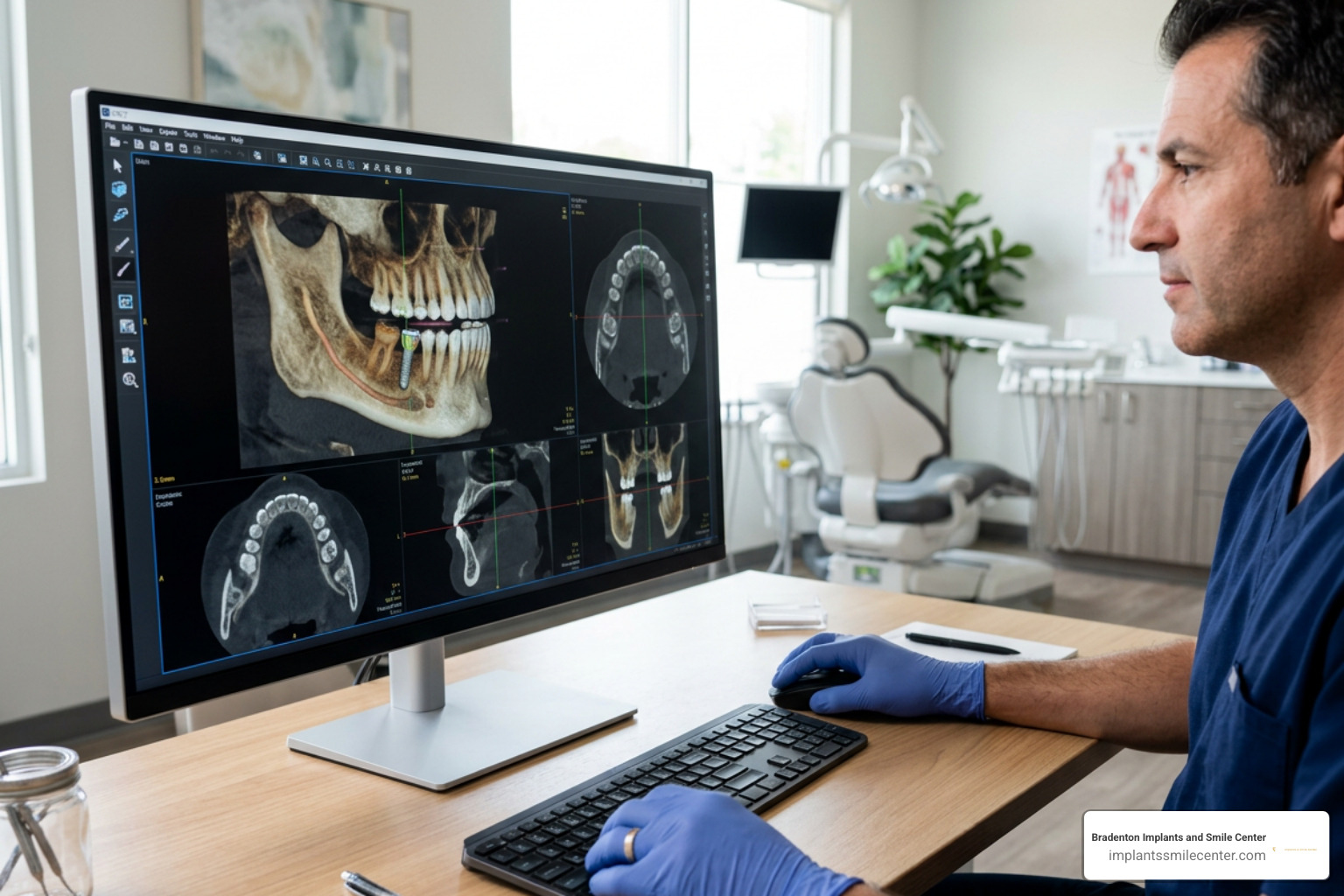
Cone Beam Computed Tomography (CBCT): A 3D CBCT scan captures high-resolution 3D images of your jawbone density, nerve pathways, sinus cavities, and surrounding roots in seconds.
Digital Surgical Planning: Using specialized software, we virtually simulate the complete surgery before you ever step foot into the operating room. We select the exact length, diameter, and angle for every single implant post.
Guided Implant Placement: Modern CBCT-derived surgical guides allow us to achieve implant placement accuracy between 0.2 and 0.4 mm. This level of precision eliminates surprises, reduces surgical time, and leads to smoother, faster patient recoveries.
Recovery Timeline, Diet, and Long-Term Care
Understanding the recovery phase helps set you up for long-term treatment success. While your new smile will look complete on day one, full structural recovery happens gradually under the surface.

Post-Surgical Healing and Dietary Guidelines
In the first few days following your full-arch placement, minor swelling, bruising, and mild gum soreness are completely normal. Most patients manage this easily with prescribed or over-the-counter medication.
However, the most critical element of post-surgical care is adhering strictly to dietary guidelines. During the first 3 to 6 months, jawbone cells are building a permanent bond around the titanium threads. Chewing hard or crunchy foods exerts excess lateral force, which can cause micro-shifts in the implant and disrupt bone growth.
Recommended Soft Foods (Months 1–3):
Scrambled eggs, omelets, and soft cheeses
Flaky baked fish and tender ground meats
Smoothies, yogurt, protein shakes, and puddings
Mashed potatoes, cooked oatmeal, pasta, and soft rice
Well-cooked vegetables, soups, and broths
Foods to Avoid (Until Cleared by Dr. Hegazin):
Hard nuts, seeds, and popcorn
Raw carrots, apples, and crunchy produce
Tough steaks, jerky, and crusty breads
Sticky candies, gums, and ice cubes
Proper daily hygiene is equally critical. You will be instructed to gently clean around your provisional bridge using a soft-bristled toothbrush, warm salt water rinses, and specialized low-pressure water flossers once your incisions close.
Minimizing Treatment Failure and Long-Term Maintenance
Immediate load full-arch implants carry an impressive 95% survival rate at three years. You can help ensure your new smile lasts a lifetime by practicing consistent care:
Clean Daily: Thoroughly clean underneath your implant bridge every morning and night to remove food particles and prevent bacteria build-up.
Protect Against Grinding: If you clench or grind your teeth while sleeping, custom nightguards can protect your temporary and permanent bridges from excess force.
Attend Professional Cleanings: Visit us regularly for professional implant maintenance. We inspect the titanium connections, evaluate gum health, and clean hard-to-reach areas around your implants.
For more information about maintaining healthy posts over time, read our guide on Services: Dental Implants.
Comparing Full-Arch Options: Cost, Stability, and Daily Function
If you are evaluating how to replace an entire row of teeth, comparing same-day implants, traditional implants, and conventional removable dentures can help simplify your decision.
Feature / Benefit Teeth in a Day Implants Traditional Dental Implants Conventional Dentures Treatment Timeline Teeth attached same day; final bridge at 4–6 months 6 to 12+ months (requires healing before teeth placement) 2 to 8 weeks (multiple fitting appointments) Bone Grafting Required Minimized in up to 95% of cases Often required before or during placement Not required (but accelerated jawbone loss continues) Bite Strength & Function High (80–90% of natural biting force) High (80–90% of natural biting force) Low (15–20% of natural biting force) Palate Coverage Open palate (natural taste & speech) Open palate (natural taste & speech) Covered acrylic palate (can impact speech & taste) Stability Fixed, non-removable bridge Fixed or removable options Removable; prone to slipping or clicking Jawbone Preservation High (prevents future bone loss) High (prevents future bone loss) None (accelerates bone loss over time) Financial Investment Moderate-to-High upfront; long-term value High upfront (especially with grafting); long-term value Low initial cost; ongoing relines, adhesives, and replacements
While conventional dentures carry lower initial costs, they fail to stimulate underlying bone tissue. Over time, progressive bone loss alters your jaw shape, requiring repeated denture relines or replacements. Implants actively preserve jawbone health, providing a stable long-term solution.
Read more about investment breakdowns in our articles on Full Arch Implants Cost and Dental Implants Cost.
Frequently Asked Questions About Same-Day Implants
Is the surgical procedure painful?
During the procedure, you should not feel any pain. We administer local anesthesia to completely numb the target area. Additionally, for maximum relaxation, we offer custom sedation options so you can rest comfortably throughout the placement.
After surgery, moderate soreness, minor swelling, and mild bruising around the cheeks or gums are normal for the first three to five days. Pain is usually easily managed with prescribed or over-the-counter pain medications. To learn more about surgical comfort options, review our detailed guide on IV Sedation Dental Implants.
How long do same-day dental implants last?
The titanium implant posts placed in your jawbone are designed to last for decades—and often a lifetime—with proper hygiene and regular dental checkups. The final ceramic bridge attached to your implants is extremely durable and typically lasts 15 to 20+ years before requiring light maintenance or minor adjustments.
How much do full-mouth same-day implants cost in 2026?
The total investment for same-day full-arch implants varies depending on several individual case factors, including:
Whether top, bottom, or both arches need treatment
Extractions or preparatory gum care required on surgical day
Choice of final bridge material (such as monolithic zirconia)
Dental insurance coverage and third-party financing arrangements
During your full-arch consultation, our team provides transparent, all-inclusive pricing so you know your exact financial options before starting care. For detailed financial guidance, browse our resource on Cost of Full Mouth Dental Implants Guide 2026.
Conclusion
Living with loose dentures, uncomfortable partials, or missing teeth can impact your quality of life every day. Teeth in a day implants provide a clinically proven way to rebuild your smile, regain confident biting strength, and preserve natural jawbone density—all in a single surgical visit.
At Bradenton Implants & Smile Center, located at 7270 55th Ave E in Bradenton, FL, we combine state-of-the-art 3D CBCT imaging, comfortable sedation choices, and compassionate, personalized clinical care to deliver predictable results for our adult and senior patients.
If you are ready to replace missing teeth and start enjoying your favorite foods again, take the first step today. Schedule a Full Mouth Dental Implants Consultation with Dr. John Hegazin and our team. We look forward to helping you restore your smile!